
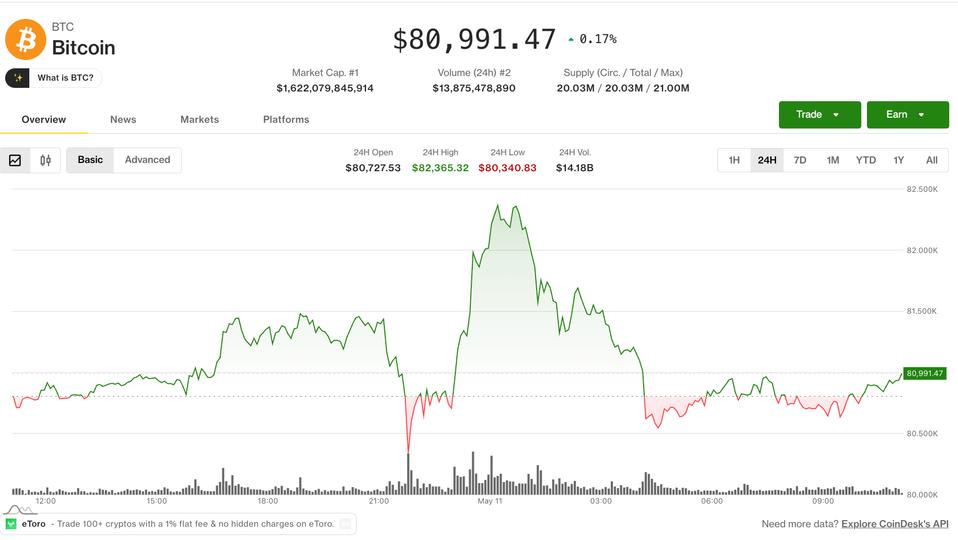
The crypto market started the week in a volatile mood, with bitcoin rising from $80,670 at 23:00 UTC on Sunday before peaking at $82,400 an hour later. The price subsequently fell to trade in a fairly tight range, just below $81,000.
The move coincided with the weekly opening of bitcoin futures on the CME and US stock futures, a period that often sparks a repositioning frenzy and a phenomenon called the “CME gap,” which occurs when the price opens at a different point than where it closed on Friday.
Due to the timing of the move, all crypto benchmarks fell on Monday with the broad CoinDesk 100 (CD100) leading the way with a 1.5% loss, while the bitcoin-dominant CoinDesk 5 (CD5) fell 0.6%.
Price action is also being dictated by geopolitical developments in Iran. US President Donald Trump said Iran’s response to a peace proposal was “totally unacceptable”, leading to a rise in the price of oil and the dollar and a fall in risk assets.
Derivatives positioning
- Market-wide crypto futures open interest (OI) remains stuck just above $130 billion for the fourth day in a row, indicating a lack of new leverage inflows and broadly stagnant momentum across the derivatives market.
- Centralized exchanges have settled more than $400 million in leveraged futures bets, with short positions accounting for most of that amount.
- SUI’s OI has increased by 29%, validating the double-digit increase in the token’s price. This, coupled with positive funding rates and a 24-hour OI-adjusted cumulative volume delta, points to growing demand for bullish exposure.
- DOGE and HBAR are other notable OI gainers, while BTC and ETH OI futures are broadly stable.
- OI in futures linked to the privacy-focused ZEC token has declined 6%, a sign of capital outflows.
- Despite the US CPI and PPI releases due later this week, the market remains calm, as evidenced by bitcoin’s 30-day implied volatility index, which is near three-month lows.
- On Deribit, bitcoin strike calls ranging from $81,000 to $86,000 dominate the volume rankings. Call options are inherently bullish plays on the underlying asset.
- The block flows included long bitcoin buying condors, a strategy initiated to benefit from low volatility and minimal price movement in the underlying asset.
symbolic talk
- Venice’s VVV token has more than doubled in the past month as traders reacted to a series of emissions cuts, token burns, new products, and growing demand for AI.
- The measure began with the supply. Venice doubled its subscription-linked burn rate in late April, and Pro, Pro+, and Max subscriptions on the platform now trigger VVV burns of $2, $5, and $10, respectively, according to data from VeniceStats.
- Venice then reduced annual emissions of the token, which can be used for privacy-focused artificial intelligence, from 6 million tokens to 5 million on May 1, the first step of a planned reduction to 3 million by July, according to the project.
- The rally accelerated after StrikeRobot, which develops AI software for robots, said Venice would become a primary inference API backend for its robotics products, starting with SR Agentic and SR Platform.
- Meanwhile, subscription revenue is rising. Co-founder Jesse Proudman said Monday that subscription and credit purchases hit a record high, surpassing the previous high by 10%.
- VVV remains below its record high of $22.5 from January 2025. The token had fallen as much as 50% shortly after its debut amid insider trading concerns linked to early purchases by Aerodrome Finance contributors.


