
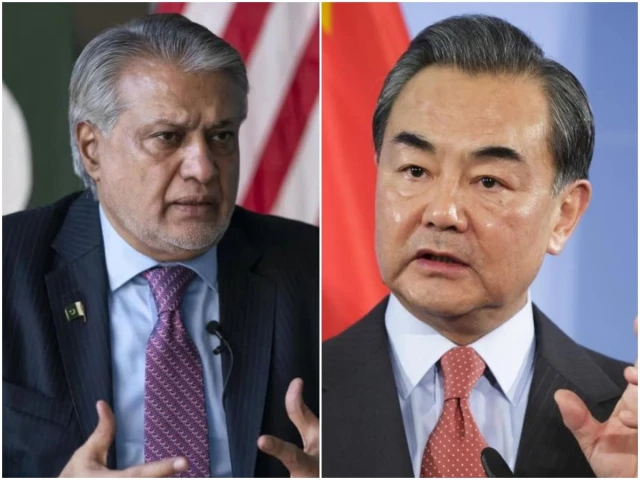
Wang Yi and Ishaq Dar agree to continue commitment in the call, emphasize regional stability and the passage of the Strait of Hormuz.
Foreign Minister Ishaq Dar (left) and Chinese Foreign Minister Wang Yi. PHOTOS: Archive
Chinese Foreign Minister Wang Yi reiterated his appreciation and support for Pakistan’s constructive mediation role in the US-Iran conflict during talks with Deputy Prime Minister and Foreign Minister Ishaq Dar on Tuesday, as both sides stressed the importance of continuing a lasting ceasefire.
According to a statement from the Ministry of Foreign Affairs, Foreign Minister Dar had a telephone conversation with his Chinese counterpart.
“The two leaders exchanged in-depth views on recent regional developments and Pakistan’s ongoing efforts to facilitate engagement between Iran and the United States, aimed at promoting sustained peace and stability in the region and beyond,” the statement said.
Deputy Prime Minister/Minister of Foreign Affairs Senator Mohammad Ishaq Dar @MIshaqDar50 He spoke today with the Foreign Minister of the People’s Republic of China, Wang Yi.
The two leaders had an in-depth exchange of views on recent regional developments and Pakistan’s ongoing efforts to facilitate… pic.twitter.com/MUXVisOIY2
— Ministry of Foreign Affairs – Pakistan (@ForeignOfficePk) May 12, 2026
During the conversation, the Chinese foreign minister reiterated his appreciation and support for Pakistan’s constructive mediating role.
“Both sides stressed the importance of continuing a lasting ceasefire and ensuring normal passage through the Strait of Hormuz,” the statement added.
Both leaders also discussed planned high-level exchanges, activities marking the 75th anniversary of the establishment of diplomatic relations between Pakistan and China, as well as broader bilateral and multilateral cooperation.
Read: Pakistan will continue peace mediation without “immediate danger” of a new war between the United States and Iran: sources
The two sides agreed to maintain close communication on all matters of mutual interest, the statement concluded.
Pakistan had negotiated a two-week ceasefire between the United States and Iran on April 8, followed by critical talks in Islamabad attended by high-level delegations from both countries on April 11 and 12.
However, neither party was able to reach an agreement to end the conflict.
Since then, the two sides have been exchanging proposals and counterproposals in an effort to reach a middle ground and resume a second round of direct talks aimed at ending the conflict, which has already disrupted global energy supplies and daily life across the region.
While Pakistan remains hopeful that direct talks will resume, sources said there was no “significant” change in Iran’s earlier stance on the nuclear issue in its response to the US proposals.
According to the sources, Tehran’s response – delivered to the United States through Islamabad last week – focused mainly on an “immediate” end to hostilities, with “little [in it] in terms of Washington’s core demand over Iran’s nuclear program.”
Read also: Prime Minister Shehbaz confirms having received Iran’s response to the US peace proposal
Iran, the sources added, has proposed “broader and separate” talks on the nuclear issue, citing its “complexity.”
However, Tehran has “reiterated” its willingness to halt uranium enrichment for a period of five years, while rejecting Washington’s demand for a 20-year moratorium, according to the sources.


