
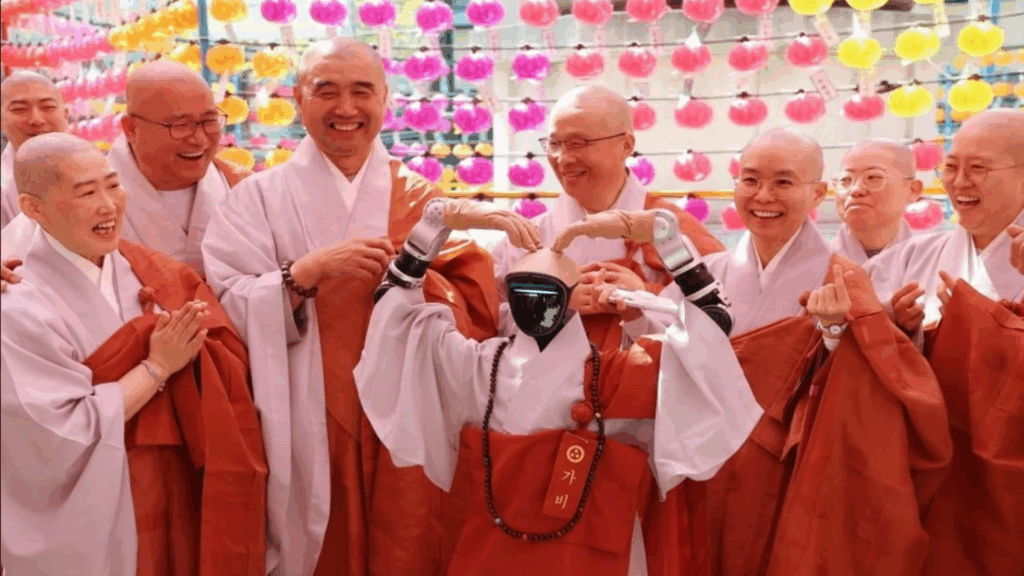
- South Korean monks officially commission humanoid robot during ceremony at Buddhist temple
- AI-powered monk confidently responded to spiritual vows during his ordination ritual
- Gabi received a symbolic sticker instead of the traditional incense burning ceremony
South Korean monks at Jogyesa Temple in Seoul have ordained a humanoid robot as a Buddhist monk.
The ceremony took place before Buddha’s birthday celebrations in May 2026.
Gabi, who is just 130 centimeters tall and wears traditional gray and brown Buddhist robes, folded her metal hands in a respectful prayer position during the ordination.

Artificial intelligence enters the monastery
When a senior monk asked her if she would take up Buddhism, Gabi replied, “Yes, I will.” The monks then placed a traditional 108-bead rosary around his mechanical neck.
Instead of undergoing the usual incense burning, Gabi received a symbolic sticker as a concession to her machine nature.
Chinese robotics company Unitree Robotics developed the Gabi model based on its Unitree G1 platform.
The machine has more than 23 degrees of freedom, giving it a remarkably fluid range of motion: it can walk steadily, balance, and perform precise gestures with its articulated hands.
The robot runs on an artificial intelligence platform capable of processing and answering verbal questions, and these physical and technical characteristics allow Gabi to bow and fold her hands during the ceremony.
Three more spiritual cyborgs will join him at the temple for Buddha’s birthday on May 24. Each of these humanoids costs approximately $16,000 according to the information available on the Unitree G1 platform.
When technology meets faith
The ordination has sparked considerable debate among religious scholars and the general public, with many people questioning whether a machine can truly maintain spiritual vows or embody Buddhist ideals.
Critics argue that a robot cannot understand suffering, which remains the very foundation of Buddhist teaching, and others express concern about the trivialization of sacred rituals that should remain deeply human acts.
Supporters see Gabi as a creative bridge to engaging younger generations with ancient teachings, as South Korea now joins Japan in a growing trend in which AI monks have appeared in Buddhist temples.
The intersection of faith and technology is no longer purely theoretical but now occurs within sacred spaces.
That said, the question of whether a robot can seek enlightenment reveals more about humans than it does about machines.
A devotional machine that cannot feel pain or joy defies the very definition of spiritual practice.
Perhaps the most telling detail was the symbolic sticker that replaced the burning of incense, a silent admission that some boundaries remain uncrossed.
The line between the spiritual and the synthetic grows thinner, but a robot’s clasped hands still contain no flesh or breath.
Via Yanko Design

Follow TechRadar on Google News and add us as a preferred source to receive news, reviews and opinions from our experts in your feeds.


