
Defense Minister warns Afghanistan of “open war” if Kabul does not act against terrorists
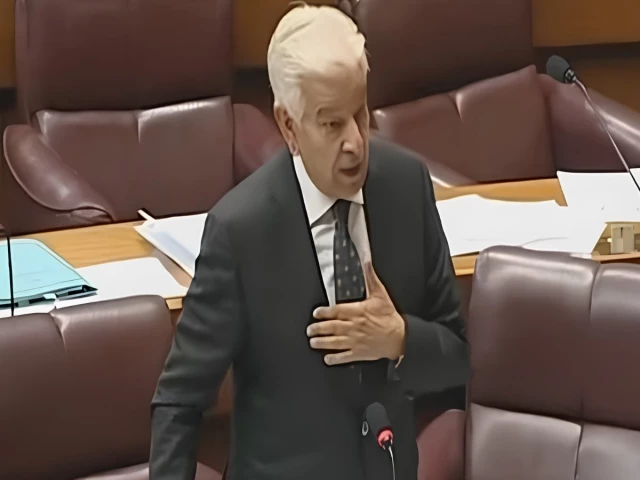
Defense Minister Khawaja Asif speaks at the National Assembly on May 13, 2026. Screen recording
ISLAMABAD:
Defense Minister Khawaja Asif on Wednesday warned Afghanistan that if Kabul did not stop harboring terrorists, Pakistan would respond in the same way it did against India last year.
Addressing the National Assembly, Asif said: “If you are not ready, then what we did with Delhi, we will do the same with Kabul.” The minister asserted that Afghanistan had effectively become an instrument of Indian policy.
“Right now, Afghanistan has become India’s proxy,” he said, adding, “Kabul is waging a Hindutva war against us” and that “there is no difference between Delhi and Kabul right now,” though Pakistan sincerely wished otherwise.
Asif said Pakistan had repeatedly attempted to engage with Afghanistan through diplomatic channels, including through Turkiye, Saudi Arabia and Qatar, but those efforts had not yielded results. “In the negotiations in Qatar, Afghanistan agreed to everything, but then refused to give guarantees,” he said, adding that Kabul was willing to accept verbally but not in writing.
Also read: Khawaja Asif warns of a stronger response to any future aggression
He said Pakistan’s main demand was a written commitment from Kabul ensuring that Afghan territory would not be used to launch attacks against Pakistan and that terrorists operating there would be expelled.
“The government in Kabul is not willing to guarantee that its territory will not be used for attacks against Pakistan,” he said. “Afghanistan is not willing to expel terrorists from its territory. Afghanistan is also not willing to stop terrorists.”
The minister added that Pakistan remained open to talks if Kabul provided written guarantees against terrorism.
Referring to a recent attack in Bannu, Asif said that many people had been martyred and the Pakistan army was still making sacrifices. “We are being forced to go to war because of this situation,” he said, adding that after India’s defeat last year, New Delhi was now acting through Afghanistan.
On the diplomatic front, Asif said efforts to channel through a third country were still ongoing, although he declined to provide further details. “Talks are still ongoing through a third country, but I can’t say much at this time,” he said.
Pakistan remains embroiled in clashes with Afghanistan as of February 2026. Operation Ghazab Lil Haq was launched following clashes along the Pakistan-Afghanistan border, after Afghan Taliban forces fired at multiple locations, prompting rapid military action by Pakistan.
Neighboring countries have since escalated hostilities along the border. Clashes intensified after Afghanistan launched a border offensive in response to Pakistani airstrikes on terrorist positions.
A temporary pause in the operation was assumed in deference to Eidul Fitr and requests from Islamic countries such as Saudi Arabia, Qatar and Turkiye. The pause, effective from midnight on March 18 and 19, 2026, was extended until March 23 and 24, 2026.
However, the operation resumed in March and since then, the Pakistan army has continued to respond to unprovoked aggression by the Taliban and Fitna al-Khawarij; a term used for terrorists belonging to the banned Tehreek-e-Taliban Pakistan (TTP).
Read more: Khawaja Asif praises armed forces, warns against future aggression
The Defense Minister also struck a cautiously optimistic note regarding internal political alignment, saying that the previously uncooperative Khyber-Pakhtunkhwa government was now on board.
“Before we did not have the cooperation of the KP government; now we do,” he said. “It’s good that we all agree that terrorism must end.” However, he warned that if Afghanistan remained unwilling to act, the situation could worsen further. “Then it will be a war, an open war,” he said.
Replying to a question from Asad Qaiser on military courts, Asif said the government would soon introduce legislation on the issue. He added that the right of appeal already existed and that several defendants had challenged military court sentences. “Many have questioned the jurisdiction of military courts,” he said.
Regarding the former Federally Administered Tribal Areas, the minister acknowledged that the promised resources have not yet been provided. “The share that is owed to the former FATA is not only the responsibility of the federation; the provinces must also contribute,” he said. As soon as the provinces agree, he added, the region will receive the rights that correspond to it.


