
Washington sets five conditions in response to Tehran’s negotiation proposal
ISLAMABAD:
As the deadlock persists and U.S. President Donald Trump contemplates his next move, Pakistan’s Interior Minister Mohsin Naqvi held key meetings in Tehran on Sunday in what appears to be a last-ditch effort to salvage the deal and avoid new hostilities.
Naqvi, one of the few Pakistani officials involved in the intricate diplomatic efforts, landed in Tehran on Saturday on a previously unannounced visit.
He accompanied the field marshal, who traveled to the Iranian capital just days after the first round of talks between Iran and the United States, held in Islamabad, failed to achieve any progress.
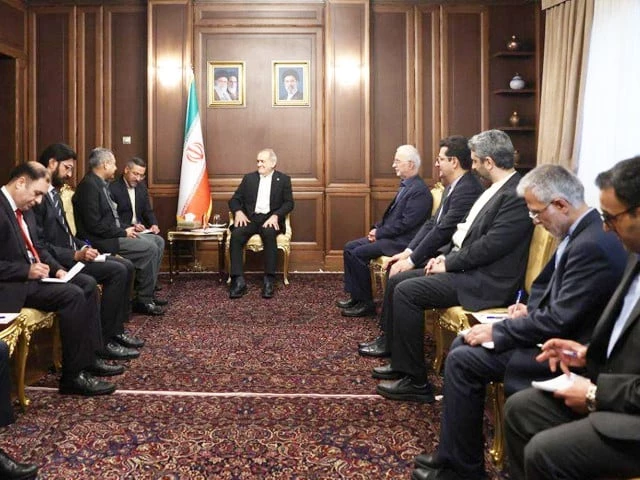
The influential minister spent three hours at the Presidential Palace, according to the Pakistani Embassy in Tehran.
Iranian Interior Minister Eskandar Momeni and Foreign Minister Seyed Abbas Araqchi were also present at the Presidential Palace during Naqvi’s crucial meeting with President Masoud Pezeshkian.
“Mr. Mohsin Naqvi also held a private meeting with the president, Dr. Masoud Pezeshkian, which lasted about 90 minutes and was attended by the Iranian Interior Minister, Eskandar Momeni,” a statement added.
According to Iran’s News Agency, Interior Minister Naqvi also met with Iranian Parliament Speaker Mohammad Bagher Ghalibaf, who led the Iranian side during high-stakes talks with US Vice President JD Vance last month in Islamabad.
So far, neither the Iranian nor the Pakistani governments have released details about the meetings. However, it is believed that Naqvi’s visit was aimed at breaking the stalemate between Iran and the United States.
Despite the exchange of several proposals between the two sides, the deadlock persists, threatening a new round of war.
“That is why Pakistan is pressuring and persuading both sides not to abandon their diplomatic efforts,” a diplomatic source said.
What has emerged so far is that Iran and the United States remain polar opposites on how to end the war.
Iran’s semi-official Fars news agency, considered close to the country’s military and security establishment, has revealed that Washington has imposed five conditions in response to Tehran’s negotiation proposal.
Those conditions include not receiving war reparations for Iran, transferring 400 kg of enriched uranium to the United States, retaining only one Iranian nuclear facility, not releasing even 25% of Iran’s frozen assets, and negotiations linked to ending the war on all fronts.
Meanwhile, Iran has its own set of conditions, including an end to conflicts on all fronts, particularly in Lebanon, the lifting of sanctions, the return of frozen assets, war compensation and recognition of Iran’s sovereignty over the Strait of Hormuz.
Tehran, through Islamabad, is now believed to have responded to American conditions.
Meanwhile, Pakistan continued its diplomatic efforts, reaching out to other stakeholders to avoid further disasters in the region.
On Sunday, Prime Minister Shehbaz Sharif received a phone call from Qatar’s Prime Minister and Foreign Minister Mohammed bin Abdulrahman bin Jassim Al Thani.
The two leaders held a warm and cordial conversation during which they exchanged views on the regional and international situation, according to an official document issued by the Prime Minister’s Office.
The prime minister thanked the Qatari leadership for their strong support and endorsement of the Pakistan-led peace efforts to reduce regional tensions and promote peace and stability.
The prime minister appreciated Qatar’s constructive role in regional diplomacy and its efforts to build consensus in support of ongoing mediation efforts. Both leaders agreed on the need for continued engagement and close consultations between all relevant parties to address shared challenges.
The prime minister conveyed his best wishes to Qatar’s Emir Tamim bin Hamad Al Thani and said he looked forward to his official visit to Pakistan.
Both sides also agreed to maintain regular high-level contacts to follow up on the results of the discussion.


