
- LightInk watch offers 400 days of battery life
- To do this, remove the functions and use an e-ink display.
- Also adds solar charging to stay recharged on the go
From the Apple Watch Ultra 3 to the Google Pixel Watch 4, customers looking to adorn their wrists with one of the best smartwatches tend to look for wearable devices that offer excellent battery life; After all, there’s no point shelling out for a device if you spend more time charging it than using it. If battery life is a priority for you, you might want to check out the LightInk clock.
This is because with 400 days of autonomy on a single charge, it surpasses the competition in terms of battery life. How do you achieve that number? Well, this isn’t just any watch: it’s solar-powered to stay constantly charged, meaning you can start charging it even when you’re miles from the nearest outlet. As long as the sun shines on you, the LightInk battery will charge.
But you’ll get 400 days of battery life before you even factor in solar charging, claims the project’s creator. As? Well, one way is to narrow down the list of features. As its name suggests, LightInk uses an E Ink display instead of an AMOLED display, unlike some rival smartwatches. E Ink technology is incredibly battery efficient, helping you get even more life out of this product.

And because it’s an open source project, there’s no cost to get it. You only need a 3D printer and some components available on the market to make it yours.
Extreme battery savings
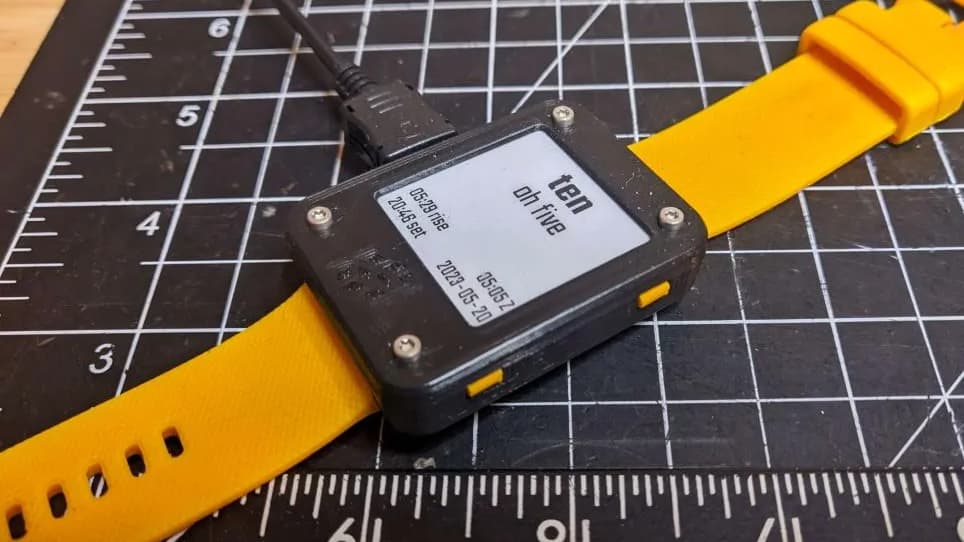
Of course, LightInk isn’t all sunshine and roses: it does have some drawbacks. Its E Ink display may give you excellent battery life, but it comes at the cost of visual fidelity. The LightInk’s display is monochrome and low-resolution, so you shouldn’t expect flashy graphics here. It doesn’t even show seconds.
And if you’re a fitness fanatic or believe in the “quantified self,” you’ll want to look elsewhere. You won’t get any of the health and fitness sensors and metrics you find in most smartwatches: the LightInk can tell time, occasionally connect to Wi-Fi and GPS, and that’s it.
You also can’t just go out and buy LightInk at your local mall. As we mentioned before, you need to have a 3D printer on hand to create many of the necessary components yourself and then assemble and solder them into a finished product. You will also need to be comfortable creating your own firmware based on the resources provided on the LightInk GitHub page.
Still, the LightInk isn’t intended to be a high-end flagship device; It is a deliberately basic product, as this is what allows you to dedicate all your energy to maximizing battery life.
It’s definitely not for everyone, but if your priority is staying away from the charger as much as possible, it might be just what you’re looking for.

Follow TechRadar on Google News and add us as a preferred source to receive news, reviews and opinions from our experts in your feeds.


