
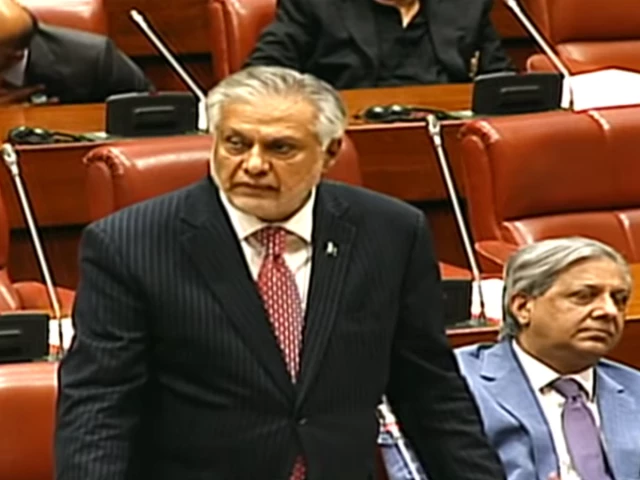
He says that both countries maintained close coordination in international forums to defend the interests of developing nations.
DPM and FM Senator Ishaq Dar addresses the Senate. SCREEN CAPTURE
ISLAMABAD:
Deputy Prime Minister and Foreign Minister Ishaq Dar on Wednesday said bilateral relations between Pakistan and China were multidimensional and based on mutual trust, respect and benefit as both countries remained in close coordination at international forums to uphold the interests of developing nations.
The statement came as a high-level Chinese delegation, led by Cai Dafeng, vice chairman of the Standing Committee of the National People’s Congress, visited the Senate to mark the 75th anniversary of diplomatic relations between the two countries.
The session was led by Senate President Yousaf Raza Gilani and Deputy Prime Minister Dar. They told senators that Pakistan remained firmly committed to the One China policy and appreciated China’s continued support for Pakistan’s sovereignty, security and development.
“Bilateral relations between Pakistan and China are multidimensional and based on mutual trust, respect and benefit,” Dar said. He added that Pakistan and China had maintained close coordination in international forums, including the United Nations and the Shanghai Cooperation Organization, to defend the interests of developing countries.
Dar said Pakistan had also played a role in reducing tensions between the United States and Iran and was working with other countries to promote regional peace, adding that during his recent visit to China, both sides proposed a five-point peace plan which was later endorsed by dozens of countries.
Recalling the origins of CPEC, Dar said the project was conceived after the 2013 general elections, when a Chinese prime minister visited Pakistan during the installation of the interim government. He said then Prime Minister Nawaz Sharif and Prime Minister Shehbaz Sharif held “very significant meetings” with the Chinese side at Hotel Serena.
Dar said Pakistan at the time was facing up to 18 hours of power cuts in cities and 20 hours in villages. “We asked China to help Pakistan overcome load shedding and power shortages. Those discussions later led to the CPEC project, and China provided massive support,” he said.
Highlighting economic cooperation, Dar said the second phase of CPEC had already begun and would include energy projects and broader development initiatives. “From Karakoram Highway to Gwadar Port, symbols of Pakistan-China friendship spread across the country,” he added, saying that CPEC had transformed Pakistan’s economic landscape and Islamabad was now looking forward to “CPEC 2.0”.
Read more: Pakistan takes advantage of China’s agricultural model
Dar also praised China’s support for parliamentary democracy and stressed the importance of regular parliamentary exchanges between the two countries. He announced that he would accompany Prime Minister Shehbaz on a state visit to China from May 23 to 26 for celebrations of 75 years of diplomatic relations and meetings with Chinese leaders, including Prime Minister Li Qiang.
He said that a large multi-party parliamentary delegation from Pakistan would participate and establish the Pakistan-China Political Parties Forum and meetings under the CPEC joint consultative mechanism.
Concluding his speech, Dar congratulated the people and leaders of both countries on the 75th anniversary of diplomatic relations and expressed hope for continued cooperation for “shared peace and progress.”
Earlier, Gilani welcomed the visiting delegation and said their visit reflected the warmth and enduring trust that defines Pakistan-China relations.
Addressing the House, Gilani said the two countries were celebrating 75 years of diplomatic relations based on “unwavering friendship, mutual respect and shared purpose.” He recalled the oft-repeated proverb that describes bilateral ties as “higher than mountains, deeper than oceans, sweeter than honey and stronger than steel.”
The Senate president recalled former Chinese Premier Wen Jiabao’s speech to Parliament in 2010, describing it as a historic and memorable occasion.
He said parliamentary ties between Pakistan and China were promoting mutual understanding and cooperation, adding that the visit of the Chinese delegation would open a new chapter in parliamentary and strategic cooperation between the two countries.
“We welcome our extremely important friends,” Gilani said, adding that Asia’s future depends on peace and dialogue. “All problems should be resolved through talks. Pakistan-China friendship is important for peace in Asia.”
He described China as a role model for Pakistan and said Beijing had addressed issues such as unemployment and economic development in decades. “China promotes relations in the world for development, unlike countries that once built ties for wars,” he added. Gilani also said that the completion of the China-Pakistan Economic Corridor would become an example of Pakistan-China friendship to the world.


