
Development priorities were approved in all provinces and regions, focused on strengthening national development.
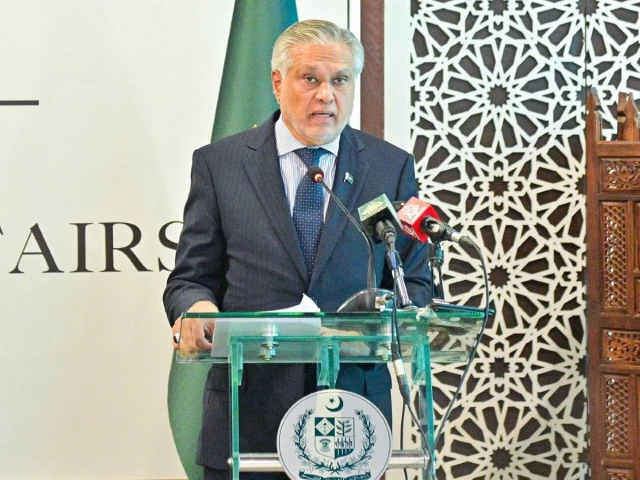
Deputy Prime Minister and Foreign Minister Ishaq Dar briefs members of the diplomatic corps at the Ministry of External Affairs in Islamabad on the first anniversary of “Marka-e-Haq” on Tuesday. Photo: X/ FO
ISLAMABAD:
On Friday, the government gave the green light to start detailed design of the long-delayed Main Line (ML-I) project.
The decision was taken on Friday during the meeting of the Executive Committee of the National Economic Council (Ecnec), chaired by Deputy Prime Minister Ishaq Dar.
During the meeting, development priorities were approved in all provinces and regions, with a focus on strengthening national development initiatives and addressing infrastructure and social sector needs, according to a press release issued by the Ministry of Foreign Affairs spokesperson.
Key initiatives included detailed design of ML-1, Havelian Dry Port, Lowari Tunnel Access Works, Thar Coal Railway Connectivity, Kachhi Canal, KP Irrigation Improvements, Jinnah Islamabad Hospital, Sindh 1000 Days Human Capital Programme, Sindh Flood Rehabilitation Support and Diamer-Basha Dam related agreements.
The ML-1 project is considered a game-changer as it aims to upgrade and modernize key infrastructure to improve cargo and passenger connectivity from Karachi to Peshawar. Work on the project is expected to begin in July 2026 from Karachi Port.
Pakistan Railways has initiated the market participation process for the proposed improvement of Karachi-Rohri section of Main Line-1 (ML-1).
The Karachi-Rohri corridor, which spans about 480 kilometres, is planned to be upgraded with modern railway infrastructure to improve operational efficiency, reliability and safety.
The proposed works include renovation of the permanent road, strengthening of the road foundations, installation of modern signaling and telecommunications systems, and rehabilitation of bridges and other civil structures along the route.
Once completed, the upgraded line is expected to support train speeds of up to 160 kilometers per hour, which will reduce passenger travel time while increasing freight capacity and improving overall service reliability.
Dar reaffirmed the government’s continued focus on infrastructure development, improved public services, regional balance and long-term economic resilience.


