
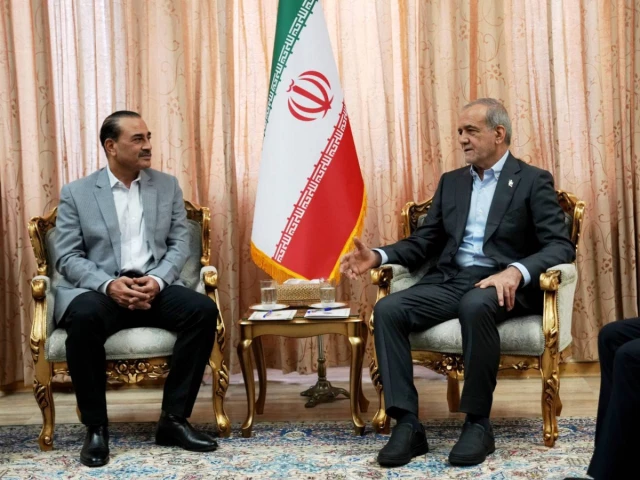
Pakistan’s mediation efforts with Iran led to “positive and constructive” talks when CDF Munir met the Iranian leadership.
Chief of Army Staff and Chief of Defense Forces Field Marshal Asim Munir met Iranian President Masoud Pezeshkian in Tehran for high-level talks to advance diplomatic initiatives. PHOTO: PRESSTV IN X
Chief of Defense Forces and Chief of Army Staff Field Marshal Asim Munir concluded his “highly productive” visit to Iran, which resulted in “encouraging progress” towards a final understanding for the framework of an agreement with the United States following intense negotiations with Tehran, the military’s media wing said on Saturday.
According to a statement issued by Inter-Services Public Relations (ISPR), CDF Munir concluded a brief but “highly productive” official visit to Iran.
“During the visit, the Field Marshal maintained high-level engagements with the Iranian leadership as part of ongoing mediation efforts aimed at promoting de-escalation and constructive engagement, amid regional tensions that have simmered following the ceasefire of April 8, 2026,” it added.
Read: Iran says US ‘betrayals, contradictions and excessive demands’ disrupt talks
He added that CDF Munir visited Iranian President Masoud Pezeshkian, Iranian Parliament Speaker Mohammad Bagher Ghalibaf, Foreign Minister Abbas Araghchi and Interior Minister Eskandar Momeni.
“Discussions remained focused on accelerating the ongoing consultation process to support peace and stability in the region and reach a conclusive agreement,” the statement said.
According to ISPR, the discussions took place in a positive and constructive atmosphere and contributed significantly to the mediation process.
“The intense negotiations of the last twenty-four hours have resulted in encouraging progress towards a final understanding,” he said, adding that Iranian leaders appreciated Pakistan’s role in the process.
“Iranian leaders appreciated Pakistan’s sincere and constructive role in facilitating dialogue and promoting peaceful resolution of regional issues,” the statement said.
Earlier, upon arrival, FDC Munir was received by the Iranian Interior Minister, along with senior civil and military officials.
Reuters reported that Iran’s chief negotiator and speaker of parliament, Mohammad Bagher Ghalibaf, told CDF Munir during a meeting that Iran would not compromise the rights of his nation and his country, state television reported.
He said Iran’s military had rebuilt its capabilities during the ceasefire and that if the United States “foolishly restarts the war,” the consequences would be “more crushing and bitter.”
The quarterback arrived in Tehran on Friday as part of ongoing mediation efforts. He was warmly received and welcomed by the Iranian Minister of the Interior, Eskandar Momeni. Home Minister Mohsin Naqvi was also present at the reception.
Pakistani Army Chief Field Marshal Asim Munir met Iran’s Foreign Minister Araghchi in Tehran for late-night talks focused on diplomatic efforts to stop US-Israeli aggression and strengthen regional peace and stability.
Continue: pic.twitter.com/L8tohHLcP2
— Press TV 🔻 (@PressTV) May 23, 2026
In recent months, Pakistan has attracted international attention for its involvement in mediation efforts between Iran and the United States amid the Middle East crisis.
On February 28, the United States and Israel launched a joint offensive against Iran. Tehran retaliated with attacks on Israel and other Gulf countries hosting American assets.
Pakistan subsequently positioned itself as a key mediator for peace, negotiating a two-week ceasefire and hosting the highest-level talks between the United States and Iran since the Islamic Revolution of 1979. Although the “Islamabad Talks” ended without an agreement, the ceasefire was held and later extended at Islamabad’s request.
Since then, the two sides have been exchanging proposals and counterproposals in an effort to reach a middle ground and resume a second round of direct talks aimed at ending the conflict, which has already disrupted global energy supplies and daily life across the region.
While Pakistan remains hopeful that direct talks will resume, sources said there was no “significant” change in Iran’s earlier stance on the nuclear issue in its response to the US proposals.
According to the sources, Tehran’s response – delivered to the United States through Islamabad last week – focused mainly on an “immediate” end to hostilities, with “little [in it] in terms of Washington’s core demand over Iran’s nuclear program.”
Iran, the sources added, has proposed “broader and separate” talks on the nuclear issue, citing its “complexity.”
However, Tehran has “reiterated” its willingness to halt uranium enrichment for a period of five years, while rejecting Washington’s demand for a 20-year moratorium, according to the sources.


