
ISLAMABAD:
Some members of the federal cabinet have raised serious questions about the price of locally manufactured vaccines and the monopolistic practices of pharmaceutical companies.
The government also agreed to offer a buyback guarantee for locally manufactured vaccines.
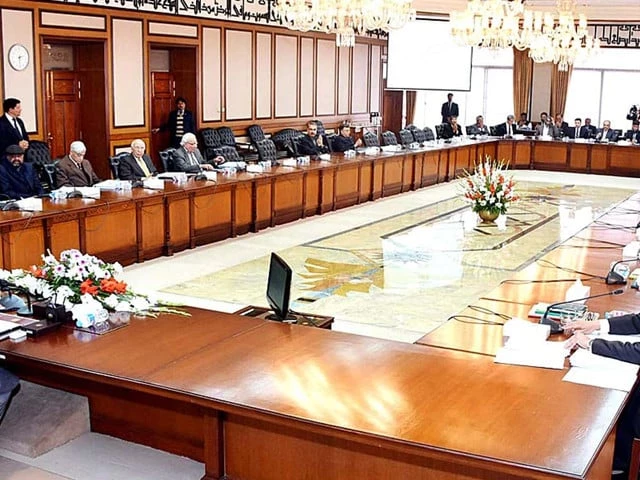
During a meeting chaired by Prime Minister Shehbaz Sharif on Saturday, the cabinet approved in principle the National Policy for Advancement of Indigenous Vaccine Production.
However, it also formed a National Policy Committee to Advance Indigenous Vaccine Production to make recommendations for determining prices for locally manufactured vaccines.
The committee will examine the factors that determine local vaccine production costs and pricing issues that could arise following the start of local vaccine production under the new policy.
The committee will also study international best practices adopted globally for pricing vaccines that could prevent excessive profiteering by the proposed National Vaccine Alliance.
The National Vaccine Alliance, made up of pharmaceutical companies, will be entrusted with responsibility for local vaccine production once the draft policy is implemented.
The committee will propose a fair pricing model for locally produced vaccines and suggest standards and safeguards to ensure that vaccines produced by the proposed alliance meet the highest international standards and are available at fair prices.
It will also propose an institutional arrangement to ensure that provinces are fully integrated into the policy framework.
During the discussion, cabinet members noted that it was critical to determine the cost and pricing model that the National Vaccine Alliance would follow.
Cabinet members further stated that the government’s buyback guarantee made it even more important to determine the details of the cost and pricing model the alliance would adopt.
He said that since the alliance would essentially function as a monopoly, it was imperative to ensure that it did not charge exorbitant prices to the detriment of vaccine users.
The cabinet members also emphasized the need to build the capacity of the Drug Regulatory Authority of Pakistan (DRAP), so that it can effectively monitor vaccine prices and ensure that vaccines produced in Pakistan meet international standards set by the WHO.
Responding to the cabinet members’ remarks, National Health Services Minister Mustafa Kamal said that due to high production costs, particularly research and development expenses, pharmaceutical companies were reluctant to produce vaccines unless they were given proper incentives.
He said that to encourage vaccine production, the global economic model is to form alliances of several pharmaceutical companies so that they can achieve economies of scale and ensure profitability.
The minister informed the cabinet that, according to the draft National Policy for the Advancement of Indigenous Vaccine Production, the price of the alliance’s vaccines would be subject to DRAP regulation.
DRAP will ensure that vaccines are available to the public at reasonable prices.


