
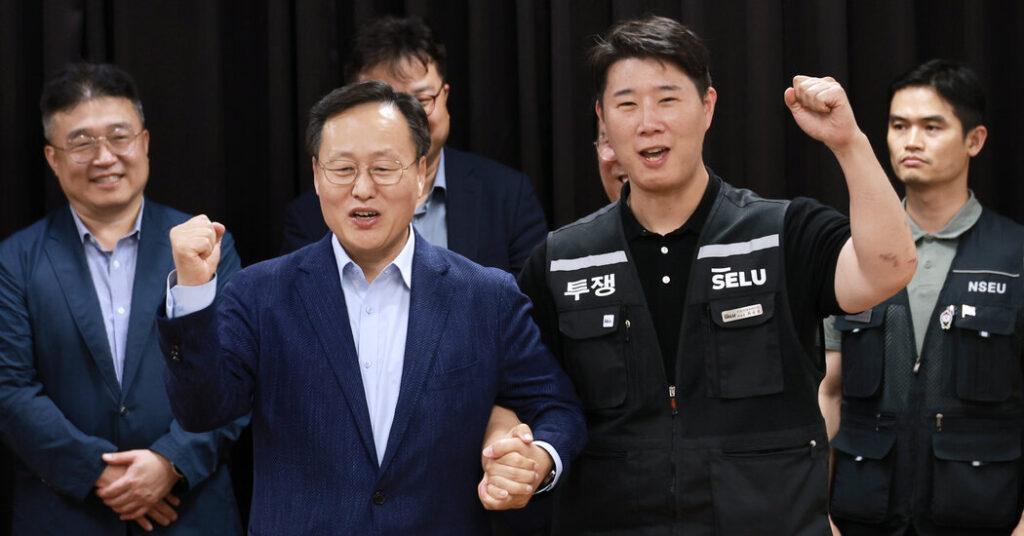
Unions at Samsung Electronics ratified a wage deal on Wednesday, securing hefty bonuses for workers at its chip division, which has been making record profits thanks to the rise of artificial intelligence.
But some workers at another Samsung division, which makes phones and televisions, said the deal overlooked their interests, in a sign of the disparities of the AI era.
Last week, Samsung agreed to commit 10.5 percent of its annual operating profit over the next 10 years to employee bonuses and remove limits on individual bonus amounts, provided it clarifies some profitability targets.
The vote ends a months-long dispute between Samsung and its workers over the distribution of its substantial AI profits, which reached a tentative agreement only after government negotiators intervened the night before a planned strike last week. It represents a major victory for workers at a company that has long maintained an anti-union stance and did not begin negotiating with them until 2021.
“There were some unfortunate aspects to the wage negotiation process, but it was still a significant agreement,” said Choi Seung-ho, head of the Samsung Electronics Workers Union, which, as the largest of the company’s three unions, led the negotiations.
Nearly three-quarters of the roughly 62,000 workers who voted said they were in favor of the deal, according to SELU.
The deal also averted a potential crisis in the global AI supply chain, which is heavily dependent on memory chips from South Korea.
Samsung Electronics, along with its South Korean colleague SK Hynix, has benefited greatly from AI’s voracious appetite for memory chips, which store and retrieve data and are essential for working with large data sets. Last year, Samsung Electronics shares rose fivefold.
As global chip prices continue to rise amid a supply shortage, some analysts have predicted that Samsung Electronics’ operating profits this year will reach a staggering $200 billion, seven times more than last year.
Samsung Electronics and SK Hynix together account for more than 60 percent of global memory chip production. Last year, SK Hynix workers negotiated their own bonuses to reflect the company’s AI-powered profits.
As the global expansion of AI continues apace, Samsung workers have argued in recent months that they should be given their fair share of a much larger pie. The message especially resonated with workers in the semiconductor division, who make up the majority of SELU members.
If the company were to hit $200 billion in operating profit this year, semiconductor workers, particularly those in the crown jewel memory unit, could receive bonuses of up to about $430,000, a Samsung spokesman said. The average monthly salary in South Korea last year was about $2,800, according to government data.
But a smaller union associated with workers at the consumer electronics division (which boycotted the negotiations and whose 15,000 members were excluded from the vote) accused the main union of neglecting its interests and condemned the deal as “discriminatory.” Under the agreement, workers in the consumer electronics division are expected to receive payments that are a fraction of those of their peers in the semiconductor division.
In the first quarter of this year, 94 percent of Samsung’s operating profits came from semiconductor sales. During negotiations, the company had argued that “rewards should follow performance.”
Although the smaller union’s attempt to block negotiations with a court order was unsuccessful, it has said it would seek to overturn the results with further legal action, arguing its exclusion from the vote was unfair.
“We do not covet performance-based rewards,” Park Jay-yong, leader of that union, told reporters on Tuesday. “We’re just saying that those under the same roof should be treated fairly and reasonably.”


