- Pakistan remains firm on its position on Palestine: Dar.
- “Israel must move towards establishing a Palestinian state.”
- Marco Rubio praises Pakistan’s efforts to promote peace in the Middle East.
Deputy Prime Minister and Foreign Minister Ishaq Dar on Friday ruled out any change in Pakistan’s long-standing policy towards Israel, saying there could be no change in Islamabad’s stance towards Israel without the establishment of an independent Palestinian state.
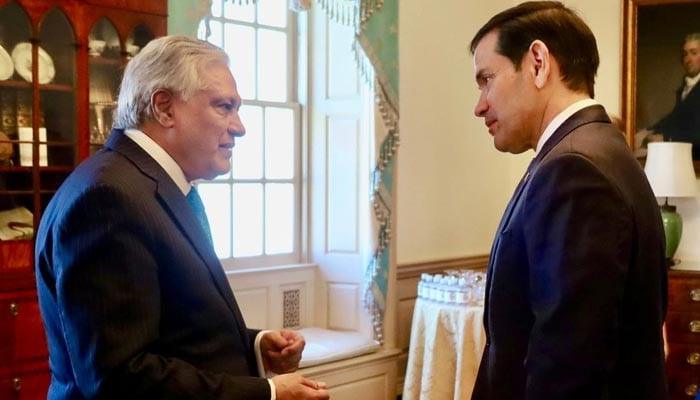
He made these remarks during a press conference at the Pakistani embassy in Washington after a meeting with US Secretary of State Marco Rubio.
He was responding to a question about US President Donald Trump urging Muslim states, including Pakistan, to join the Abraham Accords as part of a deal with Iran and whether any discussions were held with Rubio on the matter.
“Pakistan remains firm in its position on Palestine and Gaza,” Dar said, adding that Israel “must move towards the establishment of a Palestinian state” before there can be any change in Pakistan’s stance towards Israel.
The Abraham Accords are a set of agreements negotiated during the Trump administration in 2020 and widely heralded as a foreign policy success. The Accords govern the normalization of diplomatic relations between Israel and countries that have historically been hostile to it.
While they were welcomed in diplomatic circles as a step toward a more peaceful Middle East, they remain unpopular with the public in many parts of the region, not least because they do not address the Israeli-Palestinian conflict.
Earlier on May 25, US President Donald Trump urged Muslim-majority nations across the Middle East and beyond to normalize relations with Israel as part of the emerging peace deal with Iran.
In a social media post, Trump listed the countries whose leaders he spoke with on Saturday about efforts to end the war with Iran.
“After all the work done by the United States to try to solve this complex puzzle, it should be mandatory for all of these countries, at a minimum, to simultaneously sign the Abraham Accords.”
“Those countries discussed are Saudi Arabia, the United Arab Emirates (already a member!), Qatar, Pakistan, Turkiye, Egypt, Jordan and Bahrain (already a member!)”
Rubio praises Pakistan’s peace efforts
Meanwhile, Rubio – after meeting with DPM Dar – praised Pakistan’s efforts to promote peace in the Middle East.
He said he was “grateful [DPM Dar] for the role Pakistan continues to play in advancing peace in the Middle East.”
“We agreed on the importance of working together to further strengthen a meaningful partnership for greater security and greater prosperity for our two nations,” X wrote in his official name.
Addressing a press conference at Pakistan’s embassy in Washington, DPM Dar said the meeting with Rubio took place in a “cordial” atmosphere and was attended by Pakistan’s ambassador and other senior officials of the Ministry of Foreign Affairs.
Pakistan played a role in facilitating ceasefires between the United States and Iran, he said, adding that Islamabad helped create conditions for direct engagement between the two countries.
Dar said the first ceasefire between Washington and Tehran was possible thanks to Pakistan, adding that the latest truce was also achieved thanks to Islamabad’s efforts.
He added that Pakistan had acquired a “new identity on the global horizon” under the leadership of Prime Minister Shehbaz Sharif and COAS-CDF Field Marshal Asim Munir.
Dar’s comments come amid Pakistan’s continued diplomatic engagement with regional and international stakeholders to help end the war in the Middle East.