
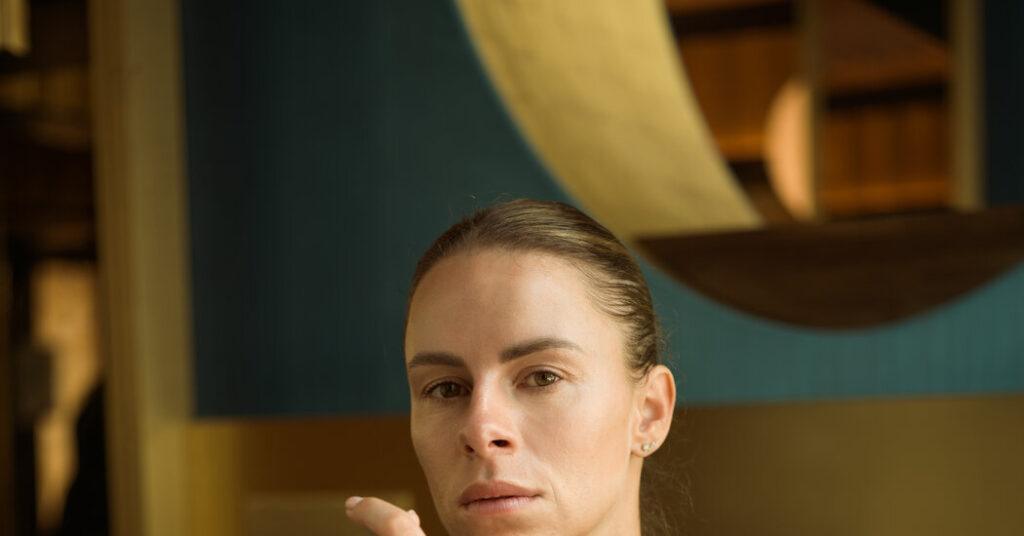
Two years ago at Wimbledon, Polish tennis player Magda Linette sought out a competitor and friend, Sloane Stephens, for advice. It is not about your right or your service, but about fertility.
Linette, then 32 years old, wanted to be a mother one day. She knew that in vitro fertilization was her best option due to a genetic condition she carried. And she knew that the sooner doctors retrieved her eggs, the better her chances would be of having a baby one day.
But she had questions. How would the procedure affect your training? Would it interfere with the tennis season? Could you test positive on a drug test because of the supplements you might have to take?
He thought Ms. Stephens, the 2017 US Open winner who often spoke publicly about her own egg retrieval, might have some answers. Then, during a quiet moment in the locker room of the All England Lawn Tennis and Croquet Club, Ms. Linette took her aside.
“I have known Magda since she was 13,” said Ms. Stephens, who encouraged Ms. Linette to undergo egg freezing. “We are the same age and the same living situation.” He added: “He shouldn’t have to stop playing tennis because he wants to have a family.”
Nine months later, Ms. Linette received another shot of encouragement. The Women’s Tennis Association, which runs the women’s circuit, announced a Maternity Fund Programme, which offered grants to pay for IVF and egg freezing treatments available to more than 320 players, plus a year of paid maternity leave. The association later protected players’ rankings when they returned after a fertility procedure.
Women often rely on their friends to navigate the emotional maze of fertility treatments. In WhatsApp chats and Slack threads, they ask how the injections will feel or which doctors have the best bedside manner. Tennis, however, is a sport in which friendships tend to be protected. Maintaining the mental edge can be as important as physical ability. Some of the sport’s best players have spoken of their inherent loneliness.
“It’s hard to trust your deepest, most personal things to someone on Monday and then compete against that person on Tuesday,” said Linette, who won three singles titles in her career and reached the third round of the French Open this week.
But with these new benefits, a brotherhood of egg freezers is emerging in the sport. They know what it feels like to tune their bodies to perform in specific ways on the court, only to then undergo treatment they can’t control. In locker rooms and players’ rooms, women offer advice, compare symptoms and, if necessary, console each other.
Stephens, 33, has been something of a promoter and confidant in this effort. Her grandfather was an obstetrician and gynecologist and she has three cousins who were born through IVF. Her family was open about fertility and supportive.
“I just want to make sure that every girl who goes through that process has the same support,” said Stephens, who froze her eggs for the first time in 2022, “whether it’s financially, emotionally or the whole thing.”
A Saudi negotiation
As fertility benefits have become more common in corporate workplaces, female athletes have pushed for them as well. WNBA players, for example, got maternity leave and fertility benefits in their 2020 collective bargaining agreement.
There is no union in women’s tennis; Players are not employees, but rather independent contractors. They have a players’ council, which takes the concerns of the players to the WTA.
Ms. Stephens served on the council for four years, until August 2023. In the fall of 2022, she began advocating for fertility benefits. He pushed for money to help pay for egg retrieval, which can cost between $10,000 and $25,000 per cycle, and urged the circuit to offer ranking protections so players recovering from the procedure could participate in tournaments without losing too much ground.
Two years later, as the WTA negotiated a sponsorship deal with Saudi Arabia’s public investment fund, the tour suggested using the money for family planning.
Saudi Arabia has had a historically poor record on women’s rights. Activists have been arrested there and women still need the approval of a male guardian to marry, although there are legal mechanisms to circumvent that requirement. The fact that the Saudis paid for a benefit that helps women delay childbearing to fit their careers struck some as a “misalignment,” said Portia Archer, who was the WTA’s chief executive when it adopted the benefits.
Still, assisted reproduction is widely available in the Saudi kingdom, although it is usually limited to married women. “In practice, there hasn’t been any misalignment,” Archer said in March, a few months before he resigned. The Saudis “were very interested from the beginning.”
Riyadh has hosted the WTA finals for the past two years, at a cost to Saudi Arabia of around $25 million per year. The kingdom’s Sports Ministry decided not to renew his three-year contract once it expires after this year’s finals in November. But the WTA claims that the maternity fund has not been affected by the Sports Ministry’s decision.
The WTA did not say how much the fund pays or how much the Saudis have invested. A representative of the Saudi public investment fund declined to comment on the maternity fund.
‘We sort of spent it together’
Once pool and ranking protections were announced, players became more comfortable arranging fertility procedures. Ms. Stephens began to receive more questions.
One player who sought it out was Beatriz Haddad Maia, 30, the top-ranked Brazilian player, who decided to go ahead with egg freezing. Among her challenges was being prohibited from exercising during the period before her egg retrieval, a break she found “super strange,” she said. Professional tennis players train for hours a day, but exercise, particularly the core exercises that are important in tennis, a torso-rotating sport, can cause complications in the days before the procedure.
Desirae Krawczyk, a 32-year-old doubles champion, and her boyfriend had talked about egg freezing, but she always found a reason to delay it. He said the fund provided $20,000 to cover the entire process, with some money left over, which helped in his decision. (The WTA said players can apply for grants up to a lifetime maximum.)
Retrieving and freezing her eggs was an “investment,” she said. “You don’t want to look back and say, ‘Oh, I should have done that.'”
He spoke to Ms. Stephens and even went to the same doctor. Two of her friends also went to that doctor, Sabrina Santamaría and Giuliana Olmos, both double players and both married.
“We kind of spent it together,” said Olmos, 33, who froze embryos she created with her husband, with the fund covering about 70 percent of the process. “If we needed help with shots or doses or anything, there was someone there who was going through the same thing.”
Olmos said she respected players who returned to play after having a baby, like Serena Williams and some other top players. Olmos has earned nearly $2 million in prize money since 2018, but that amount also helps cover expenses like travel, training and physical therapy. Paying for childcare and extra hotel rooms to take a baby on a trip would cost too much, she said.
Five-time Grand Slam winner Maria Sharapova waited until her career ended to have a child.
“My mom had me when she was very little and we formed a very close friendship,” Sharapova said. “I always thought I would be a young mother. I knew that as I got better at tennis that wouldn’t be realistic.”
He won Wimbledon at age 17 and earned $38 million in prize money between 2004 and 2020, retiring at age 32. In addition to having her son, she also began investing in fertility companies. One, Cofertility, offers free egg freezing to women who wish to donate some of their eggs.
Taking the risk
Ms Linette returned to Poland in October for the egg retrieval.
Along with the anxieties any woman might have (the discomfort, the fear of needles), she worried whether the medications she was taking would distort her mandatory drug tests. Tennis players can be punished if they test positive for something prohibited by the sport’s anti-doping policy, even if they did not intend to take the banned substance. The people at her fertility clinic were not familiar with tennis’ anti-doping procedures, which increased the chances of making a mistake.
“Without these supplements, I cannot perform the procedure,” Ms. Linette said. “I may never be able to get pregnant. So it’s a huge dilemma.”
In the end he decided to take the risk.
She had been told that egg retrieval would be uncomfortable, but she didn’t anticipate the stabbing pain in her ovaries afterwards. Doctors told him not to try playing tennis right away, an unnecessary warning since he could barely get out of bed.
““I have discovered an absolutely new admiration for women who go through those cycles over and over again,” Linette said.
About five weeks later, she finally felt ready to push herself in practice again. He could run, he could serve. Then, in late December, the tennis world reconvened in Oceania for a group of six tournaments culminating in the Australian Open, one of the sport’s four Grand Slam events.
Mrs. Linette’s ovaries hurt. With a Grand Slam tournament coming up, he wanted to make sure he could play through the pain.
He consulted a doctor, but also texted Ms. Stephens to ask her opinion. Mrs. Stephens, as always, was happy to help.


