
XRP continues to find bullish narratives beneath the surface, but the price continues to ignore them. Exchange balances are shrinking, ETF money continues to flow into cryptocurrencies, and Binance inflows have slowed dramatically.
None of that stopped XRP from losing another support level this week, which is usually a sign that technical selling is overwhelming long-term accumulation.
News background
• More than 25 million XRP have left exchanges in recent days, reducing the amount of supply available for sale.
• Binance inflows fell to their lowest levels of 2026, a trend that would normally support prices over longer time frames.
• Crypto investment products continued to attract fresh capital, with approximately $1.42 billion flowing into spot ETFs during the period.
Price Action Summary
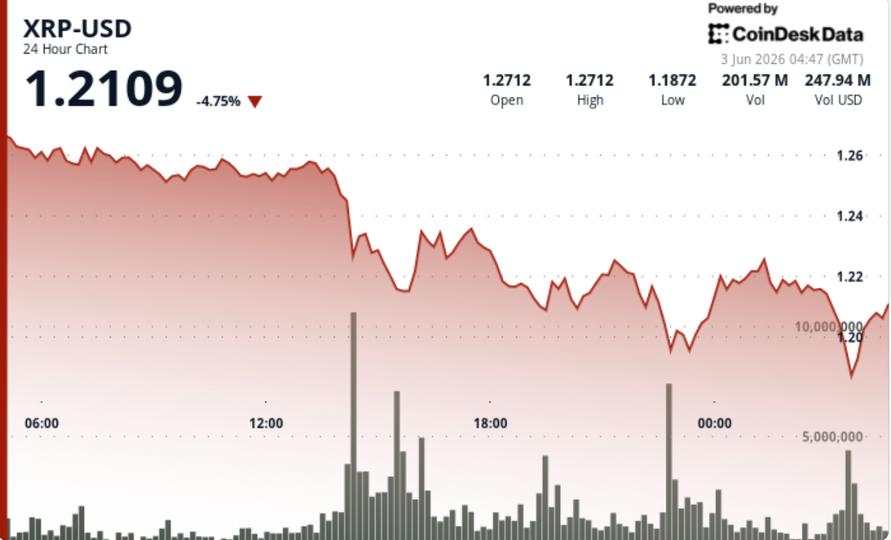
• XRP fell from $1.2712 to $1.2026 during the 24-hour session, losing more than 5%.
• The decisive move occurred during the session on June 2 at 14:00 UTC, when the volume increased to 205.7 million and pushed the price through the support of $1.25.
• XRP subsequently fell as low as $1.1858 before recovering modestly and stabilizing near the $1.20 area towards the close.
Technical analysis
• The key story is that XRP no longer reacts positively to bullish supply data. That’s often what happens at the end of downtrends, when traders focus more on price action than fundamentals.
• The break below $1.25 changed that level from support to resistance, meaning any attempted recovery now faces widespread selling pressure.
• The rebound from below $1.19 showed signs of short-term seller exhaustion, but subsequent buying remained weak.
• XRP remains trapped within a broader descending structure, with lower highs continuing to define the trend.
What traders should keep in mind
• $1.20-$1.21 is now the most important support zone on the chart. Losing it would expose the $1.13-$1.15 zone.
• $1.25 becomes the first recovery level that bulls need to recover before sentiment can improve.
• The market is now caught between weakening supply on stock exchanges and deteriorating price action. Until one of those signals prevails, traders are likely to remain cautious.


