
He says the province is being “punished” for its political alignment and the government is focusing on political retaliation rather than the economy.
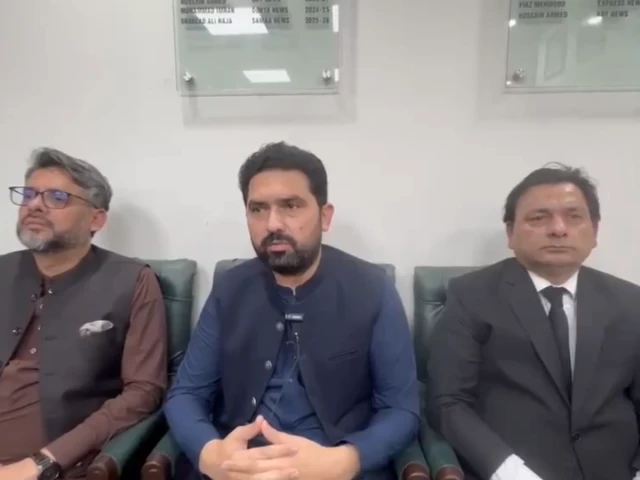
KP Financial Advisor Muzammil Aslam and Chief Minister Sohail Afridi speak to reporters. SCREEN CAPTURE
ISLAMABAD:
Khyber-Pakhtunkhwa (KP) Chief Minister Sohail Afridi on Wednesday sought permission from the Islamabad High Court (IHC) to meet Pakistan Tehreek-e-Insaf (PTI) founder Imran Khan for consultations on the province’s upcoming budget ahead of the next fiscal year.
Speaking to reporters outside the court along with KP financial advisor Muzammil Aslam, the chief minister said the meeting was necessary because the provincial budget had already been prepared and required what he described as a final input from the PTI founder.
He said the mandate given by the people of KP was linked to Imran’s political vision, so consultation on the budget was essential.
“We want to consult our leader Imran Khan before presenting the budget 2026-27 and present it as per his vision,” he said. He added that the people of KP had voted for Imran and hoped that the provincial budget would align with their political and economic priorities.
خیبرپختونخوا کے عوام نے عمران خان کو ووٹ دیا۔ لوگ عمران خان کی سوچ کے مطابق ہو۔ اس لیے ہم چاہتے ہیں کہ بجٹ 2026/26 پیش کرنے سے پہلے اپنے قائد عمران خان سے مشاورت مطابق بجٹ پیش کریں۔ … pic.twitter.com/uKbyQ6RS2X
– PTI (@PTIofficial) June 3, 2026
Afridi said consultation with Imran was necessary before finalizing the budget and reiterated that a court petition had been filed to secure a meeting. He also expressed concern about Imran’s health, stating that “25 percent of his eyesight has been affected,” adding that restrictions on his medical treatment and gatherings were worrying.
He said not allowing Imran to meet his family, lawyers and party leaders amounted to injustice.
Read: Rs 17.1 trillion budget proposed for FY27
Afridi said the province faced what he called unfair treatment in the distribution of resources, alleging that KP had been sidelined in federal development planning and the previous budget cycle.
The chief minister alleged that KP was being deprived of its financial rights under the National Finance Commission (NFC) award and other transfers, alleging that Rs 12 billion had been deducted from the province’s funds.
He said the province had spent more than Rs 30 billion on policing in the fight against terrorism.
Afridi claimed that the province was being “punished” for its political alignment and that the government was focusing on political retaliation rather than economic issues, adding that inflation, unemployment and poverty continued to rise in the country.
The prime minister also criticized the overall economic situation and said more attention should be paid to improving conditions for low-income groups and addressing growing security challenges in the province. He alleged that terrorism had increased in KP and said the federal government had not responded adequately.
He said industrial units were closing and capital was moving abroad, while farmers were facing hardship due to what he described as harmful government policies. Afridi further stated that more than 45 percent of the population had fallen below the poverty line.
Afrifi said the national debt had increased from Rp43 trillion to Rp97 trillion in recent years.
The prime minister further announced that his party would stage a protest outside Parliament during the next budget session, expected to begin on June 10, and maintained that the provincial government had the authority to make its own decisions under the constitution.
Read more: Budget 2027 and fiscal illusion
The KP financial advisor said an Annual Plan Coordination Committee (APCC) meeting had initially been scheduled for May 21 but was later held on June 1, adding that expectations of clear decisions had not materialized.
He said the Planning Minister had “laid out the challenges”, suggesting there were funding constraints at federal level. “He seemed visibly concerned about the province’s problems, and it felt as if even the Minister of Planning himself was distressed by the situation,” Aslam said.
He added that Pakistan and other countries generally raise capital through capital markets, noting that financing deals had been made through guarantees provided by an Asian bank.
Aslam said the delay in the National Economic Council (NEC) meeting and the change in the budget process was a “worrying situation”.
He further claimed that the government was struggling to finalize the budget framework, saying there were disagreements with the International Monetary Fund (IMF) and that coalition partners were also not fully aligned.
Aslam further said that in a previous meeting provinces had been asked to generate an additional Rs 430 billion in tax revenue, adding that provincial governments had questioned the viability of such a target.
“We were told to collect the property tax and share it with the federal government,” he said. He added that according to Federal Board of Revenue (FBR) data, Peshawar had generated one of the highest tax collections.
Aslam said the delay in the budget would be discussed, adding that the government was facing difficulties in preparing it.
He said the coalition government was unwilling to provide help to its partners. He claimed that Rs 225 billion had been allocated in the budget for a single road project in Quetta.
Aslam said the Planning Minister had stated that there was no development budget available to him, adding that KP had been allocated Rs 2.2 billion for development, while Punjab had been allocated Rs 7,000-8,000 million.
He said when he asked about this, he was told provincial development plans were being discontinued and said, “When you prepare a budget under pressure, this is what happens.”
Aslam further added that a key meeting of the coalition partners in Block Q had been held and added that he had been informed that the partners had expressed reservations over the budget.


