
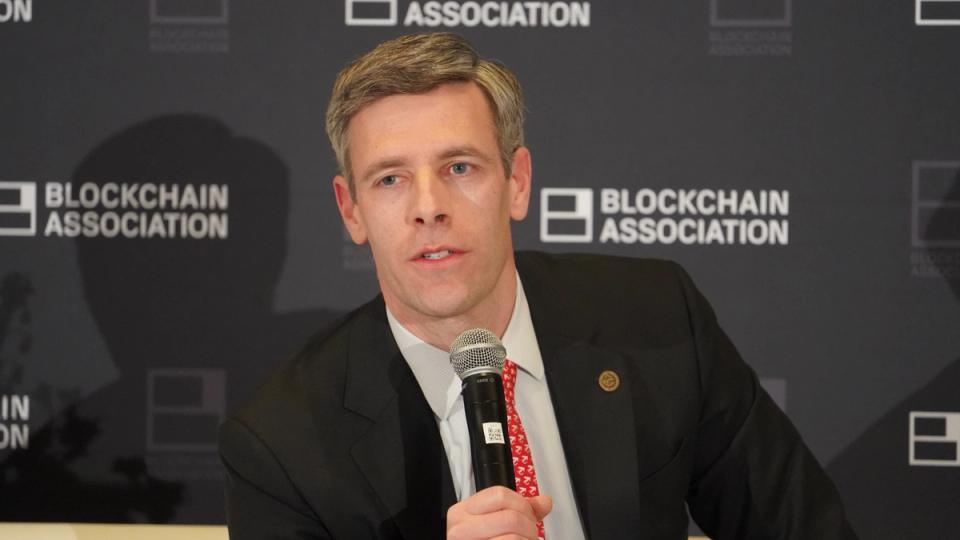
The cryptocurrency company linked to President Donald Trump, World Liberty Financial Inc., once again came under political scrutiny in a Congressional hearing in which the head of the U.S. Office of the Comptroller of the Currency suggested that the only political pressure his agency feels over its decision on whether or not to grant the company a banking charter comes from Democrats, not Trump.
Comptroller of the Currency Jonathan Gould’s rebuttal came in response to Rep. Gregory Meeks, a New York Democrat, who asked during Thursday’s hearing whether Gould is “working for the American people or working to fix Trump, which is it?”
“Your attempts to continue pressuring me are the only political pressure I have ever felt from anyone other than your Senate colleagues,” Gould said, referring to similar questions he had heard from Democrats, including Sen. Elizabeth Warren. “That is very unfortunate and unprecedented,” he added, insisting that his agency will do its job according to the statute that governs the statutes.
Democrats continue to argue that World Liberty’s connection to foreign investors and crypto partners who have previously been associated with illicit behavior (including global exchange Binance) suggests it is unfit for a US banking charter, and have argued that it is inappropriate for a Trump appointee to decide whether to grant such a benefit to a company partially owned by the president and his family.
Amid Thursday’s verbal confrontation, Gould said his agency is following ethics laws in applying for a national trust bank charter for World Liberty Trust Company.
The Trump-linked company is also a stablecoin issuer, which was a focus of the House Financial Services Committee hearing, in which U.S. supervisors of the banking and credit union industries explained where they are in implementing the Guiding and Establishing National Innovation for U.S. Stablecoins (GENIUS) Act.
Regulators have already issued several proposed rules to implement the new law, and Federal Deposit Insurance Corp. President Travis Hill said another is coming soon, saying his agency and others will propose a rule requiring “customer identification programs” for stablecoin issuers “in the very near future.”
Kyle Hauptman, president of the National Credit Union Administration, touted the rise of stablecoins in the United States in his testimony.
“As stablecoins become more widely adopted, we Americans may no longer be made fun of for talking about how many ‘business days’ a payment will take to clear. Every day is a business day with stablecoins,” he said. “Tax refunds may eventually arrive on Sundays or holidays. And if there is ever a repeat of the COVID outbreak in March 2020, Americans should be able to receive emergency stimulus funds in a more timely and secure manner.”
But Rep. Brad Sherman, a California Democrat who routinely speaks out against the risks of cryptocurrencies, said, “I can’t think of a worse idea” than allowing government payments in stablecoins. “It would sanctify an alternative to the US dollar, an alternative designed to facilitate a tax avoidance economy.”
Sherman also argued that the GENIUS Act “requires no interest to be paid on stablecoins,” and argued that “the smartest, or at least the highest-paid, lawyers in the country” are trying to find ways to get around that ban, so regulators should “write regulations that resist that.”
Also at the hearing, a lawmaker asked Federal Reserve Vice Chair for Supervision Michelle Bowman about the Fed master account given to crypto exchange Kraken.
Bowman said the approval granted only “very limited access to the payments system” and for an initially limited duration of 12 months, during which he said the Federal Reserve will be watching closely to educate itself and prepare for the formal rules for providing such accounts. The rest of the cryptocurrency industry is also very interested in the outcome of the Federal Reserve’s policy work to open such access to the central bank’s payments system and services, commonly known as “thin” master accounts.
Read more: US Senator Warren rejected the delay of the World Liberty bank charter due to ties to Trump


