
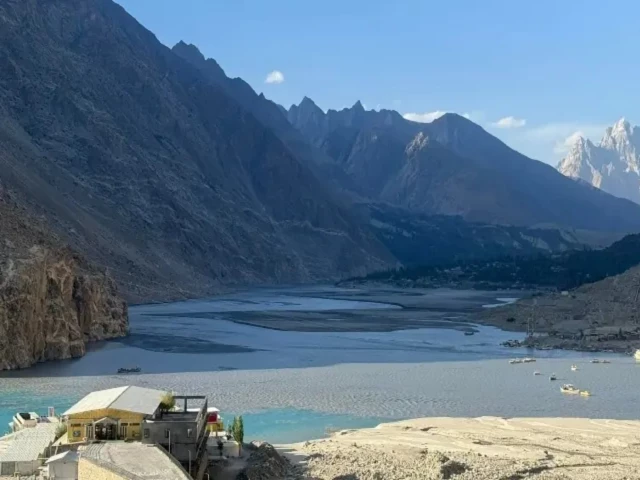
The claim was misleading as currently exposed areas may remain exposed, expand or resubmerge in the future.
Attabad Lake in Hunza is popularly known as the ‘crown jewel’ of Gilgit-Baltistan and is one of the major tourist attractions in the region. The lake was formed when the village of Attabad in the Gojal Valley suffered a major landslide that occurred on January 4, 2010.
For the past few days, videos have been circulating on social media claiming to show the latest images of the lake, showing much of its once turquoise waters replaced by dry, exposed land.
Lake Attabad in Hunza, once admired as a stunning natural wonder, now faces concerns over its changing beauty and environmental stress.
Known for its stunning blue waters and surrounded by towering mountains, it quickly became one of the most visited tourist destinations in Pakistan… pic.twitter.com/S0CZr1QvAw
– Startup Pakistan (@PakStartup) June 4, 2026
The clip was shared by several digital media pages on X, Facebook and Instagram, as seen here, here, here and here. Some said the lake no longer existed, while others expressed concern over the “visible decline in water levels”, linking it to environmental degradation in northern areas of Pakistan due to “increased tourism, unplanned activity and natural changes”. One user also called it the “end of Attabad Lake as we know it.”
Meanwhile, people in the comments section argued that the lake drying up was a common phenomenon, further fueling the debate.
WHAT WE FOUND
A keyword search conducted to verify whether the local mainstream media had reported on the lake drying up yielded news report by Pakistan todaydated June 2, 2026. “What was once a deep blue, almost surreal expanse of water, where tourists took boat rides and took postcard-perfect photographs, now looks dramatically different,” he said.
“Viral clips circulating on social media show wide expanses of sand, shrinking water channels, and areas that look more like a cold desert than a lake,” the report added.
a similar report was taken by Pakhtun Digitalan independent digital news network based in Peshawar, on June 5 with the title “Attabad Lake: A beautiful masterpiece of nature now under environmental pressure”. He raised the alarm that if measures were not taken to protect the lake, it would lose its natural beauty within a few years.
Jamil Nagri, of dawn The correspondent in Britain also confirmed that images circulating on social media were accurate.
Delving into the science behind water levels and lake formation yielded a research work 2024 which claimed that Attabad Lake was never a typical natural lake. It was formed in 2010 after a landslide blocked the Hunza River, meaning the lake is technically a landslide-dammed reservoir: a natural body of water that forms when a catastrophic landslide, rock slide, or debris from an avalanche blocks the flow of a river.
As a result, lake size and water levels are influenced by factors such as the inflow of the Hunza River and glacier-fed tributaries, rainfall, and the management of outflow through spillways built to reduce pressure on the natural dam.
The research found a gradual reduction in the lake’s surface area between 2010 and 2020. According to the authors, sediments accumulated in the lake’s northern estuary upstream as the water mass evolved over time, increasing the extent of exposed sediment deposits and altering the surrounding landscape.
“Due to its proximity to the source of the Hunza River, the lake experiences rapid sedimentation. Over time, this natural sedimentation gradually reduces the active water area and alters the surrounding landscape,” the document notes.
The study further noted that changes in the lake became less pronounced after 2016, suggesting that the water mass was moving toward a more stable state.
A climate expert based in Great Britain agreed with the same. “The lake has not dried up; instead, it is shrinking due to high levels of sediment in the lake, which is a natural phenomenon,” he told iVerify Pakistan over the phone. “This is something we have seen in most rivers in northern areas.”
The Karakoram rivers carry significant loads of rocks, sand and fine particles eroded from the surrounding mountains and glaciers.
He explained that there was sedimentation of sand and soil coming in summer seasons from the upstream tributaries, the main source of water for the lake, which made it appear that the lake was drying up. When river water decreases as it enters the lake, much of this material is deposited on the lake bed, gradually forming exposed mudflats and sandy reaches.
“Water continues to enter the lake, although it varies due to climatic factors. The enormous amount of sediment that accumulates in Lake Attabad makes it appear that the lake has dried up,” the expert added.
Therefore, it cannot be determined whether currently exposed areas remain exposed, expand or resubmerge in the future, as it is influenced by a combination of melting glaciers, river inflows, sediment deposition and other factors.
CONCLUSION
To say that Lake Attabad has dried up is misleading.
While the viral videos accurately show the exposed sediments and changes, the size and appearance of Attabad Lake is influenced by natural hydrological processes, including melting glaciers, river discharge, and sediment deposition, making it difficult to predict future changes with certainty.
This fact check was originally published by iVerify Pakistan, a project of CEJ-IBA and UNDP.


