
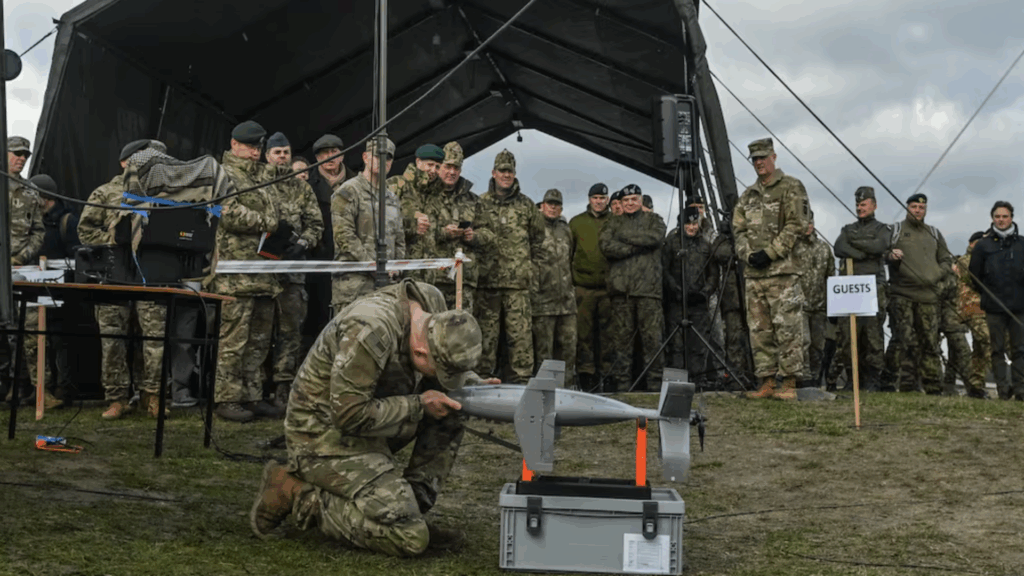
- A $5,000 Hornet gives Ukraine long-range strike power for minimal cost.
- Swarms of cheap drones change defense economics and overwhelm expensive interceptors.
- Schmidt applied software-era scaling to hardware, enabling rapid, disposable production of drones.
A former Google CEO, Eric Schmidt, has quietly become the essential link between Silicon Valley thinking and Ukraine’s most lethal unmanned strike asset.
He launched Project Eagle, which later became Perennial, with the explicit goal of building a drone that costs less than a used car but travels farther than most missiles.
The result is the Hornet, a $5,000 drone that carries 5kg of explosives over 200km in a unidirectional configuration designed for maximum range rather than recovery.

Low-cost swarm attacks expand operational depth
Ukrainian forces now possess a weapon that makes deep strikes affordable enough to deploy in large swarms rather than as valuable singular assets.
The economics of the Hornet fundamentally change what a “formidable” drone means on a modern battlefield.
For the price of a single conventional missile, Ukraine can launch ten Hornets simultaneously at ten different targets.
Each Hornet delivers the same explosive power as a heavy artillery projectile, but does so without putting the pilot or an expensive airframe at risk.
This is not a gradual improvement but rather a complete departure from previous assumptions about air warfare.
Eric Schmidt, who ran Google for nearly a decade, didn’t simply fund this project from a distant office.
He actively formed Perennial as Project Eagle before it became a manufacturing operation capable of producing Hornets at scale.
The 200 kilometer range means that Ukrainian commanders can attack far behind forward positions without repositioning delivery systems closer to the front line.
The Hornet is not designed to destroy a fortified bunker; Penetrates deep behind enemy lines to target relevant surface facilities.
An explosive charge of 5 kg is modest by artillery standards, but it is more than enough to destroy fuel depots, ammunition depots, radar installations and command vehicles.
Increase production and change the cost balance of war
A major issue in military drone development is production speed, but Schmidt introduced the principles of software development to the hardware industry.
From the moment of design, the Hornet was already treated as disposable hardware that could be reproduced quickly.
The true innovation of the drone lies not in a single component, but in the economic logic that makes losing ten Hornets cheaper than firing an advanced surface-to-air missile.
However, it remains to be seen whether a $5,000 drone can survive 200 km of electronic warfare and active air defense measures.
One positive here is that quantity offers its own form of survivability: it will be difficult to use expensive interceptors to stop 20 Hornets launching at 20 different targets.
The math favors whoever uses cheap Hornets to force a defender to spend millions on layered protection systems that can still fail with a single lucky break.
Drones are “the defining threat of our time,” said Brig. General Matt Ross, director of JIATF-401.
“We must be proactive in creating a layered defense that deploys and expands low-cost air-to-air drone interceptors across our facilities at home and abroad.”
Via Defense News

Follow TechRadar on Google News and add us as a preferred source to receive news, reviews and opinions from our experts in your feeds.


