
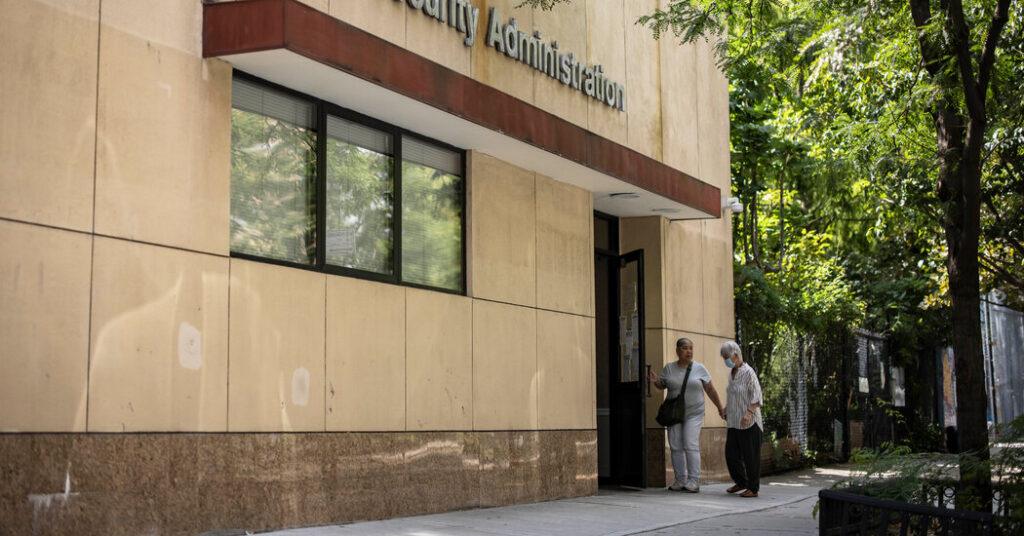
Social Security’s financial forecasts worsened this year, according to the annual financial report released Tuesday by the program’s administrators. If Congress does not develop a plan to shore up the program, it would have to cut benefits for millions of Americans in just over six years.
The deterioration of Social Security’s finances has long been thought to be a future problem that must be resolved by another president or another Congress. But now it’s getting closer because the funds will run out before the next president’s term ends.
The Social Security Old-Age and Survivors Insurance trust fund, which helps pay retiree and survivor benefits to more than 68 million beneficiaries, is now expected to run out of money by the end of 2032, a quarter early. than projected last year. That means incoming revenue would be enough to pay only 78 percent of benefits, in other words, a 22 percent reduction, according to the report.
But that situation would only materialize if lawmakers don’t act to strengthen the program before then, through some combination of higher taxes or reduced controls.
“This should be a wake-up call: Congress must act,” said Myechia Minter-Jordan, executive director of AARP. “Americans have worked hard and paid into Social Security all their lives, and they deserve to count on it when they retire. No family should see cuts to what they have earned in Social Security.”
The Medicare hospital trust fund is expected to run out of money in 2033, slightly earlier in the same year than trustees had estimated last year. In the second quarter of that year, Medicare is projected to only have enough money to pay 89 percent of the program’s hospital bills. Future spending is expected to increase in other parts of the Medicare program, which is not funded by a dedicated fund. However, that growth in spending on doctor visits and prescription drugs will increase the federal budget deficit and long-term federal debts.
Social Security has long faced a funding shortfall, but it has gotten worse in the short term for several reasons. The trustees assumed that fertility and immigration rates would be lower, which would be a drag on the program. And the trust fund will collect less tax revenue from Social Security beneficiaries, because of the big tax and policy bill passed last summer. Trustees also assumed that workers’ incomes would grow faster, which would help the program’s finances.
Social Security must also confront its oldest challenges, driven in part by demographic changes. Declining birth rates mean fewer workers pay taxes into the program, while thousands of baby boomers retire daily and collect their benefits for longer periods.
Additionally, a larger proportion of the country’s wage base is not subject to payroll taxes (the lifeblood of Social Security) compared to previous years. Taxes apply up to just $184,500 of income, and growing income inequality means that a greater proportion of Americans’ income exceeds that limit and is not subject to tax.
Medical costs have also been growing faster than the rest of the economy in recent years, putting additional pressure on Medicare’s finances on top of demographic trends affecting both programs.
A separate trust fund, which finances Social Security disability benefits for an additional 8.1 million people, is on stronger footing. You will be able to pay your bills for the next 75 years, according to the report.
Many Americans believe Social Security is in worse shape than it actually is: A recent AARP survey found that 39 percent of respondents believed the program would not be able to make any payments when the trust fund was depleted.
There is widespread misunderstanding about how the program works. It is generally funded through a combination of payroll taxes, ordinary income taxes on benefits, and interest earned on the trust fund. If the amount of taxes collected exceeds the amount paid, that excess is held in the trust fund. And if the benefits exceed the taxes collected, that gap is covered with money from the fund.
“Simply put, the trust fund functions like a personal checking account: money in and money out,” Jonathan Schwabish, a senior fellow at the Urban Institute, said in a report this year.
But since the early 2010s, benefits paid have exceeded taxes received, leading the trust fund balance to decline, he added. Once the fund is empty, the program will be able to pay benefits using only the taxes it has received.
By law, Social Security (unlike parts of Medicare) cannot use money from general revenues in the federal budget to pay benefits.
“These insolvency dates may seem abstract and far away, but the reality is that senators elected in 2026 will be in office when Social Security reaches insolvency,” said Margaret Spellings, president and CEO of the Bipartisan Policy Center.


