
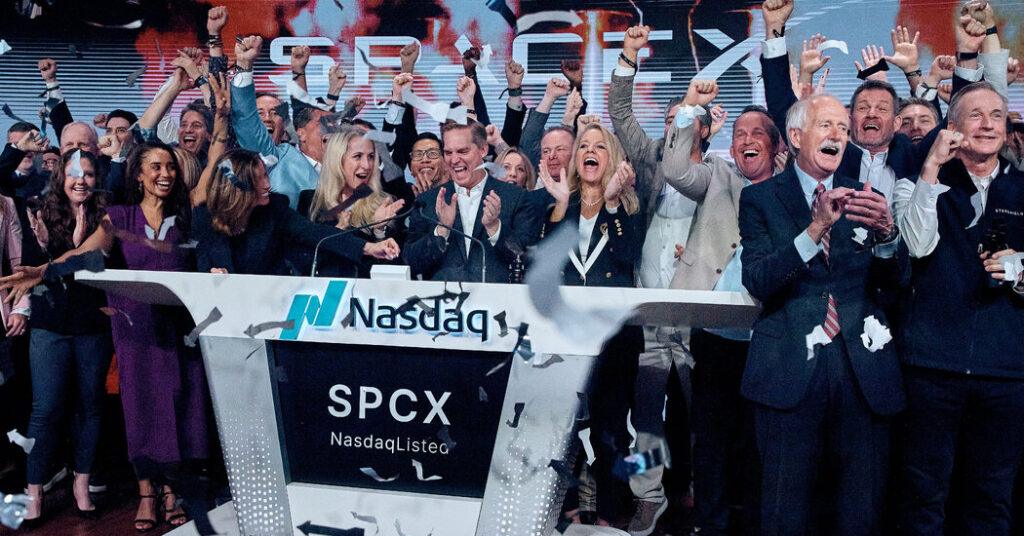
The day he found out SpaceX was going public, Kevin Conlon knew he wanted to buy what he believed could be a transformative company focused on space and technology.
On Friday, the company’s first day of trading, Conlon, 70, placed three orders to buy about $10,000 in shares.
“I know the guy’s a little crazy,” Conlon said of SpaceX CEO Elon Musk. “But people like Howard Hughes were crazy.”
Conlon, who lives in Northern California, is among the legions of individual investors who helped propel SpaceX stock to dizzying heights during its early days as a public company. Its shares are now more than 40 percent higher than their initial public offering price. SpaceX briefly became one of the five most valuable companies on Tuesday, surpassing Amazon and coming close to overtaking Microsoft.
On Wednesday, the company’s shares fell for the first time, falling 5 percent, amid a broad market sell-off driven by expectations of higher interest rates.
Since Friday, SpaceX has been the most-bought stock by retail investors each day, according to data from Vanda Research, a company that specializes in tracking retail trading.
After subtracting sellers from buyers, retail investors have bought a net total of $370 million in SpaceX since Friday, with Tuesday standing out as the biggest buying day with $146 million, according to Vanda. That’s more than the net retail purchases of Nvidia, Microsoft, Alphabet, Meta and Amazon combined during the same period.
“We are running out of superlatives to describe retail enthusiasm for SpaceX,” Vanda analysts said in a research note.
SpaceX’s successful trading debut is the latest example of how retail investors have become a force in financial markets in recent years.
Its influence increased during the coronavirus pandemic, when many people stuck at home began to take an interest in the trade. Meme stocks like AMC Entertainment and GameStop, two struggling companies whose fortunes were transformed by individuals who bought their weakened shares en masse, showed the market power of retail investors.
They often make investments of only a few thousand dollars at a time, but together, they can move a stock and even the overall market.
Retail investors have been big supporters of Musk’s other businesses, such as Tesla. The newly minted billionaire had promised that he would be more involved in the SpaceX IPO, which valued the company at $1.77 trillion, than usual.
SpaceX allocated more than 20 percent of its shares to retail investors. The usual amount is around 5 percent.
When the shares became available Tuesday for options trading (derivatives that allow investors to bet on the rise or fall of a company’s value without owning the shares themselves), SpaceX broke new records, according to data from Cboe Global Markets. It became the most traded new listing in history, surpassing Meta’s debut in the options markets in 2012.
Jake Taylor, head of U.S. individual stock options at Optiver, described the trading activity as “overwhelmingly bullish.”
At first, Loren Svetvilas, 57, didn’t tell anyone that he had bought SpaceX shares last week. He said he wasn’t a fan of Musk, but couldn’t resist buying shares in the space company.
Svetvilas pays a financial planner to manage most of his investments, but he keeps a small reserve of money to play with.
He said he had received 11 of the 18 shares he had applied for in the IPO and planned to wait until his money doubled before selling them.
Its shares are already up more than 50 percent.
“It’s not that I’m proud of it,” Svetvilas said. “But he’s doing well.”
Analysts at Vanda Research noted that while individual investor involvement in SpaceX had similarities to the rapidly appreciating stock valuations of the meme stock craze, the company was more similar to other tech giants that also attracted big retail bets. These companies are perceived as the vanguard of a future economy.
“Together, these companies are at the forefront of artificial intelligence and technology, and are increasingly viewed by investors as the companies most likely to shape the next decade,” the analysts said.
They suggested expanding the stock of the so-called Magnificent Seven (Nvidia, Microsoft, Alphabet, Amazon, Tesla, Apple and Meta) to include SpaceX, as well as Anthropic and OpenAI, two large artificial intelligence companies that are planning to go public this year. Analysts proposed the nickname “The Fab 10” for this expanded group.
Conlon, the Northern California retail investor, isn’t interested in SpaceX (or Anthropic, when it goes public) as a fad or a meme. It’s more focused on the long term, such as SpaceX’s commitment to putting data centers in space and the growing dominance of artificial intelligence across the economy.
“I think both are inevitable,” he said.


