
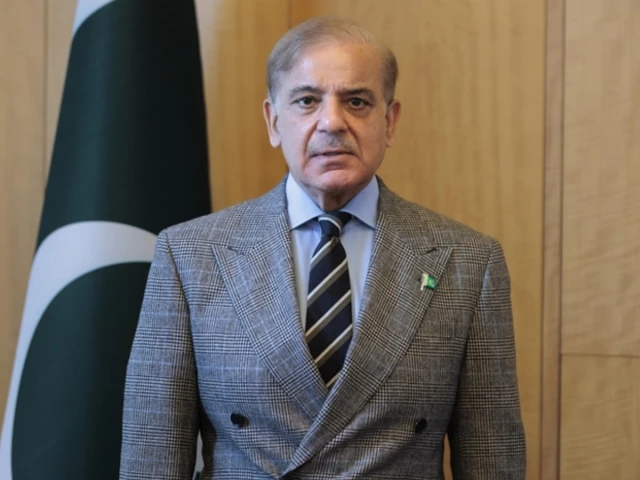
It orders that the price of petrol be reduced by Rs 74 and diesel by Rs 67. It is committed to passing on the benefits of lower costs to people.
Prime Minister Shehbaz Sharif. Photo: Archive
ISLAMABAD:
Prime Minister Shehbaz Sharif on Friday announced a sharp cut in oil prices, passing on the impact of falling global oil rates to consumers after Iran and the United States reached a peace deal that eased tensions in global energy markets.
As per the revised prices, the government reduced petrol by Rs 74.28 per liter and high speed diesel (HSD) by Rs 67.31 per litre. As a result, the price of petrol has been reduced from Rs 373.78 per liter to Rs 299.50 per litre, while HSD has dropped from Rs 378.78 to Rs 311.47 per litre.
The announcement comes as international crude oil prices fell to around $75 a barrel, returning close to pre-conflict levels following the diplomatic breakthrough. Oil contracts on Friday traded between a high of $81.00 and a low of $72.83 before closing at $75.22, down $7.22 or 8.73 percent from the previous week’s close.
HSD is widely used in the transportation and agriculture sectors, while gasoline is commonly used in motorcycles and automobiles. Officials said the reduction is expected to ease inflationary pressures in the economy, offering relief to consumers who have faced repeated fuel price increases in recent months.
In a statement, Prime Minister Shehbaz Sharif said that as the regional situation improves and global oil prices decline, the government has immediately conveyed the benefit of reduced oil costs to the public.
He said the federal government generated savings of Rs 129 billion through development budget adjustments and austerity measures, which were used to provide relief to citizens amid rising fuel prices.
“The promise we made to the nation, by the grace of Allah, is now being fulfilled,” the prime minister said, adding that the government fully understands the difficulties faced by the public and appreciates their patience and resilience during difficult times.
He said the government made continuous efforts since the beginning of the crisis to reduce fuel prices within the available fiscal space.
The prime minister further noted that some countries were forced to introduce fuel rationing during the regional economic crisis, while Pakistan avoided a power shortage through effective planning and management.
“As a result of our timely measures, there were no shortages, no long queues and the public did not face any disruption in the availability of petroleum products,” he said, appreciating the cooperation of provincial chief ministers in maintaining economic stability and supporting federal efforts.
He added that the government took all possible measures to protect citizens from global inflationary shocks. “We are now transferring the full benefit of lower international oil prices directly to consumers,” he said, reiterating that efforts would continue to maintain economic stability and further reduce inflation.
The prime minister also touched on the broader regional context, stating that “Almighty Allah has honored Pakistan” and that the Islamabad MoU was a historic event.
He paid special tribute to Field Marshal Syed Asim Munir and said his “tireless efforts and professional capabilities” played a vital role in facilitating the peace agreement that helped stabilize regional markets.


