
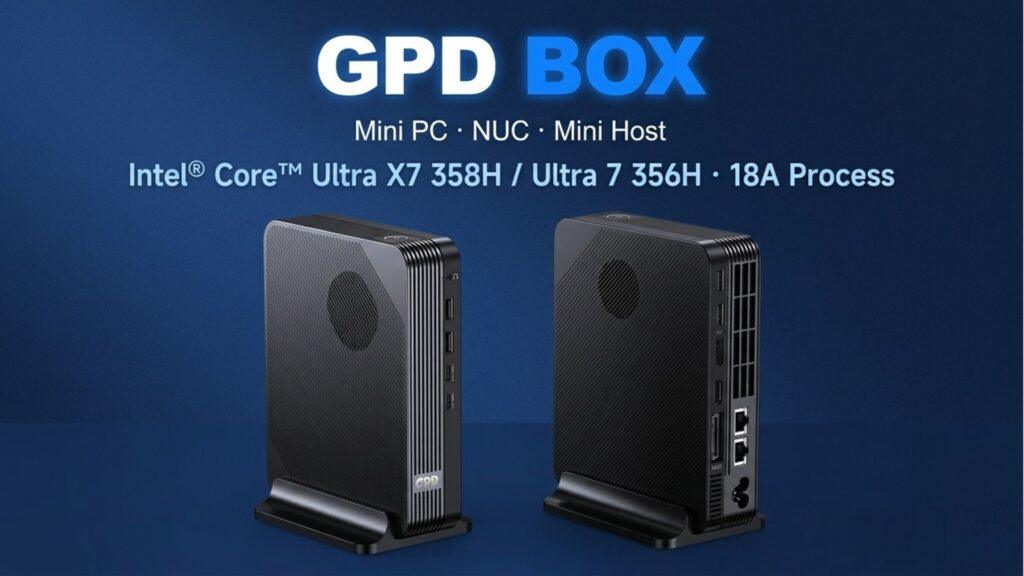
- GPD launches Panther Lake Mini PC with powerful integrated graphics
- Core Ultra X7 358H offers graphics performance close to RTX 3050M
- MCIO 8i connection provides high-bandwidth external GPU expansion support
GPD has introduced its new Panther Lake Mini PC with Intel Core Ultra processors, combining compact dimensions with desktop-centric connectivity options.
The base configuration uses the Core Ultra 7 356H processor, while the upgraded variant implements the Core Ultra X7 358H CPU with superior Arc B390 integrated graphics.
This graphics card delivers 2% of the mobile RTX 3050M in various gaming benchmarks with a thermal envelope of just 25 watts, making it remarkably efficient for a compact chassis.

MCIO port promises desktop-level expansion
GPD Box is distinguished by an MCIO 8i connection that provides 512 Gbps of bidirectional bandwidth through its interface.
GPD claims this “effectively matches a native PCIe 5.0 x8 cable connection,” which would theoretically eliminate bandwidth bottlenecks common to USB4 and Thunderbolt implementations.
The G2 eGPU add-on dock ships with an 800W ATX 3.1 power supply and two separate power cables for graphics cards, although buyers must still purchase their own GPU separately.
This docking station provides some flexibility to owners of existing graphics cards looking for external expansion.
The Core Ultra X7 358H version inexplicably lacks this MCIO port entirely, leaving its owners dependent solely on USB4 for any external GPU connectivity.
This decision effectively forces a compromise between the X7’s superior integrated graphics and the expansion potential of the base model’s MCIO connection.
The cheaper Ultra 7 356H configuration retains the MCIO port while offering a weaker iGPU, creating an awkward trade-off that performance-focused buyers won’t like.
Connectivity specs remain generous despite the baffling exclusion of GPIO
Despite measuring just 175 × 134 × 39.5 mm, the system packs a substantial range of connectivity options throughout its compact chassis.
The rear panel provides one DisplayPort 2.1 UHBR20 output and one HDMI 2.1 FRL port along with two 2.5GbE RJ45 sockets with link aggregation capability.
Two USB 3.2 Gen 2 Type A ports complement the front panel’s offering of two USB4 V2 Type C connections and another pair of USB 3.2 Gen 2 Type A plugs.
Wireless connectivity includes Wi-Fi 6E and Bluetooth 5.3, which should meet most modern networking and peripheral requirements without significant difficulties.
The X7 358H variant comes with 32GB of LPDDR5-8533 memory and a 1TB NVMe M.2 2280 SSD as standard equipment in both configurations.
The omission of dedicated GPIO pins seems particularly shortsighted, given the industrial applications in which this mini PC could find a natural home.
The absence of this interface restricts the device’s usefulness for embedded systems, automation tasks, and custom hardware integration projects that rely on such connections.
GPD appears to have created a product that excels in raw graphics performance in the 358H while alienating the professional audience that might have valued the expandability of the 356H.
GPD Box is available on Indiegogo and starts at HK$11,377 (~$1,452) for the base configuration with the Core Ultra 7 356H processor.
The standalone Core Ultra X7 358H model with the higher-performance Arc B390 integrated graphics solution costs HK$12,020 (~$1,534).
The Core Ultra 7 356H bundle with the base G2 eGPU costs HK$14,394 (~$1,837), including external graphics expansion hardware.
While the Core Ultra

Follow TechRadar on Google News and add us as a preferred source to receive news, reviews and opinions from our experts in your feeds.


