
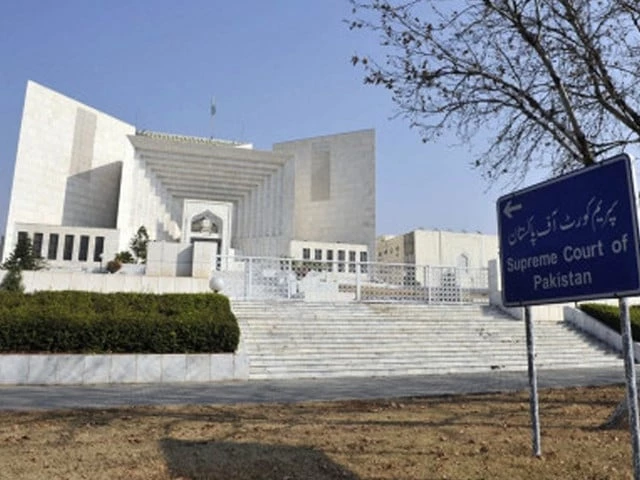
ISLAMABAD:
The Supreme Court set aside a judgment of the Khyber-Pakhtunkhwa Service Court and ordered authorities to reconsider the case of a reinstated school teacher for granting arrears of benefits under Fundamental Rule (FR) 54.
The court held that an employee honorably acquitted of criminal charges is entitled to full salary and service benefits during the period of absence, subject to legal determination by the competent authority.
The ruling was written by Justice Muhammad Ali Mazhar, with Chief Justice of Pakistan Yahya Afridi also on the bench, in a civil appeal arising from a 2019 decision of the Khyber Pakhtunkhwa Service Court, Swat Field Court.
The appellant, Mian Abdul Saeed, a secondary school teacher (BPS-17) posted at Gokand Government Secondary School, Buner District, was suspended on December 31, 2012 after he was implicated in an FIR under sections 302, 324, 147, 148 and 149 of the Pakistan Penal Code.
He was subsequently convicted by an additional district judge in Buner on December 19, 2013, leading to his dismissal from service on July 6, 2015. However, on appeal, the Peshawar High Court (PHC) acquitted him on December 11, 2017.
After his acquittal, he requested his reinstatement along with back benefits. The departmental authority reinstated him by order dated April 19, 2018, but denied him back benefits and treated the intervening period as unpaid leave.
His appeal to the Service Court was only partially accepted, maintaining the denial of arrears of benefits and treating the period of absence as due leave, which led him to approach the Supreme Court.
At the licensing stage, the high court examined whether a public official honorably acquitted of criminal charges is entitled to receive full benefits under FR 54.
During the proceedings, the appellant’s attorney argued that once a public official is acquitted, he is entitled to receive full salary and benefits as if he had never been separated from service.
It was held that the appellant’s dismissal was based solely on his conviction and that no departmental inquiry had been carried out. Therefore, the denial of arrears of benefits was illegal and contrary to the Fundamental Standards.
Additional Advocate General for KP argued that since the appellant did not perform his duties during the intervening period, he was not entitled to arrears of benefits and the period was rightly treated as unpaid leave.
He further submitted that under Section 17 of the Khyber Pakhtunkhwa Civil Servants Act, 1973, the competent authority had discretion to grant arrears. After examining the record, the Supreme Court noted that the appellant was initially suspended after his arrest and later removed from service after his conviction.


