
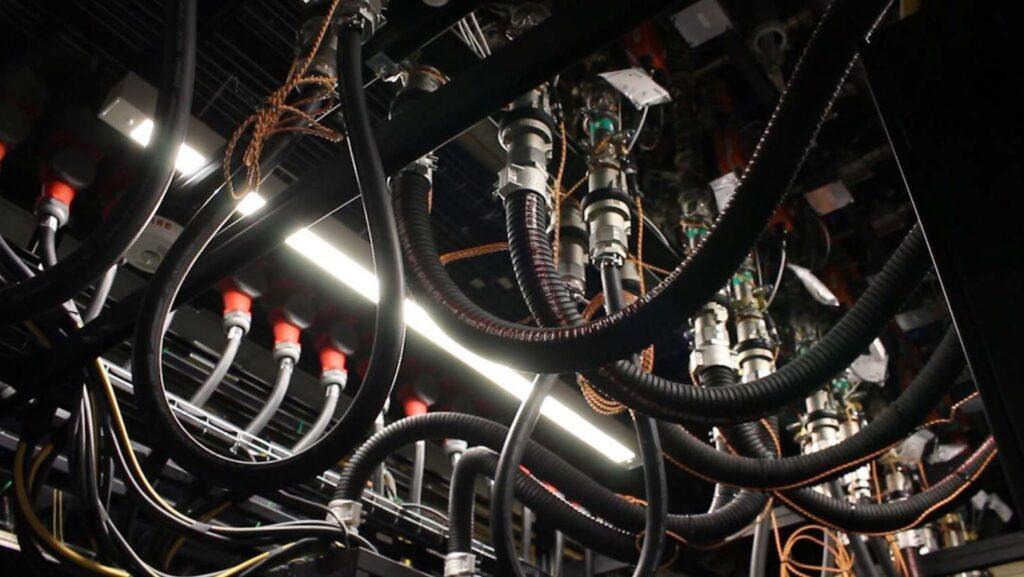
- Nvidia’s closed-loop liquid cooling system virtually eliminates water waste
- Direct-to-chip cooling transfers heat more effectively than air
- Enables higher performance per watt and higher rack densities
Data centers are not without their critics: Power-intensive computing raises temperatures, and giant campuses consume considerable amounts of air and/or water to keep them running optimally.
Land shortages and financial incentives have also pushed new development closer to high-risk areas, including drought-prone regions, ultimately leading to even greater cooling needs.
But Nvidia knows this and knows that traditional air cooling has practically reached its limits as AI hardware becomes increasingly dense.

Closed-loop cooling virtually eliminates water waste
With cooling now a central part of AI infrastructure design, Nvidia’s latest liquid-cooled AI systems promise higher thresholds for load reduction, reducing water and power consumption as a result.
By running the coolant at higher temperatures (45°C or 113°F, to be specific), it allowed for simpler cooling systems and reduced electricity consumption. Nvidia’s concept uses 75% water and 25% glycol as a coolant, and notes that it can run 5 to 7°C hotter than hot tubs.
Compared to traditional evaporative cooling towers, Nvidia’s latest proposal involves a closed-loop system where coolant continuously circulates through the servers to remove excess heat from the chips. The hot coolant is then circulated through external dry coolers leaving virtually no water evaporation.
The company boasted that cooling-related water consumption can be reduced by up to 100% in suitable climates subject to occasional extreme days, eliminating cooling towers entirely.
“The Nvidia DSX reference design for AI factories has zero water consumption – we have eliminated massive amounts of power usage and virtually all water usage,” said data center infrastructure and cooling director Ali Heydari.
The system’s efficiency comes primarily from direct-to-chip liquid cooling, where liquid flows directly through cold plates connected to the CPUs and GPUs. This captures and expels heat exactly where it is produced.
Not only is this more effective than cooling entire rooms, but the liquid also promises to transfer heat thousands of times more effectively than air.
Significant improvements in water consumption, energy efficiency and energy use effectiveness (PUE) help on the sustainability front, but the benefits go elsewhere.
Nvidia says it can increase rack density and performance
Nvidia recognized that chip power consumption and rack density continue to increase, so by deploying liquid-cooled data centers, companies can add more GPUs per rack, utilize greater rack power, and ultimately include larger AI clusters within the same building footprint.
The company explained that its Rubin systems now fit inside two racks, instead of six, which represents a significant space saving.
At the same time, air cooling has become ineffective. “Once watts per chip crossed a certain level, liquid cooling became mandatory,” said Motivair CEO Richard Whitmore.
Fully independent testing from Nvidia’s latest announcement shows that its H100 systems delivered around 17% better performance when water-cooled, compared to air-cooled. Under sustained AI workloads, GPU temperatures fluctuated between 41 and 50°C when water-cooled and between 54 and 72°C when air-cooled.
In addition to improving immediate and sustained performance, higher thermal efficiency could also increase longevity.
The new higher temperature closed loop water cooling model will be used in upcoming Rubin deployments this year.

Follow TechRadar on Google News and add us as a preferred source to receive news, reviews and opinions from our experts in your feeds.


