
Expresses hope that the agreement will contribute to lasting peace and stability in the region
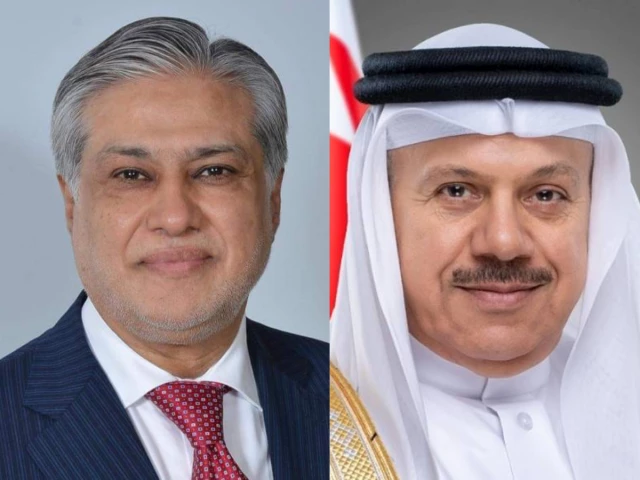
In the photo, on the left, Foreign Minister Ishaq Dar; On the right, Bahrain’s Foreign Minister Abdullatif bin Rashid Al Zayani. PHOTO: MOFA/ BAHRAIN FO
Bahrain’s Foreign Minister Dr Abdullatif bin Rashid Al Zayani on Sunday said he will visit Pakistan in the near future to personally thank the country’s leadership for their role in facilitating the “Islamabad Memorandum of Understanding (MoU)” and ceasefire, the Ministry of Foreign Affairs (FO) said.
According to the FO, Al Zayani conveyed the message during a telephone conversation with Deputy Prime Minister and Foreign Minister Senator Ishaq Dar.
Deputy Prime Minister/Minister of Foreign Affairs, Senator Mohammad Ishaq Dar @MIshaqDar50, today held a telephone conversation with the Minister of Foreign Affairs of the Kingdom of Bahrain, HE Dr. Abdullatif bin Rashid Al Zayani.
The two leaders discussed the latest developments in the regional situation… pic.twitter.com/f54nQELkIp
– Ministry of Foreign Affairs – Pakistan (@ForeignOfficePk) June 28, 2026
Bahrain’s Foreign Minister congratulated Dar on the signing of the Islamabad MoU and praised Pakistan’s role in facilitating understanding.
He “appreciated Pakistan’s constructive role in facilitating understanding” and expressed hope that the deal “will contribute to lasting peace and stability in the region,” the foreign ministry said.
Al Zayani also said he would visit Pakistan “in the near future to personally thank the Prime Minister, the DPM/FM and the CDF for their great efforts in achieving the ceasefire.”
The two foreign ministers also discussed the developments in the regional situation after the signing of the Islamabad MoU. Dar thanked his Bahraini counterpart “for his kind sentiments” and reaffirmed Pakistan’s commitment to diplomacy.
He reiterated Pakistan’s determination “to promote dialogue and diplomacy to achieve peace and stability in the region and beyond,” according to the Ministry of Foreign Affairs.
The call comes a week after the first round of four-party talks between Iran and the United States, mediated by Qatar and Pakistan, concluded in Switzerland, marking the first formal follow-up commitment since the agreement was signed earlier this week.
On June 18, Prime Minister Shehbaz signed the “Islamabad Memorandum of Understanding” as a mediator, formalizing the important diplomatic breakthrough between the United States and Iran. Israel, excluded from the peace talks, has distanced itself from the US-Iran deal and has continued fighting Hezbollah in Lebanon, also raising questions about whether the deal will hold.
The United States and Israel launched war against Iran on February 28, assassinating Supreme Leader Ayatollah Ali Khamenei and military leaders on the first day. It quickly became a regional conflict that has killed more than 7,000 people, mainly in Iran and Lebanon; rising energy prices; They renewed inflationary pressures and raised concerns about a major food supply crisis in developing countries.


