
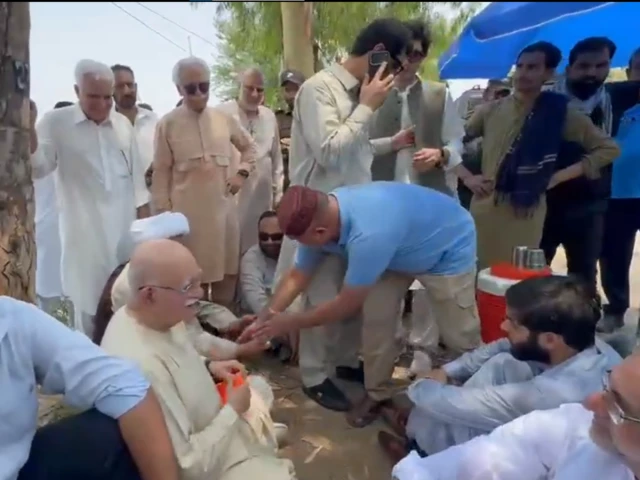
The spokesperson says the police told the delegation that the seniors had ordered them not to allow entry into AJK.
Police prevented a high-level delegation of Tehreek Tahaffuz-e-Ayeen Pakistan (TTAP), led by National Assembly Opposition Leader Mahmood Khan Achakzai, from traveling to Azad Jammu and Kashmir. SCREEN CAPTURE
ISLAMABAD:
A high-level delegation of Tehreek Tahaffuz-e-Ayeen Pakistan (TTAP), led by National Assembly opposition leader Mahmood Khan Achakzai, was prevented by police from traveling to Azad Jammu and Kashmir (AJK) on Monday after announcing plans to join an ongoing sit-in in Rawalakot, the alliance’s spokesperson said.
Earlier today, TTAP announced that its delegation would travel to Rawalakot to express solidarity with the banned Joint Awami Action Committee (JAAC) sit-in and support what it described as public demands in line with the principles of democratic freedoms, constitutional supremacy and public rights.
تحریک تحفظ آئین پاکستان کا وفد عوامی ایکشن کمیٹی کے دھرنے سے اظہارِ یکجہتی کے لیے راولاکوٹ روانہ
اسلام آباد، 29 years: وفد، قائد حزب اختلاف قومی اسمبلی محمود خان اچکزئی کی سربراہی میں آزاد کشمیر کے شہر راولاکوٹ کے لیے روانہ ہو گیا ہے، جہاں… pic.twitter.com/PUX0jC8TM6
– Tehreek-e-Tahafuz-e-Ayin-e-Pakistan (@TTAP_OFFICIAL) June 29, 2026
The delegation included Senate Opposition Leader Allama Raja Nasir Abbas, former Prime Minister Shahid Khaqan Abbasi, Senator Mustafa Nawaz Khokhar, TTAP Spokesperson Hussain Ahmad Yousafzai and Khalid Yousaf Chaudhry, lawyer of Pakistan Tehreek-e-Insaf founder Imran Khan.
According to the spokesperson, the delegation intended to meet with JAAC leaders and address participants in the sit-in, reaffirming their commitment to the Constitution, democracy and the protection of public rights.
Read: Khawaja Asif doubles down, says he ‘stands by’ AJK’s controversial comments despite avalanche of criticism
However, in a later statement, TTAP said police detained the delegation in Kahuta before it could enter AJK.
تحریک تحفظ آئین پاکستان کے وفد کو آزاد کشمیر میں دھرنے سے اظہارِ یکجہتی کے لیے جانے سے روک دیا گیا
راولپناد جاتے کہوٹہ کے مقام دیا۔ وفد کے اراکین نے… pic.twitter.com/dcsoHyQzqv
– Tehreek-e-Tahafuz-e-Ayin-e-Pakistan (@TTAP_OFFICIAL) June 29, 2026
The party spokesman said members of the delegation asked the police under what legal authority they were prevented from proceeding. According to the spokesperson, the police officers responded that their “senior officers” had ordered them not to allow the delegation to continue.
TTAP said peaceful political activity and the right to express solidarity cannot be restricted through the use of force. He further alleged that preventing the delegation from proceeding without a legal order or written directive amounted to violation of fundamental rights.
The delegation maintained that it had been traveling peacefully to express solidarity with the people of AJK and said that preventing its progress was tantamount to restricting political freedoms, according to the spokesperson.
Background
Recent riots and deadly clashes broke out in areas including Rawalakot where the JAAC had been staging a sit-in in front of the Rawalakot Combined Military Hospital. AJK Police allege that armed JAAC members opened fire on law enforcement forces deployed in a planned attack, leaving four personnel dead and around 20 injured. JAAC, however, disputes this version, stating that security forces used tear gas and fired projectiles towards the hospital.
According to the AJK police, three people linked to the JAAC and four law enforcement officers died during the protests. JAAC, however, said in a statement on
The clash occurred when the AJK government and the JAAC witnessed a clash as the AJK election date was announced as July 27.
Read more: Certain elements seek to create instability in AJK despite repeated offers of dialogue: Rana Sanaullah
AJK’s 53-member legislative assembly includes 12 seats reserved for Kashmiri refugees, people who fled Indian-controlled Kashmir in 1947 and 1965 and are now scattered across Pakistan. Six seats represent refugees from the Jammu division (~434,000 people) and six from the Kashmir Valley (~30,000 people), an already imbalanced arrangement that many consider unfair.
The region witnessed one of its most turbulent periods in October last year, when protests led by the JAAC broke out over demands for constitutional and governance reforms. At least nine people, including three police officers, died during the riots.
The JAAC, which organized the protests and strike, had put forward a wide-ranging charter of demands, including an end to the privileges enjoyed by the ruling elite, the abolition of 12 assembly seats reserved for refugees, and the elimination of the quota system.
Two days after the violence, the government and the JAAC reached an agreement covering 12 basic and 13 additional points. Under the agreement, both sides agreed to constitute a high-level committee to examine the issue of refugee seats in the AJK Legislative Assembly.


