
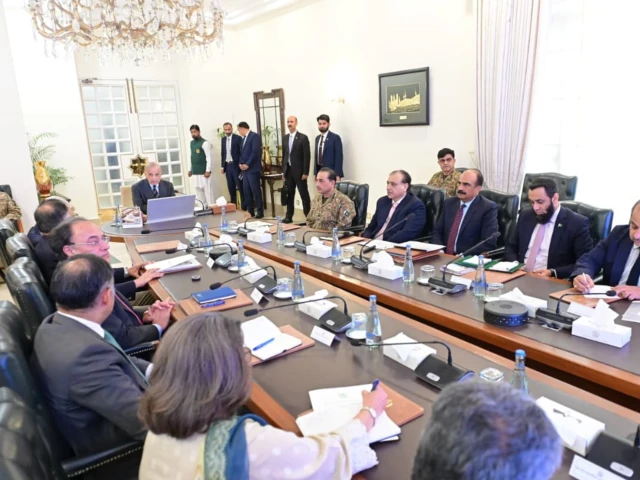
Prime Minister Shehbaz Sharif chairs a meeting on people’s welfare in Islamabad on Tuesday. Photo: X/ PMO
Prime Minister Shehbaz Sharif on Tuesday emphasized that maintaining a balance between population growth and available resources was essential for sustainable development, saying rapid population growth was putting increasing pressure on national resources and posing a major challenge to the country’s progress.
Chairing a high-level meeting on population welfare, the prime minister said population planning should be aligned with national development, economic stability and human resource enhancement, according to a press release from the Media Office (PMO) of the Prime Minister’s Office.
He directed the authorities to convene the inaugural meeting of the National Population Council as soon as possible and directed that its organizational structure be finalized without delay to facilitate the formulation of effective policies on population-related issues.
The meeting was attended by Chief of Defense Forces and Chief of Army Staff Field Marshal Syed Asim Munir, Defense Minister Khawaja Muhammad Asif, Planning Minister Ahsan Iqbal, Finance Minister Muhammad Aurangzeb, Information Minister Attaullah Tarar, Minister of State for Finance and Railways Bilal Azhar Kayani and senior government officials.
The prime minister announced that he would personally chair the National Population Council, which would comprise the chief ministers of the four provinces, the chief minister of Azad Jammu and Kashmir, the chief minister of Gilgit-Baltistan and other key stakeholders.
During the meeting, participants were informed about the country’s demographic increase and the measures aimed at the control and well-being of the population.
Members of the report highlighted plans to link social protection programs with family planning initiatives, while emphasizing that women’s education and economic empowerment would form a key pillar of the national population strategy.
Participants in the meeting were also informed that a nationwide public awareness campaign would be launched to promote balanced population growth and family planning.
Participants were also informed that successful population management programs were currently being implemented in Bangladesh, Indonesia and Iran.
According to the PMO, the National Population Council, in collaboration with provincial governments, would help implement an effective national population welfare campaign.
Read also: Ahsan calls population growth unsustainable
It was further reported that the Secretariat of the Council would be established in the Ministry of Planning.
Pakistan’s population, which was 31 million at independence in 1947, rose to 241 million, according to the 2023 census. However, last year, new figures released by the United States Census Bureau estimated that the population had surpassed 257 million, further cementing Pakistan’s status among the world’s most populous nations despite a decline in the fertility rate.
According to the United Nations World Fertility Report 2024Pakistan’s fertility rate has fallen from six live births per woman in 1994 to 3.6 in 2024. Despite the decline, the country is projected to become the world’s third most populous nation by 2050, surpassing the United States, Indonesia, Brazil and Russia, and its population is expected to exceed 380 million.
The projections are supported by the official. Population projections 2023-2050 report, prepared in collaboration with the United Nations Population Fund (UNFPA), which estimates that Pakistan’s population will grow by 59 percent to more than 383 million by 2050.
On Monday, Planning Minister Ahsan Iqbal also warned that uncontrolled population growth was Pakistan’s most critical structural challenge and called for urgent reforms at the national level to address the problem.
“No country in history has made sustained progress with such a high population growth rate,” he said, adding that successful nations had reduced their growth rates to around 1 to 1.5 percent or less. He said rapid population growth diluted the economic benefits.
“If the economy grows at three percent while the population increases by 2.5 percent, real progress is only half a percent,” he said, describing it as a major impediment to national prosperity.


