
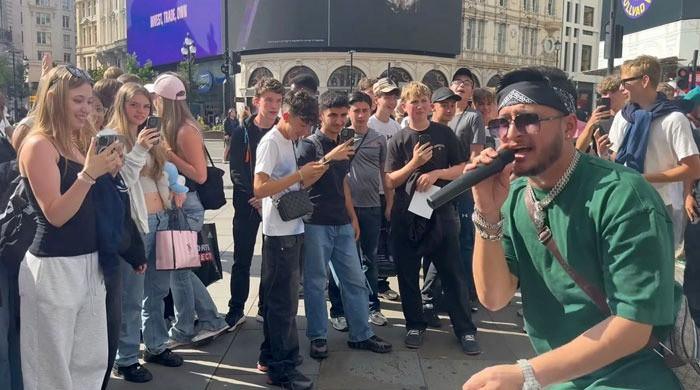
LONDON: Pakistani freestyle rapper Ghani Tiger is making his presence felt in London as he continues to connect with his fans through his energetic Punjabi and Urdu rap songs and poetry.
After moving to London from Pakistan about a year ago, Tiger rose to fame thanks to his freestyle rap, often focusing on relevant social and political issues.
In recent months, his tribute rap to Pakistan’s armed forces has gone viral on social media due to its catchy lyrics and patriotic theme.
Tiger, whose real name is Hamza Ghani, has opened concerts for rap star Bohemia, Abrar-ul-Haq and Bilal Saeed at venues across London, drawing loud applause from fans.
He has also performed at private events, street corners and various London landmarks including Trafalgar Square and Piccadilly Circus.
Many in the industry consider Tiger to be a gifted talent.
You can create and perform a new rap song in seconds, developing lyrics, rhythm, and delivery almost instantly. Bohemia, Abrar-ul-Haq and Zeeshan Rokhri have described him as a genius for his ability to create instant rap poetry.
In 2020, his father was murdered and his brother was shot in Pasrur, Punjab. Tiger posted an emotional video calling for justice and the case attracted widespread attention online.
According to Tiger, some of those involved in his father’s murder are still at large. He later turned his personal tragedy into emotional songs of loss, hope and survival.
In an interview, he said, “My father’s murder was the darkest phase of my life. I was young when he was killed. I created hope out of despair and decided to live through positivity and hope. I worked hard to take care of my family and made sure to provide education to the needy around me.”
He made a name for himself through the underground rap circuit in Pakistan, live events and online streaming platforms.
He is now known for his sharp delivery, street-inspired lyrics and huge social media following, establishing himself as one of Pakistan’s rising freestyle rap voices.
He said: “Through my real-life story I learned how to turn everyday emotions, struggles and ambitions into hard-hitting rap performances. I have been reaching a wider British-Asian audience since moving to London. There is a growing influence of South Asian rap in the UK, where artists mix Punjabi, Urdu and English sounds to create music that speaks directly to diaspora communities. I love this.”
Tiger said artists in the freestyle rap genre appeal to audiences through their raw and unfiltered style.
He said: “Rap artists are generally not refined products of the industry. Instead, their music conveys the feeling of a real-life experience, online hustle and grassroots popularity. It is very different from traditional, smooth and poetic music. It is a different experience. A large number of the new generation identify with this style of music.”
Tiger said that gaining recognition through freestyle rap is not easy.
He said: “I personally haven’t sought traditional routes to fame. I believe in building my own stage, finding my own audiences and bringing my sound directly to the people. Social media has been a huge help.”
For Tiger, London has become a new platform to showcase his freestyle talent, reach a wider audience and strengthen his connection with fans across the British-Pakistani community.


