
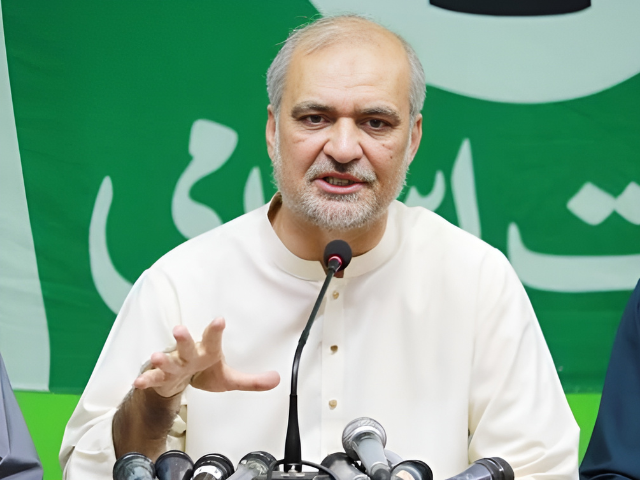
Jamaat-e-Islami (JI) Emir Hafiz Naeem-ur-Rehman. photo file
Jamaat-e-Islami (JI) Emir Hafiz Naeemur Rehman on Tuesday announced nationwide protests on July 10 against oil tax, rising fuel prices, inflation and what he called the government’s ineffective economic policies.
At a press conference in Lahore, Rehman said the protests would continue until the government provided significant relief to the public. JI Deputy Emir Liaqat Baloch, JI Central Punjab Emir Muhammad Javed Kasuri and Lahore Emir Ziauddin Ansari flanked Rehman during the press conference.
The JI chief rebuked the government’s overall handling of the power sector, saying that although the official price of liquefied petroleum gas (LPG) was fixed at Rs 241 per kilogram, it was sold in the market at around Rs 500/kg. He added that the prolonged reduction in gas load and high LPG prices put an additional burden on consumers.
“Affordable gas is vital for economic growth,” he stressed.
Referring to the recent reduction in oil prices by the government, the JI leader termed the relief of Rs 1.97 per liter “inadequate”.
He also described the Rs 118 per liter in compound taxes and levies on gasoline collected by the authorities as “extortion” and claimed that the government collected around Rs 8.5 trillion, which was used to meet tax collection targets instead of improving power supply infrastructure.
Rehman urged the public to oppose what he described as an unfair system, stating that the retail price of petrol should not exceed Rs 225 per litre. He made a special appeal to young people to participate in Friday’s protests across the country.
The JI chief also questioned the collection of climate support tax on petroleum products and asked where, according to him, approximately Rs 60 billion collected under the tax had been spent.
He highlighted that the oil tax disproportionately affected low-income and middle-class citizens, including workers, students and motorcycle users, while influential landowners continued to evade taxes. He demanded immediate abolition of the tax and reiterated that petrol prices should not exceed Rs 225 per litre.
The JI chief further claimed that the government lacked a clear economic strategy and had not used the country’s natural resources “effectively”, while citing suboptimal use of oil and mineral reserves as an example.
Criticizing the delay in the Pakistan-Iran gas pipeline project, he urged the government to restore trade with the neighboring country to help meet Pakistan’s energy demands and asserted that Iran had already completed its part of the work.
Commenting on the Federal Board of Revenue (FBR), Rehman alleged that the department was plagued with corruption worth trillions of rupees, and this burden of inefficiency was being passed on to the public.
Food and agriculture
While talking about other issues of daily inconvenience, the JI leader said that the price of naan was also inconsistent in different parts of the city. He added that wheat was bought from farmers at Rs 3,500 per maund, while flour was sold at around Rs 5,600 per maund. The high cost of naan paid by consumers did not benefit farmers at all.
Sugar mills owned by politically influential groups had withheld Rs 1,500 crore from sugarcane farmers, Rehman further alleged.
He also rejected the government’s decision to export sugar, arguing that this would lead to an increase in sugar prices.
“Cotton cultivation in Pakistan has also declined to historic lows,” he lamented.
Rehman squarely blamed the government for the deterioration of the agricultural sector, insisting that billions of rupees were being spent on advertising campaigns instead of addressing public issues.
Education, transportation and well-being projects.
On education, the JI emir denounced the Punjab government’s decision to outsource 11,000 government schools. He said providing free and quality education was the constitutional responsibility of the government and argued that education should be treated as Pakistan’s top national priority.
“More than 10 million children in Punjab do not go to school and universities do not receive adequate subsidies,” he stressed during the press conference.
The JI leader also asked the government to build an underground railway system in Lahore to improve urban transportation.
Commenting on the government’s social welfare policies, he said the Benazir Income Support Program had become “a source of corruption”. He questioned why the government decided to spend hundreds of billions of rupees on welfare programs and not on information technology and vocational training infrastructure to enable youth get sustainable employment.
Political landscape
Deliberating on the political situation in Azad Jammu and Kashmir, he highlighted the need for dialogue.
“Several prime ministers have left office since the elections, causing political instability,” he explained.
Discussing local government politics in Karachi, he alleged that JI’s electoral mandate for mayoralty was ignored, adding that repeated replacement of elected representatives led to public unrest.
Recalling last year’s war with India, Rehman said, “Pakistan earned international honors while India suffered shame.”
The JI Emir urged the government to strongly raise the issue of Indus River rights before the international community.
Concluding the press conference, the JI chief called on citizens to participate in nationwide protests on Friday to force the government to take relief measures.


