
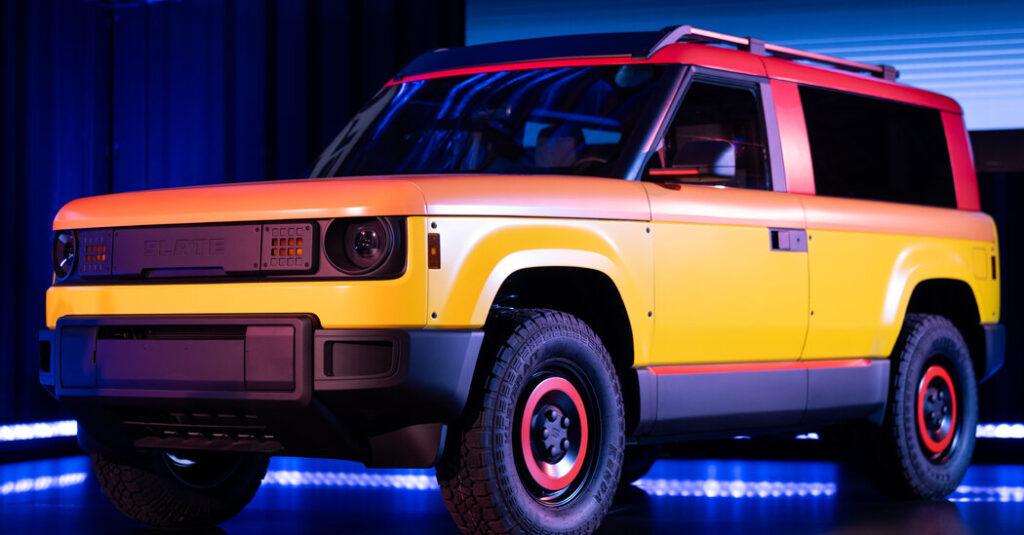
The electric van is tiny and spartan: the windows open manually and it comes in only one color, gray. Many questions remain about the entire project, but Slate Auto is betting it has a big part of the answer: affordability.
The basic truck that has drawn attention online and offline will cost approximately $25,000 (not including an undisclosed destination charge) and will be sold directly to customers.
Among those burning questions: Can Slate reach its goal of 150,000 sales a year? And can it survive in an environment where better-funded electric car companies like Rivian and Lucid have yet to hit their volume targets or turn a profit, despite rave reviews and enviable owner satisfaction?
With the average price of new trucks topping $64,000, Slate Auto last year told the automotive world of its bold plan: It was building an electric pickup truck with a target price of $20,000 after a $7,500 federal tax credit, one of the least expensive vehicles of any type.
But a lot can change in a year. Tariffs have come and gone at breakneck speeds, affecting battery and materials prices, while federal tax credits for electric vehicles disappeared at President Trump’s insistence.
Last month, at its new design studio in Carson, California, Slate offered testing and announced its new price, $24,950, suggesting a decision to swallow a few thousand dollars of lost federal subsidy. The company says it has received 180,000 reservations, along with 10,000 confirmed orders with a $300 non-refundable deposit. All sales are made online.
A network of 3,000 repair shops will handle maintenance, 200 of them equipped for heavy electrical repairs, the company says. Deliveries are scheduled to begin in the fourth quarter. The truck will be built on an abandoned site Slate acquired in Warsaw, Indiana, inside a converted factory that once printed JC Penney catalogs.
Slate claims a range of 205 miles (up from its original projection of 150), enough for daily jobs and easier commutes, but a little limited for road trips.
Short test drives for automotive journalists offered limited opportunities to evaluate the truck, but revealed strong acceleration (zero to 60 in eight seconds) and a surprisingly smooth, noise-free experience. A sophisticated suspension system known as De Dion replaces cheaper leaf springs at the rear of the truck, chosen to increase space for batteries and improve handling without compromising transport space. Taking the engineer who drove us at his word, the all-electric power steering has been optimized for road feel and quick response.
There are many complementary options. A $5,000 kit can turn Slate’s truck into a sport-utility vehicle, with a rear seat, a roll bar with built-in airbags, and a long roof. Slate envisions owners alternating between a pickup truck and a four- or five-seat SUV, as the transformation can be accomplished with hand tools and no special skills.
Among those 200 options, pre-cut vinyl wrap kits in any of 100 colors cost $500, with a similar sum anticipated for installation. With no plans to overhaul the model outwardly, the company says it hopes people will keep their trucks for decades and add options as they go.
To bolster the confidence of buyers of the new company’s first product, Slate offers a four-year, 50,000-mile bumper-to-bumper warranty, with a longer warranty on the battery and powertrain.
The promised payload of 1,550 pounds is close to the 1,850 pounds that the much larger Ford F-150 can carry in its base version. The 2000 pound towing capacity will be best suited for homeowners and professional gardeners; those towing large boats, for example, will have to look elsewhere.
The interior is just as spartan, with no central infotainment panel, no screens or carpets. Owners are expected to use their phones as a guide: a dash mount is standard equipment, as is, thankfully, air conditioning.
The seats seemed comfortable during our brief drives, while the door panels and other plastic trim, said to be pre-production items, actually looked like pre-production plastic, although time will tell if the final plastic pieces are even close to premium quality. Slate claims to have kept the price low by reducing the number of parts in the vehicle (800 versus 1,800 in a typical truck) and avoiding the billion-dollar cost of equipping the factory with a paint shop.
Some competition is coming, including an electric Ford pickup truck that is expected to start at around $30,000, after the automaker shelved its electric F-150.
Despite the challenges of an emerging automaker, there are reasons to think Slate has a chance. The executive team has extensive experience in automotive manufacturing and design, as well as online retail. CEO Peter Faricy is a former head of Amazon Marketplace. Chris Barman, the president, spent 15 years in various Chrysler reorganizations, eventually serving as vice president of electrical engineering. Other executives have resumes that include Chrysler, Volvo, Harley-Davidson, Rivian, Ford, Toyota and Tesla.
While Jeff Bezos’ personal involvement in Slate is said to be minimal, his investment put the company on the automotive world’s radar. And Amazon’s DNA is well represented. Jeff Wilke, one of Slate’s founders, spent 20 years building Amazon Prime, and William Barker, another founder, was an early Amazon investor as a teenager.
With Miles Arnone, an engineer and investor, Wilke and his company founded Re:Build Manufacturing, Slate’s parent company, arguing that American manufacturing was dying and that offshoring and other strategies favored by private equity firms were hollowing out American competitiveness along with American communities.
Slate is intended to be an antidote to that approach. At the opening ceremony in California, Wilke noted that 4,000 employees had lost their jobs with the closure of the Warsaw catalog factory.
“There were people who had spent their entire careers at the plant and they became very emotional, recounting their experience through tears and, now, with joy at the fact that this place was going to continue,” he said. The company plans to rehire 2,100 of them, he added.
Beyond its small electric truck (a market opening that, at least for the moment, remains ripe for acquisition), the investment philosophy behind Slate is designed for the long term, not a quick public offering.
“When we raised the original capital for Re:Build,” Wilke said, “I simply called people who I knew were patriotic Americans who were friends who could write big checks.” Referring to Mr. Barker, he added: “Will was the first person I called to invest in Re:Build, and we did the same with Slate.”
The company has raised more than $1.4 billion privately to date.
“You have to really believe in a 10-year journey,” Barker said. “We’ve been very lucky and focused on making sure everyone we bring into the company is long-term oriented. Long-term greed means a trail of value for the ecosystem. Short-term greed is typically trading paper. Win-win versus lose-win.”


