
Economists and CEOs are divided over whether artificial intelligence is making American workers even more productive.
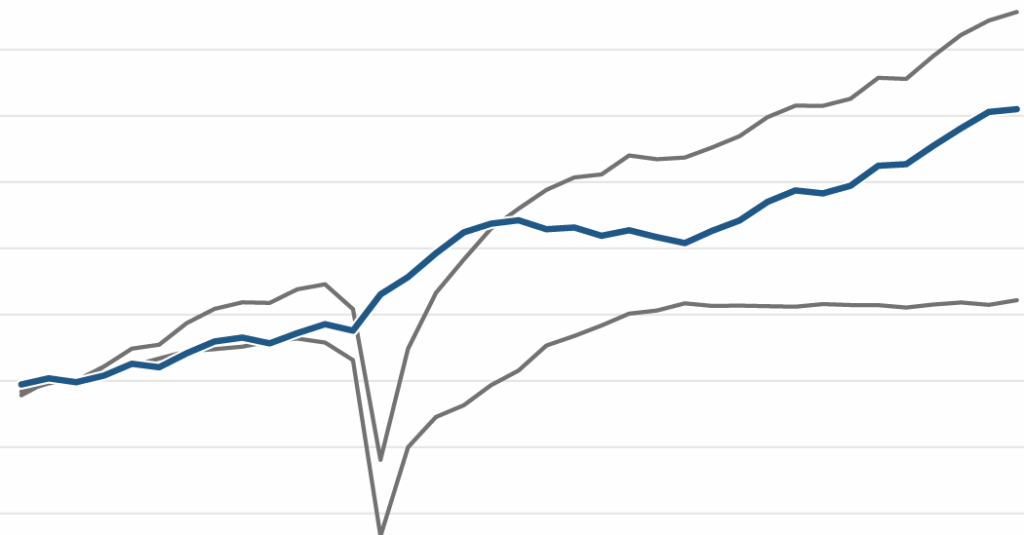
However, if we zoom out, the data hides a quieter trend. For years, “labor productivity” – an economic measure of how much each worker produces – has been increasing at its fastest pace in at least two decades. Artificial intelligence is simply a new ingredient in the set of forces driving the trend, not the central one, at least for now. Tight labor markets, digitalization and remote work are among other parts of the mix.
“I never thought I’d see so many years of really high productivity, and I certainly would expect that to continue,” Jerome H. Powell told reporters in March, before stepping down as chairman of the Federal Reserve. “And we haven’t really started to see the effects of generative AI”
A potential mutual benefit
At best, productivity increases are a sign that workers are using new tools or updated methods to work more efficiently; smarter, not just harder. This can be beneficial for workers, customers, and business owners: if companies can produce more in the same or fewer work hours, then they can presumably increase revenue, reinvest in operations, and pay workers more, all without sacrificing profitability or relying on price increases to increase profits.
Henry McVey, chief investment officer at KKR, a private equity firm, said he was seeing exactly that across his portfolio: in healthcare, technology and retail. Restaurant chains are using cloud computing to better manage inventory. Remote work has helped companies recruit from a larger talent pool. Medical records have gone digital.
“I think productivity gains have started to emerge from Covid with the digitalization of work, remote work and the implementation of machine learning, and we’re just scratching the surface of AI,” McVey said.
Another factor contributing to the more positive productivity numbers has been low unemployment, which has remained at 4.5 percent or less since October 2021, the longest streak since the 1960s. When almost everyone who wants a job has one, employers have to pay more to attract workers, pushing them to look for efficiencies elsewhere.
That can be self-reinforcing, said Chirag Lala of the Center for Public Enterprise, a nonprofit focused on economic development, especially if artificial intelligence begins to bear fruit. “Once we start a trend with consumption, income or productivity, it’s like inertia,” he said. Breaking it requires serious shock.
Personnel adjustments
McVey pointed to another, more solemn reason why productivity has increased: job cuts. There have been major layoffs in finance and technology, two industries that generate a huge proportion of corporate profits. Tech employment has declined for 18 consecutive months. Finance has lost more than 100,000 jobs since a peak in May 2025.
A Federal Reserve survey of companies this spring noted that many companies said AI-powered efficiencies had allowed them to delay or skip hiring altogether. A separate index of corporate earnings calls, compiled by Bloomberg, reported lower appetite for hiring across nearly all industries.
In the Permian Basin in West Texas, the heart of the world-leading U.S. oil industry, companies are running more efficiently than ever, said Steve Pruett, CEO of Elevation Resources. He credits industry consolidation, along with better drilling technology.
“We used to drill only two miles down and one mile out,” Pruett said. “As the technology improved and we did better, we still drill two miles deep, but now we drill two miles further out, the well produces more, there are better return rates on those ‘longer laterals’ and better productivity per rig.”
When Elevation was founded in 2013, the oil and gas industry employed about 200,000 people. By this summer, that figure had fallen to about 115,000, even as profits and output per worker rose.
Job loss is clearly bad news for affected workers as companies become more efficient. But economists generally consider “doing more with less” to be an advantage for the economy as a whole.
For the “professional and business services” sector, tracked by the Department of Labor, productivity growth has been at or above 3 percent annually since 2021. Employment in the sector has fallen since 2023, leading to a large number of discouraged job seekers, even as the health care, social assistance and education sectors have helped offset overall employment growth.
The economy’s continued better-than-expected growth, despite muted immigration and waves of baby boomer retirements, is also a sign of rising productivity among “prime-age” workers ages 25 to 54.
Reasons to be cautious
Not everyone is convinced that recent productivity data is optimistic. Productivity numbers are notoriously noisy in the short term, skeptics point out. And to the extent that technology evangelists have attributed existing advances to artificial intelligence, some experts remain unconvinced. The Yale Budget Lab’s AI Labor Market Tracker, for example, has found no clear link between AI adoption and changes in employment.
“There are several possibilities here, and the productivity data in particular is really difficult to interpret,” said Martha Gimbel, executive director of the Yale Budget Lab.
Productivity is, simply, production divided by hours of work. But economists also measure it in “real” terms, meaning that the “output” side of the equation is adjusted for inflation. Volatile spikes in inflation can therefore drag down overall productivity numbers, even when workers are no less efficient than before.
Last year’s tariffs and this year’s oil price shock from the war with Iran fueled inflation, which can make productivity look weaker in the short term than it really is. Still, oil prices have fallen from wartime highs. If that holds, productivity data could look better later this year.
Who shares the fruits?
Whether corporate efficiency gains will be shared with households is an open question. For years, wages have lagged behind productivity growth, decreasing workers’ share of national income.
“If real pay lags productivity growth, the labor share falls,” said Jared Bernstein, who served as chairman of former President Joseph R. Biden Jr.’s Council of Economic Advisers. Over the past decade, productivity growth has doubled real pay growth, according to Bernstein’s analysis.
An axiom in economics is that, initially, productivity appears “everywhere except in productivity statistics,” as Nobel laureate Robert Solow said. After all, it wasn’t until the 2000s that the productive effects of the Internet and personal computing boom of the 1990s became evident.
Mike Skordes, head of U.S. Economics at Truist, a bank based in Charlotte, North Carolina, said it was already producing more research than before, as a result of improved tools for data analysis and modeling.
Just a few years ago, he said, “I would have hired three lower-level junior economists to do some of the graphs and things that I can now do with the push of a button.”


