
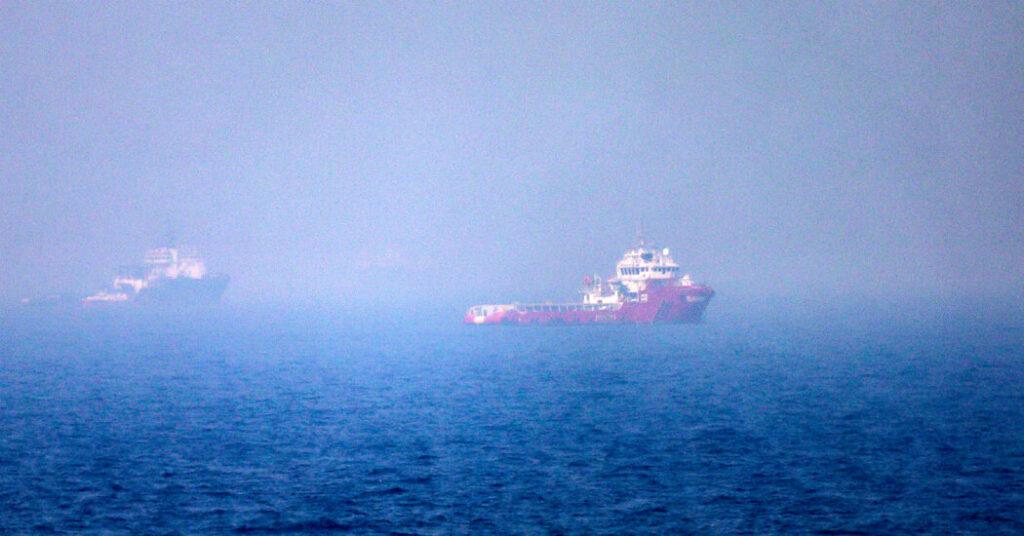
President Trump’s first naval blockade of Iranian ports in April caused oil prices to rise, but not to the stratospheric levels some feared. And Tehran’s oil exports plummeted, depriving it of billions in revenue.
The strategy may be more difficult to carry out a second time without inflicting wider collateral damage on the markets.
U.S. oil reserves, which have been steadily drawn since the start of the war to help combat global shortages, are now at their lowest levels since 1983. Commercial inventories have also been depleted. And other oil-producing countries in the region may have a harder time getting their ships out because of the increased risks.
Another wild card is China. China, typically the world’s largest oil importer, has been helping to keep oil prices in check by significantly reducing crude oil imports. New data on Tuesday showed that pattern held at least through June. But China may not continue down that path.
“We have already exhausted all the shock absorbers that helped moderate the prices of oil and natural gas and, to some extent, fertilizers and helium during the first three or four months of the war,” said David L. Goldwyn, a former U.S. diplomat and Energy Department official.
A month after signing a truce, Iran and the United States have returned to open war. Conditions around the Strait of Hormuz, a vital waterway for oil and gas shipments, have deteriorated significantly after days of back-and-forth strikes.
As Iran attacks more ships, Trump announced Monday that the United States would reestablish its blockade of Iranian ports. It also said it would charge a 20 percent tariff on cargo transiting the strait, although a day later it said it would “replace” tariffs for “several” Persian Gulf states investing in the United States.
Its change of course left key issues unresolved and could create more uncertainty for shippers. Oil prices soared in response. Brent crude, the international benchmark, was trading near $87 a barrel on Wednesday, its highest level in about a month.
“Even without a return to full combat, it could be difficult to keep prices under control,” Clearview Energy Partners, a Washington research firm, warned in a note to clients.
Before the war, about a fifth of the world’s oil passed through the Strait of Hormuz, making any threat to shipping a major concern for energy markets. But increasingly, analysts said, countries and companies are adapting to a new normal in which getting energy out of the Persian Gulf is complicated and, at least for a time, expensive. Countries such as Saudi Arabia, the United Arab Emirates and Kuwait are increasingly looking for ways to bypass the strait by expanding pipelines or developing expensive new ones.
“There will be a geopolitical risk premium on oil and gas prices going forward,” said Jorge León, senior vice president at Rystad Energy, a consulting firm.
After the war began on February 28, with joint attacks by the United States and Israel, Iran effectively closed the Strait of Hormuz to ships from most countries. World oil prices rose, of course, to around $100 a barrel within a week of the conflict.
Then, on April 13, the United States imposed its first blockade, causing oil prices to soar above $120 per barrel by the end of the month, the highest level since the conflict began.
But slowly prices sank again. When the United States and Iran signed the brief memorandum of understanding that ended hostilities in mid-June, oil was trading around $80 a barrel. Over time, prices fell further as increasing numbers of ships sailed through the strait.
For Iran, the effect of the blockade was disastrous. Oil exports through the Strait of Hormuz accounted for about 80 percent of total Iranian exports. The United States drowned more than 1.5 million barrels per day, which is equivalent to billions of dollars. Squeezing Tehran’s most important source of revenue put pressure on Iran to accept the ceasefire, analysts said.
And yet, Iran also gained some advantages during that time. As part of the deal, Trump granted a temporary waiver to sanctions allowing the sale of Iranian oil and an agreement to lift the blockade. Those measures gave Iran “valuable breathing room,” said Robin Brooks, a senior fellow at the Brookings Institution, a Washington-based think tank.
Iran exported between 45 million and 50 million barrels of crude oil after Trump lifted the first blockade, according to data provided by Rystad. That translates into billions of dollars going to replenish government coffers.
This was possible, Brooks noted, because Iran was using empty tankers to store oil around the strait.
“The big mistake that was made in the first round of the blockade was allowing empty Iranian oil tankers into the Gulf,” he said, adding that the Trump administration “definitely cannot do that again.”
He and others speculated that Iran might now be in a better position to weather the effects of a new blockade.
The Trump administration, according to Goldwyn, a former US government official, is basically trying to convince the oil market that the United States has control over the strait. And, he noted, ahead of the critical midterm elections in November, Trump also faces political pressure to keep prices in check.
“Iranians can endure this pain well beyond November,” Goldwyn said, adding: “The question is: Can the Trump administration?”


