
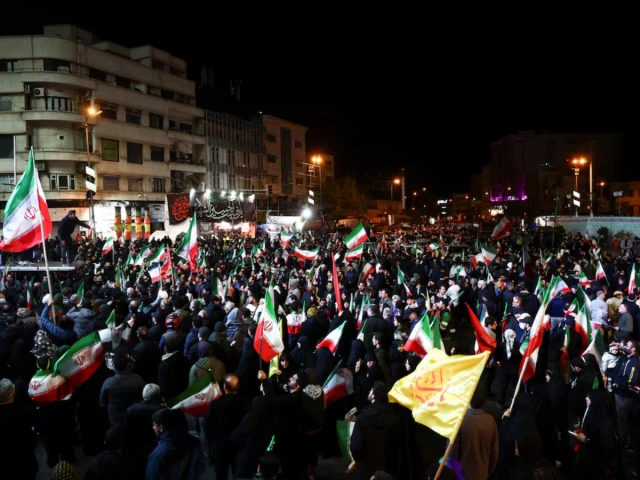
People gather after a two-week ceasefire in the Iran war was announced, in Tehran, Iran, April 8, 2026. PHOTO: REUTERS
ISLAMABAD:
All bets were off. The world and the region were preparing for the worst. At one point, it seemed that all of Pakistan’s efforts to seek an end to hostilities would fail.
However, the Pakistani authorities who handled the complex process did not give up.
The story of Pakistan’s involvement in seeking rapprochement between the United States and Iran began in June last year. It was during the 12-day war between Iran and Israel, which the United States later joined, that put Pakistan in the spotlight.
US President Donald Trump inviting Pakistan Army Chief Field Marshal Syed Asim Munir was public knowledge, but not much was known about what happened next and the discreet role Islamabad played over the past 10 months.
The 12-day war ended with Iranian-choreographed attacks on Doha, but Pakistan, sensing the fire was temporarily out, continued working behind closed doors to broker a deal between Tehran and Washington.
The meeting between Trump and Munir at the White House was essential to establish personal contacts between the American president and the field marshal. But, significantly, the field marshal’s constructive role managed to win the trust of Iran’s top leaders.
“People may have forgotten the June war, but we haven’t,” said a senior Pakistani official familiar with the events. The official, who spoke on condition of anonymity due to the sensitivity of the issue, revealed that Pakistan had opened a “discreet” channel between Tehran and Washington after the war.
At one point, Pakistan’s Deputy Prime Minister and Foreign Minister Ishaq Dar exchanged different proposals between Iran and the United States.
The official said that months before the recent war, Pakistan quietly pushed for a deal between Iran and the United States.
Pakistan shared a set of draft agreements with the United States.
The draft provided for Iran to agree not to seek nuclear weapons in exchange for the lifting of sanctions. The secret talks collapsed after the United States wanted to include the issue of Iranian ballistic missiles in the final agreement, something Iran was unwilling to agree to.
When tensions were rising before the latest phase of hostilities, Islamabad re-entered the fray to avert the crisis. While Oman hosted talks between Iran and the United States, Pakistan launched a parallel channel, seeking a reduction in tensions.
Days before the United States and Israel bombed Iran on February 28, Pakistan reached out to Iran seeking a meeting with its supreme leader, Ayatullah Ali Khamenei. Prime Minister Shehbaz Sharif and the field marshal wanted to seek an audience with Khamenei as a last-ditch effort to stave off attacks from the United States and Israel.
Iranian authorities welcomed the Pakistani efforts but rejected the request to meet the Supreme Leader, citing security concerns.
It was unclear whether the visit could have prevented the United States and Israel from assassinating the Supreme Leader, but it did highlight Pakistan’s close involvement even then in preventing the war from occurring.
However, when the war began, Pakistan was not only walking a tight diplomatic rope, it was literally navigating landmines. Iran is a neighbor, while the Gulf countries (now under attack by Iran) were Pakistan’s partners and, for some, financial lifelines.
This time the conflict was different because Iran launched retaliatory attacks against the Gulf countries. Pakistan signed a mutual defense pact with Saudi Arabia in September, and Iranian attacks on Riyadh made Islamabad’s challenge even more daunting.
However, Pakistan chose to follow the diplomatic route, taking advantage of its unique position of having close ties with all relevant countries that are parties to the conflict.
“It was not an easy decision. Some of our Gulf partners were not happy. They did not support the mediation efforts. They wanted Trump to finish the job,” said a source briefed on the matter.
Pakistan, however, absorbed the pressure and pushed for diplomacy, offering channels of communication to the warring parties.
At first he had little success, but as the war became more intense, the fear of a wider conflict became real. It was then that Pakistan emerged as a key interlocutor. The task, however, was extremely difficult, if not impossible.
As the world watched helplessly, drones and missiles flying across the region, ships stranded in the Strait of Hormuz, sending oil prices sky-high, Pakistan established secure lines of communication to give diplomacy a chance.
Prime Minister Shehbaz Sharif and his deputy Ishaq Dar were at the forefront, reaching out to relevant parties, but the real work was being done behind closed doors at the military and intelligence levels.
About 10 days ago, those diplomatic efforts were about to bear fruit when a meeting between Iranian and American officials was scheduled in Islamabad.
But the growing trust deficit between Tehran and Washington prevented that meeting from taking place, not once, but twice.
“At one point we felt disappointed,” admitted another official. “We thought everything was lost.”
But since the stakes were too high and if the war dragged on Pakistan would have been forced to take sides, the effort continued.
There was a dangerous moment when all parties were close to reaching an agreement. Iran’s attacks on Saudi petrochemical factories sparked a furious response from Pakistan.
The Foreign Ministry and corps commanders issued strong statements condemning the attacks, while privately informing Tehran that such attacks could potentially close the small window of diplomacy.
Iran was told that if this window was closed, the results would be catastrophic. The message finally pushed Iran to accept a deal that was developed with Prime Minister Shehbaz Sharif’s late-night release.
It was a carefully calibrated measure designed to give both sides a way out. What happened after the Prime Minister’s post about X was inevitable. Pakistan had done something that few were willing to bet on. Many even questioned Islamabad’s ability to achieve something that is now part of the history books.
“Despite this historic success, vigilance is necessary. Detractors and enemy elements may try to discredit this feat,” warned a security source.
“You also have to remember that the job is only half done,” the source added.


