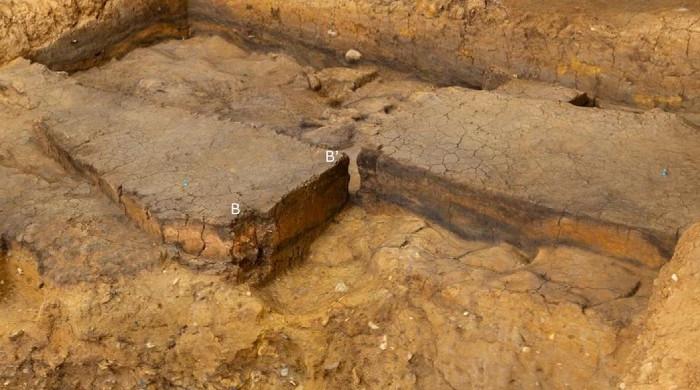
Scientists have discovered the oldest known evidence of prehistoric humans making fire in the English county of Suffolk, a home apparently made by Neanderthals about 415,000 years ago, revealing that this milestone for our evolutionary lineage occurred much earlier than previously known.
In a former clay brick-making pit near the village of Barnham, researchers found a lump of hot clay, some heat-shattered flint axes and two pieces of iron pyrite (a mineral that creates sparks when struck against flint to ignite tinder) which they identified as a repeatedly used campfire.
It was located near a watering hole where these humans camped.
“We think humans brought pyrite to the site with the intention of making fire. And this has huge implications for beating back early fires,” said archaeologist Nick Ashton, curator of the Paleolithic Collections at the British Museum in London and leader of the research published Wednesday in the journal Nature.
Until now, the oldest known evidence of fire-making dated back to about 50,000 years ago at a site in northern France, also attributed to Neanderthals.
The controlled use of fire was a milestone for the human evolutionary lineage, not only for cooking and providing protection from predators, but also to provide heat that allowed hunter-gatherers to thrive in areas with colder environments.
“Places like Britain, for example,” said Rob Davis, an archaeologist at the British Museum and co-author of the study.
Through cooking, our ancestors were able to remove pathogens from meat and toxins from edible roots and tubers. Cooking made these foods more tender and digestible, releasing body energy from the gut to fuel brain development.
According to the researchers, being able to consume a greater variety of foods contributed to better survival and allowed larger groups of humans to be fed.
Fire may also have contributed to social evolution. The use of fire at night allowed these humans to gather and socialize, perhaps engaging in storytelling and developing language and belief systems.
“The campfire becomes a social center,” Davis said.
“We are a species that has used fire to really shape the world around us,” Davis said, noting that the new findings show that this trait is something our species Homo sapiens has in common with Neanderthals and possibly other large-brained human relatives who lived at that time such as the Denisovans.
The Paleolithic, or Old Stone Age, site at Barnham dates back to before the first known Homo sapiens fossils in Africa.
Researchers believe that Neanderthals, our close evolutionary cousins, were the ones who made fire, further evidence showing the intelligence and ingenuity of these archaic humans long maligned in popular culture.
Paleoanthropologist and study co-author Chris Stringer said no human fossil remains were found at the Barnham site.
But Stringer pointed out that pieces of a human skull about 400,000 years old characteristic of a Neanderthal were found in the mid-20th century, less than 100 miles to the south, in a town called Swanscombe. Stringer said the Swanscombe skull fragments match Neanderthal fossils from a site called Sima de los Huesos, meaning “well of bones”, near Burgos in Spain, which dates back to about 430,000 years ago.
“Therefore, it is very likely that the Barnham fire makers were early Neanderthals, like Swanscombe and the Sima people,” Stringer said.
Neanderthals became extinct approximately 39,000 years ago, shortly after Homo sapiens devastated the European territory they called home. Their legacy lives on in the genomes of most people on Earth, thanks to interbreeding between Homo sapiens and Neanderthals before their disappearance.
Previous archaeological work at the site has given scientists a good understanding of what the place looked like at the time it was made home, with a rich variety of animals, from elephants to smaller mammals and birds, and evidence of human activity in the form of cut marks on animal bones.
There is archaeological evidence from Africa dating back more than a million years that humans used natural fire (from forest fires or lightning), but those sites lacked evidence that a deliberate fire had been set.
Investigators spent four years conducting tests to prove that Barnham’s evidence was deliberately set fire. They said numerous tests demonstrated this, including geochemical tests that revealed temperatures of more than 700 degrees Celsius (1,290 degrees Fahrenheit) with repeated use of fire at the same location.