
Asif says India and Afghanistan support indirect terrorism; Cites presence of terrorist groups on Afghan soil
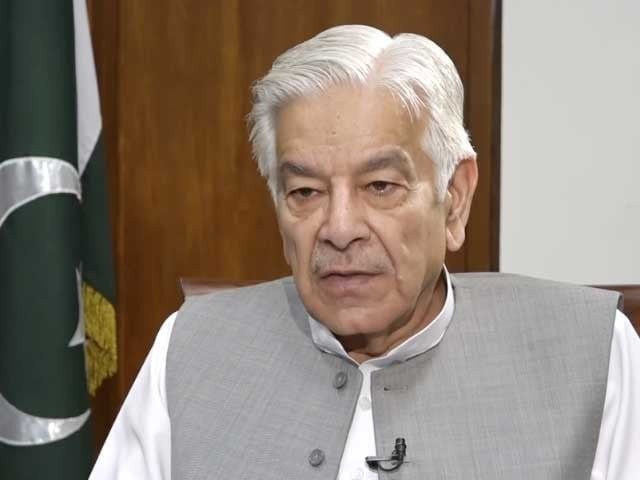
Defense Minister Khawaja Asif during an interview with Voice of America (VoA). SCREEN CAPTURE
ISLAMABAD:
Pakistan will not hesitate to carry out more airstrikes inside Afghanistan unless Kabul ensures peace, Defense Minister Khawaja Asif said on Wednesday, accusing India and Afghanistan of working together against Pakistan through a proxy war fueled by terrorists.
In an interview with France 24, Asif said the terrorist violence in Pakistan was the result of terrorism backed by India and enabled by Kabul’s complicity, stating that “almost all franchises of terrorism” were present due to the Afghan government’s inaction.
He said Pakistan retained the option of cross-border action and would exercise it if necessary. “We will not hesitate. If anyone in Kabul can guarantee peace, there will be no hostilities, but they will continue to patronize and become co-conspirators,” he said, adding that the Afghan authorities cannot deny the responsibility of terrorists operating from their soil.
Referring to last year’s attacks inside Afghanistan, Asif said the option remained firmly on the table. It accused Delhi of waging a proxy war following defeat during a four-day conflict in May, when the Pakistan Air Force (PAF) repelled Indian attempts to violate its territory.
Asif said India, Kabul and terrorist groups were “on the same page” in attacking Pakistan, although India would continue to deny the allegation despite maintaining close relations with Afghan authorities. He stressed that war with India remains “a possibility” under the prevailing conditions.
The defense minister said Islamabad had made multiple diplomatic efforts to resolve the issue, including engagements in Istanbul, Doha and Kabul, but the talks did not produce results. According to Asif, Afghan officials recognized that elements of Tehreek-e-Taliban Pakistan (TTP) were operating from their territory.
He said Kabul indirectly admitted that they lacked control over terrorist groups. “We told them and then we will deal with them,” he said, adding that Pakistan had urged Kabul to allow action against terrorist groups if it could not control them itself.
Asif listed several organizations that he said were active from Afghan soil, including the East Turkestan Islamic Movement, TTP, Islamic State and Da’esh, along with smaller factions. He accused Kabul of providing safe haven to these groups.
The comments came after a deadly suicide bomb attack at Imambalgah Khadijatul Kubra in Islamabad, which killed 36 worshipers and injured about 169 others. Subsequent raids in Nowshera and Peshawar led to the arrest of four facilitators.
Authorities said the Afghan mastermind linked to Daesh was also captured. Interior Minister Mohsin Naqvi claimed the network had been trained in Afghanistan.
Situation in Gaza
Turning to the Middle East, Asif said Pakistan was willing to contribute to an international stabilization force in Gaza, provided acceptable terms of reference were established. He highlighted Pakistan’s long-standing role in United Nations peacekeeping missions and described participation as a potential opportunity to advance a two-state solution.
“Gaza and Palestine are causes close to our hearts,” he said, highlighting Pakistan’s continued support for the Palestinians in global forums. He added that participation in a peacekeeping force could help move closer to a viable two-state outcome.
On relations with Israel, Asif ruled out any prospect of normalization unless Palestinians were granted the right to self-determination in their own homeland under a two-state framework, even though several Muslim countries have established ties with Tel Aviv.
The minister also addressed Pakistan’s internal political dynamics, describing the current system as a “hybrid arrangement” in which national institutions, including the military, work alongside the elected government.
He rejected claims of a military government, insisting that the military was supporting civilian leadership during a period marked by terrorist threats and economic tensions. “There is absolutely no military government. My boss is the prime minister,” Asif said.
He recognized the historical role of the establishment, while emphasizing that current challenges required institutional cooperation. Asif concluded by saying that Pakistan would continue to face proxy war while remaining open to peace, warning that Kabul’s continued inaction would leave Islamabad with no choice but to respond decisively.
Pakistan has repeatedly warned that behind the militant violence is a nexus between Afghanistan and India, pointing to a rise in attacks originating across the border. Recent United Nations reports have also cited an increase in TTP operations launched from Afghan territory, reinforcing Islamabad’s long-standing complaints about terrorist sanctuaries.
(WITH INPUTS FROM THE NEWS DESK)


