
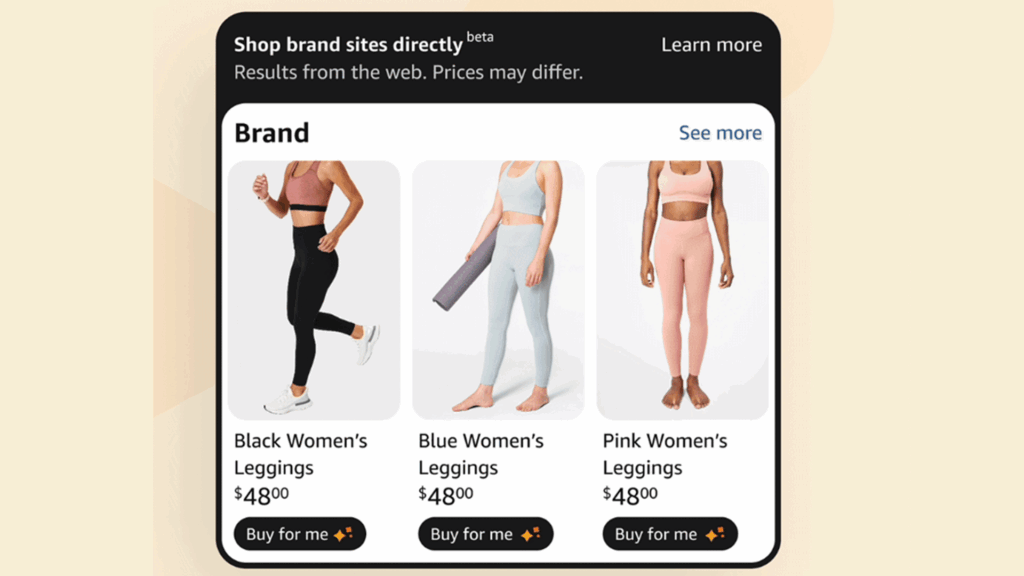
- Amazon’s Buy for Me feature uses AI to order products from other retailers
- Some small businesses found their items listed on Amazon without even registering
- Amazon calls the feature an experiment that is still working out issues
Amazon’s latest experiment in AI-powered shopping can help you find the perfect purchase by riding roughshod over third-party companies. The Shop Direct and Buy for Me features that Amazon began testing last year streamline the process of finding and purchasing items that Amazon may not have in its inventory.
If you click the Buy for Me button, Amazon’s system uses information pulled from a brand’s public website to place the order on your behalf using your data. From the buyer’s point of view, it feels like they are buying something on Amazon. But from the retailer’s point of view, Amazon walked into its store uninvited and started calling customers.
In recent weeks, online retailers began complaining to Amazon and sharing stories on social media about how they were never asked if they wanted to participate. Some say they didn’t even know the program existed until orders started arriving in their inboxes from unknown “buyforme.amazon” email addresses. Others say Amazon listed products that were out of stock or were never intended for direct-to-consumer sales.
You may not have noticed if you’re only shopping on Amazon. You search for something, see a product that looks legitimate, and the purchase happens in the background. The whole problem is on the retail side.
“Products I don’t even have anymore (like those completely removed from the backend) are sold in this ‘buy from stores directly’ section of the app,” one retailer recounted on Reddit. They use AI images of items that are not mine and authorize orders to my site for items that are out of stock. “I didn’t sign up for this nor is there an easy way to cancel it.”
Amazon has said that the artificial intelligence tool is not doing anything wrong since the listings are based on publicly available product and price information. The system is also supposed to verify that items are in stock and priced correctly before offering them to customers. If there are any issues, Amazon has an email address listed for merchants to submit an opt-out request.
The AI buyer sneaks in
Putting the burden of avoiding Amazon’s AI agent on third-party brands understandably upsets some of those retailers. Furthermore, it does not help them with orders already placed. Not to mention companies that intentionally stay away from Amazon for financial or marketing reasons may not like being dragged onto the platform by ambitious AI buyers.
And that’s before even considering accuracy issues like the one described in the Reddit post. AI systems are only as good as the data they ingest, and if Amazon uses outdated or mismatched products and images, it’s the brand receiving the order that has to struggle to explain it.
There is an additional element of irony in this situation, as Amazon has lobbied hard against any third-party AI agent scraping its own platform for data. Completely blocks Google, OpenAI and Perplexity bots. Now, Amazon itself is using AI to take down other retailers’ sites in the name of convenience.
For buyers, this contradiction takes a backseat. It’s easy to imagine how attractive it could be for an AI buyer to find products and compare prices on the Internet. But after years of companies collecting public information with little opposition, having the process directly tied to AI purchasing could make the problems more tangible, and Amazon’s AI buyers might have to start calling and advertising before taking over the cash register.
Follow TechRadar on Google News and add us as a preferred source to receive news, reviews and opinions from our experts in your feeds. Be sure to click the Follow button!
And of course you can also follow TechRadar on TikTok for news, reviews, unboxings in video form and receive regular updates from us on WhatsApp also.


