
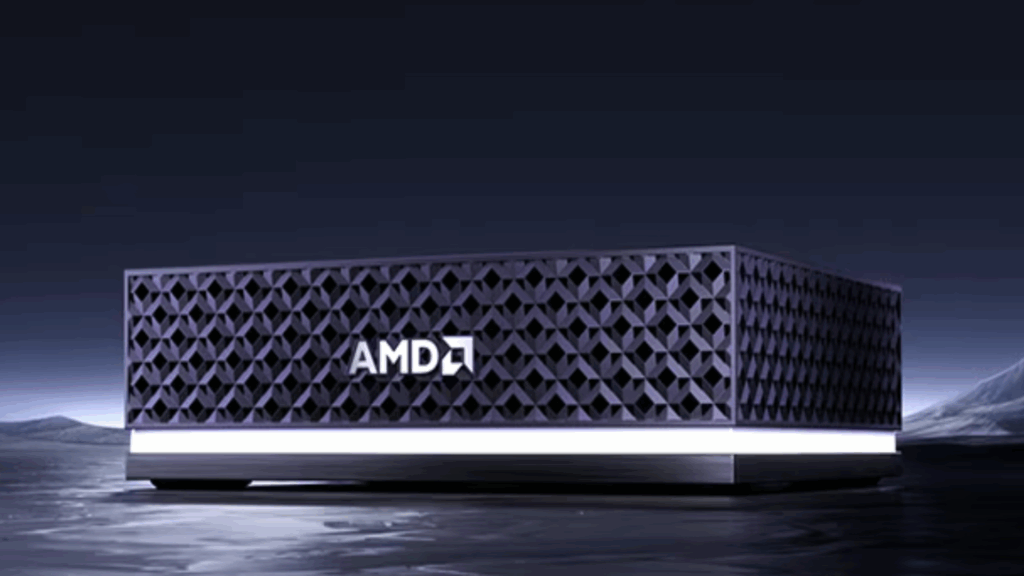
- AMD Ryzen AI Halo offers 16 CPU cores and 32 threads for AI workloads
- Integrate an NPU along with Radeon GPU cores for AI tasks
- Ryzen AI Halo offers full ROCm support on Windows and Linux platforms
AMD has confirmed that it will launch its first PC in 2026, called Ryzen AI Halo, a system built around its Ryzen AI Max+ 395 processor with up to 16 Zen 5 CPU cores and 32 threads.
The company describes the device as a reference platform for local AI development, designed to run Windows and Linux with full AMD ROCm support and AI model compatibility from day one.
With up to 128 GB of unified memory and an integrated NPU, the device can handle large generative AI models, although actual performance will depend on the intensity of the workload.
Processing architecture and core specifications.
The Ryzen AI Halo processor uses 4nm process technology with boost clocks of up to 5.1 GHz.
Cache specifications include 16 MB L2 and 64 MB L3, while the configurable TDP ranges from 45 to 120 W depending on system configuration.
The processor is combined with Radeon 8060S graphics with 40 cores and a maximum frequency of 2900MHz.
The GPU supports multiple display resolutions, including up to 7680×4320 at 60Hz, and includes DisplayPort 2.1 with adaptive sync, an HDMI 2.1 interface, and HDR metadata.
With this configuration, the device supports up to four displays simultaneously.
The system supports up to 128GB of LPDDR5x 8000 memory via a 256-bit interface, along with RAID storage and NVMe boot options that support RAID0 and RAID1.
Connectivity options include two 40Gbps USB4 ports, three USB 3.2 Gen 2 ports, three USB 2.0 ports, sixteen usable PCIe 4.0 lanes, and wireless capabilities.
The system supports advanced AI capabilities with a rating of up to 126 TOPS overall, including 50 TOPS from the integrated NPU.
Security features include AMD’s enhanced antivirus protection with the NX bit.
Ryzen AI Halo is designed to compete directly with Nvidia’s DGX Spark mini PC, a compact AI system aimed at similar on-premises AI workloads.
Both systems offer high-performance computing in small form factors and support ample memory capacity for large AI models.
DGX Spark is based on Nvidia’s HGX architecture and CUDA optimized frameworks, while Ryzen AI Halo integrates a Radeon NPU and GPU cores with full ROCm support.
This approach allows developers to run AI models locally without relying on managed cloud infrastructure.
Halo’s 128GB LPDDR5x memory capacity and overall AI computing rating of 126 TOPS aim to match or exceed the performance of the DGX Spark mini PC, offering an alternative for institutions looking for local AI experimentation.
However, Nvidia’s DGX Spark mini PC has already established benchmarks and a mature ecosystem, while the Ryzen AI Halo will need to demonstrate comparable or superior performance in real-world AI workflows.
TechRadar will cover this year’s edition extensively CESand will bring you all the important announcements as they happen. Go to our CES 2026 News page for the latest stories and our hands-on verdicts on everything from wireless TVs and foldable screens to new phones, laptops, smart home devices and the latest in artificial intelligence. You can also ask us a question about the show on our CES 2026 Live Q&A and we will do our best to answer it.
And don’t forget follow us on tiktok and WhatsApp For the latest from the CES fair!


