When I travel abroad, I often meet emigrants eager to share their memories of Karachi. There are conversations soaked in nostalgia. They miss the city they have left behind. And since Karachi is my home, where I have lived almost all my life, I really enjoy these encounters.
But I had no intention of writing about Karachi, which lives in the imaginations of those who have lived here for many years of their lives before finding their new homes in distant lands. In fact, I returned this week after a three-week stay in Southern California with our daughter and was ready to share some of my experiences. Karachi, however, has abruptly intervened and I am distracted.
By the way, I was in San Francisco for four days before boarding my flight home from Los Angeles, and there was something different about the city that I knew quite well. It really made me think of Karachi and the chaotic scenes we witnessed on its roads.
Well, I saw quite a few driverless taxis on the roads. It seemed like a matter of routine that there was no special noise around them in the corners. However, for me it was a magical sight. As I said, I will not continue with the topic because I am back in Karachi, where a terrible human tragedy has overwhelmed my senses. I can’t leave it out as the main point of my column.
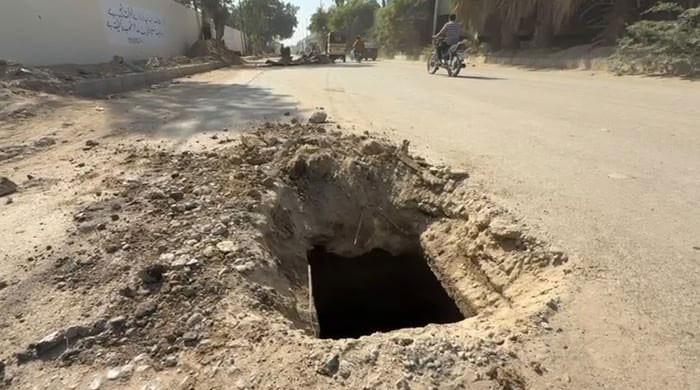
What is noteworthy here is not only the news that there was an open sewer and a child fell into it and died. Yes, that in itself would be a cause for concern and a human tragedy that would touch our hearts. But the circumstances under which this week’s tragedy unfolded are exceptional. CCTV footage of the incident that emerged later is heartbreaking. I have gone through the agonizing experience of watching it and felt the disbelief of what really happened.
There are reasons why the death of a three-year-old boy after falling into an open manhole has shocked the administration, both local and provincial. The fact that this response has been a bit late requires some explanation. Still, the incident has generated a lot of attention and debate, and media coverage has tried to reflect the anger and pain of people in general.
As I have already said, the death of little Ibrahim Nabil has its unique characteristics. Firstly, let us consider the fact that the incident did not occur in a desolate place but on the well-lit and quite busy sidewalk in front of a department store in Gulshan-e-Iqbal. It happened in the presence of the child’s parents and other people. Ibrahim fell into the sewer and was literally swallowed because he could not be immediately rescued from the drain below and was swept away. His body was found in a sewer about fifteen hours later, in a place located very far from the sewer.
I’ve tried to summarize it, but the details of the episode are complex and not easy to understand. Many questions should be raised. Apparently, the massive BRT construction activity along University Road, which has wreaked havoc on traffic on a vital thoroughfare, had complicated matters. But this also guaranteed the availability of heavy machinery.
There is little clarity on how the rescue operation was carried out after people at the scene raised the alarm. Naturally, however, different agencies were put in place and a lot of digging was done along the drain through which water was flowing. A large number of operations must have been involved in this activity.
But look at the irony of Ibrahim’s body being discovered by a teenager in an open drain near Sir Syed University. This is how the operation that lasted all night ended on Monday. The boy, said to have been a “scavenger” although some dispute this, was invited to the office of a senior police officer and given a bouquet. Naturally, this was a media photo shoot.
Actually, the story of uncovered manholes is an old story in Karachi, as it should be in other South Asian cities. Typically, manhole covers are stolen by drug addicts and municipal staff are tasked with controlling them. I remember writing stories about open sewers when I was a young journalist about fifty years ago.
(As an aside, I remember noticing large iron manhole covers in Manhattan, New York, that were made in India by Tata).
On Wednesday, Chief Minister Murad Ali Shah suspended five officials, including the deputy commissioner of the area, for their alleged negligence. This action was taken following denials of responsibility by KMC and BRT (Red Line) officials after exchanging accusations of negligence. Also on Wednesday, Mayor Murtaza Wahab visited the family of the deceased boy to ask for “forgiveness.” He took responsibility for Ibrahim’s death and said no blame game would be indulged.
One aspect of this open pit tragedy was the immediate outcry from the local community. On Sunday night, after Ibrahim was lost in the drain, a mob blocked traffic on University Road and the nearby flyover for a few hours. This is how the crowd reacts when a serious accident occurs. In many ways, it is an expression of the helplessness of the people. How should they have behaved as responsible citizens?
More widespread has been the anger and feeling of indignation throughout civil society. A district court issued notices to the mayor, director of Karachi Water and Sewerage Corporation and others regarding a request to register a case against them. Social media is flooded with angry comments.
Whatever this tragedy may tell us about the prevailing situation in Karachi, its citizens have no choice but to make their way down a dangerous path that may also have an open manhole.
The writer is an experienced journalist. He can be contacted at: [email protected]
Disclaimer: The views expressed in this article are those of the writer and do not necessarily reflect the editorial policy of PakGazette.tv.
Originally published in The News