
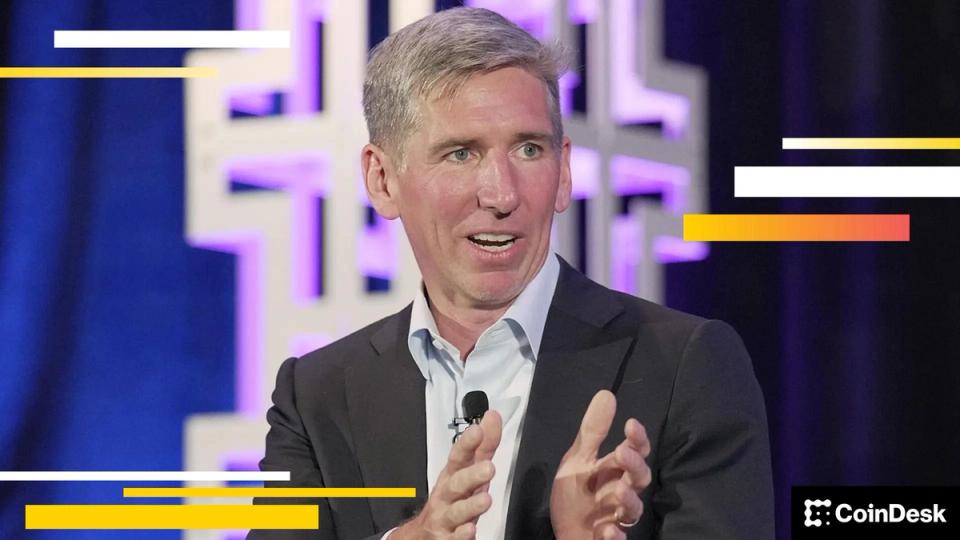
Bitcoin could reach $1 million per coin if it captures a larger share of the global store of value market currently dominated by gold and government bonds, according to Matt Hougan, CIO of Bitwise Asset Management.
In a report earlier this week, Hougan said bitcoin’s long-term upside depends less on short-term market cycles and more on how much of the global wealth preservation market absorbs the cryptocurrency over time.
“A million seems crazy,” Hougan said. “It implies that bitcoin will increase 14 times compared to the current price.”
He pointed to several factors supporting that forecast, including the rapid growth of the global market for stores of value, including gold, government bonds and other defensive assets, which has expanded from about $2.5 trillion in 2004 to nearly $40 trillion today. Currently, Bitcoin represents only about 4% of that market by value.
If the largest cryptocurrency captured about half of that market under current conditions, its price could approach that $1 million mark in about a decade, Hougan said. If the broader store of value market continues to expand, bitcoin would require a smaller stake to reach that level.
Setting the price of a million dollars
The $1 million forecast has become a recurring theme throughout the crypto industry. President Donald Trump’s son Eric recently doubled down on his BTC call worth $1 million. In August, Coinbase CEO Brian Armstrong said bitcoin could reach that price by 2030.
Jack Dorsey, who ran X (formerly Twitter) until 2021 and co-founded payments company Block (formerly Square), said bitcoin could reach $1 million within five years. Arthur Hayes, former CEO of BitMEX, believes it could arrive as soon as 2028. Cathie Wood’s Ark Invest projected that bitcoin could reach $3.8 million by the end of the decade. Bernstein in 2024 predicted $1 million by 2033.
So why has the $1 million target become such a cited benchmark for bitcoin? CoinDesk asked several market analysts.
“It’s a clear headline and shorthand for the idea that Bitcoin could rival gold as a store of value. The exact number matters less than the proportion of global wealth that Bitcoin captures,” said Mati Greenspan, market analyst and founder of Quantum Economics.
For Jason Fernandes, also a market analyst and co-founder of AdLunam, the milestone is more psychological than a precise valuation target, reflecting the belief that bitcoin could ultimately win the store of value debate.
However, he also believes that part of the narrative is driven by marketing dynamics. “Part of the narrative is promotional because round numbers travel well and align with incentives for holders,” Fernandes said, although he added that the underlying thesis is not pure hype.
“I think many investors make a ‘static denominator’ mistake, valuing bitcoin against the current market store of value rather than a much larger future one,” he said.
For Fernandes, the real question is not whether a million dollars in bitcoin is theoretically possible, but whether institutional adoption is growing enough to justify that price.
Analysts agree on the direction, but not on the schedule
Some of the analysts who shared their comments with CoinDesk said Hougan’s projection is plausible in the long term, although most frame it as a decade-scale adoption story rather than a short-term forecast.
“Geopolitical tension strengthens the Bitcoin thesis,” Greenspan said. “In times of uncertainty, investors look for neutral stores of value, and Bitcoin increasingly falls into that bucket alongside gold.”
Greenspan said achieving this milestone is possible, but would likely take a decade or more, requiring continued institutional adoption and broader regulatory clarity.
Fernandes said Hougan’s argument is essentially a market share thesis. Bitcoin does not need to replace gold directly, he said; you just need to capture a slice of a growing global market for stores of value.
“A $1 million bitcoin assumes long-term adoption and market share gains within the global store of value market,” Fernandes said. “It’s a thesis on the final state of bitcoin if it matures into a major global monetary asset.”
Institutional adoption remains the key factor
Hougan has argued that bitcoin’s fixed supply of 21 million coins and its decentralized network give it similar characteristics to traditional stores of value, such as gold.
Fernandes said the long-term million-dollar thesis largely depends on continued institutional adoption and growth in the global store of value market.
“BTC does not need to replace gold or fiat money; it only needs to capture about 17% of a projected reserve market value of $121 trillion over the next decade to justify a $1 million price tag,” Fernandes said.
Greenspan said geopolitical uncertainty could further strengthen bitcoin’s appeal as a neutral asset.
“In times of uncertainty, investors look for neutral stores of value, and bitcoin increasingly falls into that bucket alongside gold,” he said, although he added that achieving such a valuation would likely take years of sustained adoption.
Bitlease founder Nima Beni said the timeline could accelerate if confidence in traditional financial assets weakens.
“Bitcoin hits $1 million as confidence in traditional ‘safe’ assets is broken,” he said, pointing to possible sovereign debt crises or disruptions in the gold market as possible catalysts.
Despite the bullish projections, analysts said bitcoin’s path to such valuations would depend more on long-term adoption and macroeconomic conditions than short-term market cycles.


