
Defense minister says all targets neutralized as ISPR reports heavy terrorist losses
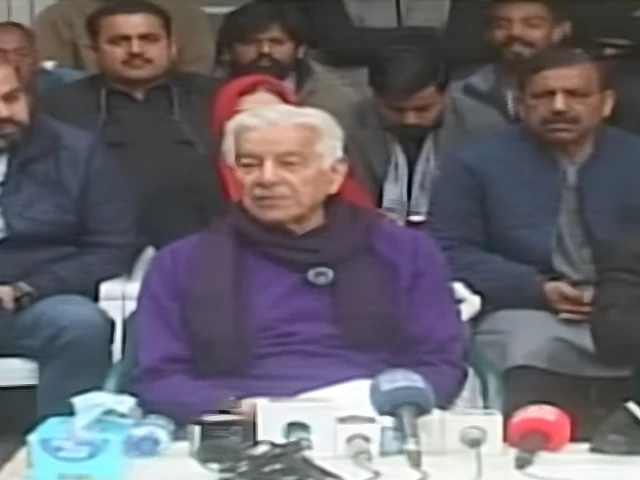
Khawaja Asif addresses the media about yesterday’s attacks in Balochistan. Photo: Youtube (PTV)
Defense Minister Khawaja Asif on Sunday said Pakistan’s findings show that “all links point towards India” in the recent attacks in Balochistan that were claimed by the banned Balochistan Liberation Army (BLA).
On Saturday, terrorists carried out a series of coordinated attacks in multiple locations across the province. According to Inter-Services Public Relations (ISPR), security forces killed 92 terrorists, while 18 civilians were martyred. The military said that during the clearing operations and intense fighting, “15 brave sons of the soil, after having fought valiantly, made the ultimate sacrifice and embraced martyrdom.”
The BLA claimed responsibility for the attacks in a social media post, describing them as the second phase of “Operation Heroof.” The government has designated the BLA and other Baloch groups as “Fitna al Hindustan,” alleging that they are acting as proxies for India to destabilize Pakistan through hybrid warfare. Authorities say the BLA’s suicide wing, the Majeed Brigade, has developed links with other anti-Pakistan terrorist groups operating from Afghanistan.
Security sources also claimed that Indian media and Indian-linked social media accounts amplified support for Fitna al Hindustan during the attacks, which they described as part of a coordinated hostile information campaign.
Speaking to reporters in his hometown of Sialkot, Asif said the BLA “is an internationally recognized and internationally banned terrorist organization,” adding that it seeks to maintain its visibility “to obtain foreign funding from India.” He said the group had carried out attacks against civilians, including kidnappings of civilians and government employees.
Read: 92 terrorists killed and 15 security personnel martyred as attacks thwarted across Balochistan: ISPR
He alleged that the group had tried to mask its activities by adopting a human rights stance. “They have also used a veil in the form of human rights activism, a kind of disguise in the form of BYC and the missing persons narrative,” he said.
Recalling his previous tenure as defense minister, Asif said he had stated eight years ago that many people described as missing were actually members of terrorist organizations like the BLA. “They are agents of these terrorist organizations that attack our offices and homes,” he said. According to Asif, when such people are killed, they are identified as terrorists, while a “false narrative” is created around the missing people.
He claimed that some of them were alive and living in Dubai or Muscat, while their relatives received subsidies, adding that “a human rights narrative has been created out of thin air to draw the world’s attention.”
Asif further alleged that women and children were now being used by terrorist groups. “Now they are also using children and women. In two attacks yesterday, women were used,” he said, claiming they were being indoctrinated. He added that a failed suicide bomber who was captured had confessed and said the groups targeted unemployed, poor and working-class people.
Commenting on the security response, Asif said all targets were neutralized. He claimed that 11 security personnel were martyred, while more than 100 terrorists were killed, adding that the number could rise.
Outlining what he described as the broader objective of the State, Asif said Pakistan aimed to ensure peace in all provinces and defeat foreign intervention, including what he called cross-Afghanistan engagement in the form of the BLA and the Tehreek-e-Taliban Pakistan (TTP). “We have been fighting on many fronts, but we will defeat all forms of terrorism in the country and no concessions will be made,” he said, calling for national solidarity.
He said multiple locations including Sariab Road in Quetta, Frontier Corps headquarters in Noshki and areas in Dalbandin were attacked the previous day, with attacks reported at 12 locations.
Asif said Balochistan’s vast geography and sparse population had allowed terrorists room to operate, but claimed this advantage would disappear in the coming days. He said the operation, which he referred to as “Herof 2.0,” ended due to poor planning, forcing the attackers to retreat and leave behind bodies. He also alleged that Afghanistan-based perpetrators were using children to promote their agenda.
On international issues, Asif said additional Epstein files had been released and claimed Indian media was defending Prime Minister Narendra Modi. “The other side of Modi has come to light,” he said, adding that India’s Congress Party had made allegations about Modi’s conduct related to Israel. He further claimed that Modi’s role had emerged following the publication of the Epstein files and said: “No one can go as low as what Israel and India have been doing.”


