- It singles out Pakistani citizens among the victims of the UAE attacks.
- It says fuel, power and aviation links were disrupted due to regional conflict.
- Supports Bahraini and Russian resolutions calling for cessation of hostilities and talks.
Pakistan on Wednesday called for an immediate ceasefire in the Middle East, warning that only a peaceful, negotiated settlement could prevent further civilian casualties, regional instability and disruption of critical infrastructure and energy supplies.
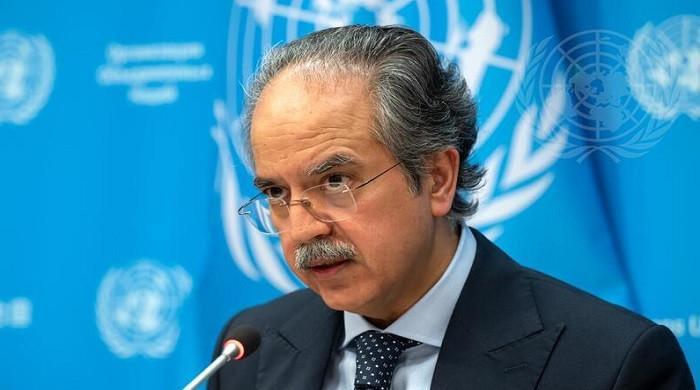
“The consequences of the conflict we are witnessing right now are clear: everyone is affected. This is a conflict that should never have happened,” Ambassador Asim Iftikhar Ahmad, Pakistan’s permanent representative to the United Nations, told the UN Security Council.
He warned that violations of international law put peace at risk. “When international law is violated, peace is in danger, no progress is made. We call for the immediate and complete cessation of hostilities and a return to the dialogue table.”
Calling the Security Council’s failure to unite behind a comprehensive response to end the conflict a sad reality, the ambassador announced that Pakistan supported the two draft resolutions under discussion, presented by Bahrain and the Russian Federation.
“I thank the representatives of Bahrain and the Russian Federation for presenting their respective draft resolutions,” he said.
Pakistan’s vote in favor of the Bahrain resolution reflects solidarity with the Gulf States, including Bahrain, Kuwait, Oman, Qatar, Saudi Arabia, the United Arab Emirates and Jordan.
“Our positive vote signifies Pakistan’s strong support for the brotherly countries of Bahrain, Kuwait, Oman, Qatar, Saudi Arabia, the United Arab Emirates and Jordan,” he said. “It also serves to underscore our condemnation of all unjustified attacks they face, especially those against civilians and critical civilian infrastructure.”
He noted that these countries have faced attacks despite advocating for dialogue and diplomatic engagement. “It is very unfortunate that brotherly states… have been attacked even though they all along supported dialogue, facilitated diplomatic engagement and advocated avoiding escalation,” he said.
At the same time, Pakistan welcomed the Russian Federation’s resolution, which calls for restraint, cessation of military activities and return to negotiations.
“The draft resolution tabled by the Russian Federation… urges the parties to stop military activities, refrain from further escalation and return to negotiations, something that is consistent with Pakistan’s overall position,” he said.
Ambassador Ahmad highlighted the humanitarian and socio-economic impacts, noting that at least two Pakistani citizens were killed in attacks on the United Arab Emirates and that millions of Pakistanis in the Gulf remain at risk.
“Our fuel supply has been severely hampered, forcing the Government to take extraordinary measures to conserve the use of oil, gas and electricity,” he said. “Several essential aviation links have been cut, while others face disruptions.”
He condemned all illegal use of force and urged respect for international humanitarian law. “Any use of force outside the limits of the UN Charter is illegal and condemnable,” he said.
The ambassador highlighted the need for dialogue and diplomacy. “We call for a swift return to dialogue and diplomacy to seek a peaceful resolution of all contentious issues… Sincere commitment and genuine political will are required to restore trust and build the foundations of peaceful coexistence,” he said.
Pakistan also acknowledged ongoing mediation efforts in the region. “We welcome and deeply appreciate the sincere efforts being made by various countries to mediate between the warring parties,” he said, noting that Pakistan has remained in close contact with regional and international partners.
He concluded by reiterating Pakistan’s call for restraint. “All parties must immediately de-escalate the situation, desist from launching further attacks and urgently resume diplomacy for a negotiated and lasting resolution to the crisis,” he said.