
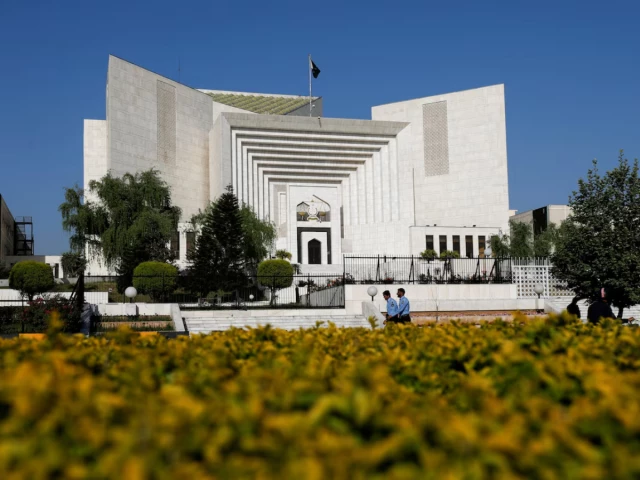
Police officers walk past the Supreme Court of Pakistan building, in Islamabad, Pakistan, April 6, 2022. REUTERS
ISLAMABAD:
The Supreme Court of Pakistan has set out key legal principles regarding the reinstatement and back pay of police employees, ruling that setting aside a dismissal order does not automatically entitle an employee to receive full salary and benefits during the intervening period. Instead, the authority to grant or deny back pay lies with the competent authority, which must exercise this discretion in a fair, reasonable and transparent manner.
In a detailed judgment approved by the report, a five-member bench headed by Justice Shahid Waheed issued a consolidated decision on multiple appeals and civil petitions involving employees of Khyber Pakhtunkhwa Police. Other members of the court were Justice Naeem Akhtar Afghan, Justice Malik Shahzad Ahmad Khan, Justice Aqeel Ahmed Abbasi and Justice Shakeel Ahmed.
The central issue before the court was whether an employee, upon reinstatement following the setting aside of a dismissal order, is automatically entitled to receive full wages and benefits during the period of dismissal.
The court ruled that under section 17 of the Khyber Pakhtunkhwa Civil Servants Act, 1973, award of back pay is a discretionary power, but this discretion is neither absolute nor arbitrary. It must be exercised in accordance with Article 10-A of the Constitution, which guarantees the right to a fair trial, and the broader principle of a “culture of justification”.
The judgment emphasized that administrative powers should not be exercised solely on the basis of authority or power, but should be supported by sound reasoning, rational justification and transparent motives. The court clarified that the annulment of a dismissal and the approval of back wages are two distinct, although interrelated, issues.
The Supreme Court identified four possible reasons on which a dismissal can be annulled: procedural defects, technical reasons, disproportionality of the sentence and lack of proof of the allegations. It noted that if a termination is found to be substantially wrongful, the likelihood of full reinstatement with back wages is greater. However, when reinstatement is due to technical or procedural deficiencies, the decision regarding back wages must be made in light of the specific circumstances of each case.
The court further ruled that an employee requesting back wages must prove to the appropriate forum that he remained unemployed or worked at lower wages during the layoff period.
Conversely, if the government or relevant authority objects to the payment of back wages, it has the burden of proving, with credible evidence, that the employee was wholly or comparably employed elsewhere during that time.


