
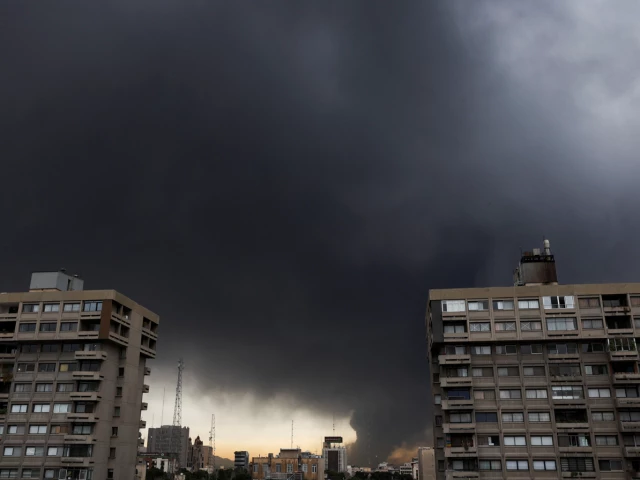
Smoke rises after an explosion, amid the conflict between the United States and Israel with Iran, in Tehran, Iran, on March 8, 2026. PHOTO: REUTERS
QUETA:
Toxic smoke from burning oil facilities in Tehran following recent attacks could drift into Pakistan’s western regions, the Pakistan Meteorological Department (PMD) has warned, raising concerns about deteriorating air quality in parts of Balochistan and Khyber-Pakhtunkhwa.
For the second day in a row, the sky over the Iranian capital remained shrouded in dense black smoke after attacks on oil facilities that set fire to storage tanks and refineries, seriously polluting the air.
Smoke containing potentially dangerous pollutants is now reportedly moving eastwards towards Pakistan, driven by prevailing westerly winds.
The Pakistan Meteorological Department (PMD) has warned that airborne pollutants from Iran could reach parts of Balochistan and the western districts of Khyber-Pakhtunkhwa, potentially affecting air quality in cities such as Quetta, Chaman, Zhob, Chagai, Peshawar and Dera Ismail Khan.
Eyewitnesses reported that early morning rain appeared to contain traces of oil and other chemicals. A Tehran resident said the sky seemed unusually dark when he woke up, while raindrops left black stains on vehicles, balconies and clothes, making it difficult to breathe.
The Iranian Red Crescent advised residents to stay indoors, wear masks, avoid exposure to rainwater and turn off air conditioning systems.
Experts say the burning of oil facilities releases harmful compounds, including hydrocarbons, sulfur dioxide and nitrogen oxides, which can seriously degrade air quality and pose health risks.
Forecasters have warned that westerly winds can carry fine toxic particles, particularly PM2.5 pollutants, thousands of kilometers from their source.
They added that Balochistan’s dry climate and dust-laden winds could further disperse these pollutants, increasing the likelihood of deteriorating air quality in the border regions.
While the Pakistan Meteorological Department said the probability of a “black rain” occurring in Pakistan remains low, it warned that the Air Quality Index (AQI) could increase significantly, increasing the risk of pollution-related health problems.
The situation is considered particularly worrying for Quetta, a city already struggling with air pollution.
Medical experts said children, the elderly, asthma patients and pregnant women could be the most vulnerable to the effects of polluted air, which can cause respiratory illnesses, eye irritation and cardiovascular complications.
Authorities in Balochistan and Khyber-Pakhtunkhwa have put health institutions on alert, while the PMD has instructed its regional offices to collect rainwater samples to monitor pollution levels.


