
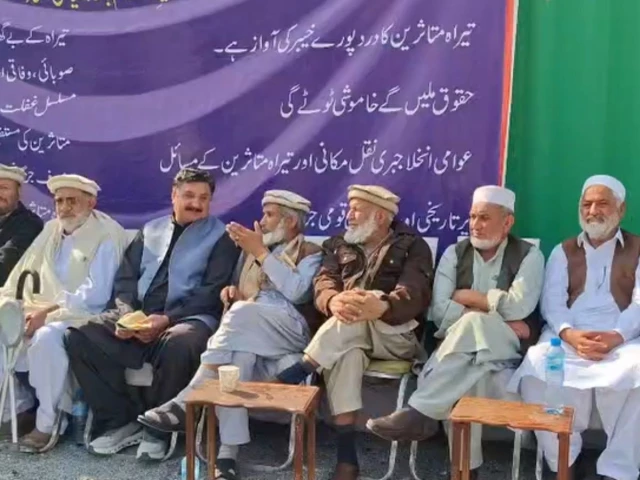
Tirah Victims’ Rights Conference held at Bara Bazaar on January 31 under the auspices of Khyber National Jirga. PHOTO: SCREEN CAPTURE
KHYBER:
A jirga called on Saturday by Bara Siyasi Ittehad, an alliance of different Bara political parties, on Saturday demanded the immediate implementation of its unanimously adopted declaration, calling for the restoration of complete peace in Tirah and a clear guarantee of sustainable peace in the future.
The alliance deliberated on the Tirah crisis as tribal elders and community leaders denounced the current situation in the valley.
The jirga was held in Bara at the request of tribal elders and Tirah representatives, where participants discussed the deteriorating situation caused by administrative failures and agreed on a future course of action.
According to the statement, all forms of violence by the Khawarij, including shooting, shelling, mortar attacks on homes and shooting down of quadcopters, must immediately stop as these actions are spreading fear among civilians.
The alliance also demanded that the dignified return of all displaced families be guaranteed and that every promise and agreement made with them be formally recognized and practically implemented.
The statement called for impartial investigations into political interference, nepotism, administrative failures and corruption in the registration of Tirah victims, and demanded action against those responsible.
It also called for full registration of all residents who own houses or properties in Tirah, granting them internally displaced status and including them in the relief package.
The jirga warned that the law and order situation in Upper Bara and Bara plains had become alarming and needed to be brought under control on an emergency basis.
The alliance announced the launch of a peace movement in Bara starting today to help restore security and provide a safe environment for the public.
He also urged the provincial government to fulfill its constitutional duty by eliminating kidnapping for ransom, threats of extortion and fear among citizens.
Reaffirming its commitment, the Bara Political Alliance said it will continue to support the displaced people of Tirah on all platforms and persist in their struggle until their rights are fully guaranteed.
Earlier, jirga speakers criticized the Khyber-Pakhtunkhwa government for “incompetence, mismanagement and corruption” in relief efforts.
They vehemently denounced the provincial government for alleged political interference and corruption in the distribution of the Rs 4 billion compensation package to the affected families, calling the process flawed and unfair.
While paying tribute to the security forces for their role in maintaining peace, jirga participants accused the government of failing to achieve effective governance.
The agenda of the jirga was presented by the president of the alliance, Haji Shireen Afridi, who also announced full solidarity, sympathy and support for all the displaced families of Tirah.
The alliance demanded that the provincial government ensure full care, protection and arrangements for all displaced people.
Former president Haji Shireen Afridi said the alliance had held jirgas twice with the Khawarij, after which the responsibility was handed over to the provincial government and the tribal elders of Tirah, but both efforts failed.
Other Bara Political Alliance leaders said the suffering of those displaced from Tirah was not limited to a single tribe or area, but had become a collective national issue that could no longer be ignored.
Ministers
Information Minister Ataullah Tarar and Minister of State for Home Affairs Talal Chaudhry termed the Khyber National Jirga a “charging letter” against the KP government, alleging poor governance and asking provincial authorities to apologize for what they described as building a false narrative.
Speaking to a private television channel, Tarar said the jirga had not only demanded restoration of peace but had also leveled serious accusations against the KP government. He said the jirga had concluded that the provincial authorities were guilty of mismanagement and corruption and had failed to live up to the people’s expectations.
Speaking to a private television channel, Talal Chaudhry said the findings of the jirga “left no room” for the version presented by the KP government. He said it had been established that decisions regarding Tirah were made by local residents after assessing the ground realities, and that they left the area under an agreement reached between the people of Tirah and the provincial government.
“These people (the jirga) have explained, very clearly, all those things that the federal government, in one way or another, was trying to convey to the public,” he said.
Thousands flee
Tens of thousands of people have fled a remote mountainous region in recent weeks, residents said, after warnings broadcast from mosques urged families to evacuate ahead of possible military action against terrorists.
Tirah Valley residents said they had moved from the area to nearby towns despite heavy snowfall and cold winter temperatures due to announcements to avoid potential clashes.
“Announcements were made in the mosque that everyone had to leave, so everyone was leaving. We left too,” said Gul Afridi, a merchant who fled with his family to the town of Bara, located 71 kilometers east of the Tirah Valley.
Local officials in the region, who asked to remain anonymous, said thousands of families have fled and are being registered for assistance in nearby towns.
The government has not announced the evacuation or any planned military operations. On Tuesday, Defense Minister Khawaja Muhammad Asif denied that any operation was being planned or underway in Tirah, calling the movement a routine seasonal migration driven by harsh winter conditions.
However, a military source with knowledge of the matter said the relocation came after months of consultations with tribal elders, district officials and security authorities about the presence of terrorists in Tirah, who they said were operating among the civilian population and putting pressure on residents.
The source asked to remain anonymous because he is not authorized to speak to the media. The source said civilians were encouraged to leave temporarily to reduce the risk of harm while “targeted intelligence-based operations” continued, adding that a large-scale offensive had not been prepared due to the area’s mountainous terrain and winter conditions.
The Inter-Services Public Relations, the Ministry of Home Affairs and the Khyber-Pakhtunkhwa government did not respond to requests for comment made on Friday.
Not the cold
Residents rejected suggestions that only winter prompted the movement. “No one left because of the cold,” said Abdur Rahim, who said he left his village for Bara earlier this month after hearing evacuation announcements. “It’s been snowing for years. We’ve lived there our whole lives. People left because of the ads.”
Gul Afridi described a dangerous journey through snowy roads coupled with food shortages that made the evacuation an ordeal that took his family almost a week. “I have no home here, no support for my businesses. I don’t know what awaits us,” he said at a public school in Bara, where hundreds of displaced people lined up to register for assistance, complaining of slow processes and uncertainty about how long they would remain displaced.
Abdul Azeem, another displaced resident, said families were stranded for days and children died along the way. “There were a lot of difficulties. People were trapped because of the snow,” he said.
With additional contributions from Reuters


