
Highlights decentralized economic planning and warns that the economy “cannot be handled with sticks”
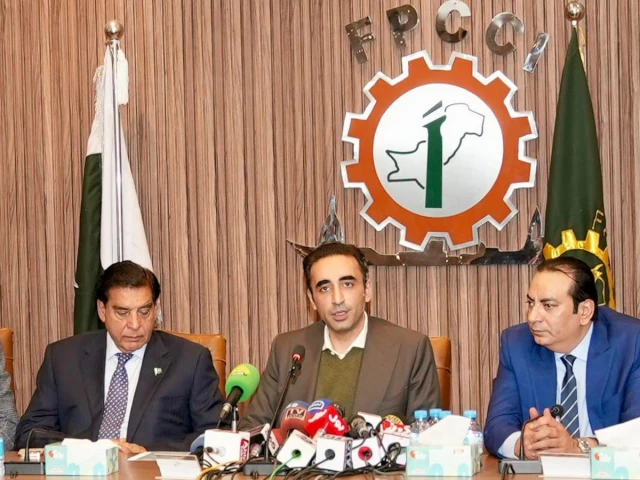
PPP Chairman Bilawal Bhutto Zardari addresses a ceremony organized by the Federation of Pakistan Chambers of Commerce and Industry on Tuesday, December 9, 2025. Photo: X
Pakistan People’s Party (PPP) Chairman Bilawal Bhutto Zardari has called for the creation of new provinces only when there is consensus, urging the government to focus on areas with agreement before implementing plans to establish 20 provinces.
Speaking to the media on Tuesday, he said the National Assembly had already agreed on certain provinces and stressed that the proposals, ready for implementation, must be carried out immediately.
Bilawal noted that the PPP has historically maintained governance and at times implemented governor’s rule when necessary. Citing the Punjab assembly’s legislation to create a province and establish a local government, he compared it with the even stronger framework of Sindh and emphasized that political stability requires cooperation between parties. He warned that failure to involve stakeholders could create provincial challenges.
Recalling the PPP’s successful no-confidence motion that removed a sitting prime minister, Bilawal criticized the PTI for consistently adopting a disruptive approach and called for constructive engagement between political parties. When asked about meeting PTI Chairman Imran Khan in Adiala Jail, he reiterated the need for all parties to maintain dialogue.
Separately, Bilawal warned that Pakistan’s economy “cannot be handled with sticks”, urging the government to abandon coercive measures and adopt a cooperative and decentralized approach to economic planning.
At a ceremony organized by the Federation of Pakistan Chambers of Commerce and Industry (FPCCI), he said Pakistan’s business history is often misrepresented but the focus should be on the future. He assured that the PPP would work together with the FPCCI advisory group to strengthen economic initiatives and planning at the district level.
“One difference between the prime minister’s team and ours is that they favor centralization, while we believe in decentralization. If they prepare plans for the districts, they will strengthen our arguments, and I appreciate their recommendations for the economic offices,” he said.
Bilawal emphasized that governments often rely on coercion to manage the economy, but “a country cannot be governed by force alone; it must be governed with cooperation.” And he added: “You attract more with honey than with vinegar.” He also urged competitive tax rates, respect for the business community and voluntary compliance to achieve better economic outcomes.
As a practical example, Bilawal pointed out that before the 18th Amendment, the Federal Board of Revenue (FBR) collected tax on sales of services. After devolution, Sindh immediately took over the responsibility of collection and has since surpassed FBR records. Punjab, Khyber-Pakhtunkhwa and Balochistan have also surpassed previous federal collections. “This shows that decentralization works,” he said.
He highlighted the overall objective of the PPP to increase revenues, improve tax collection and expand the tax net while promoting economic growth and human development.
Bilawal expressed pride in Pakistan’s three-generation long relationship with China, noting that the country has not fully taken advantage of trade incentives offered by Beijing. He also pointed to the opportunities created by the recent tariff war and Europe’s GSP Plus status, which had led to a 60 percent increase in exports to Europe during his tenure as foreign minister.
He acknowledged that the President, Governors of Punjab and Khyber-Pakhtunkhwa, Sindh Government and Prime Minister are actively working to resolve the problems faced by the business community. He reiterated that while the Prime Minister favors centralization, the PPP believes that decentralization is key to sustainable growth and supports the district-level programs of the FPCCI.


