
ISLAMABAD:
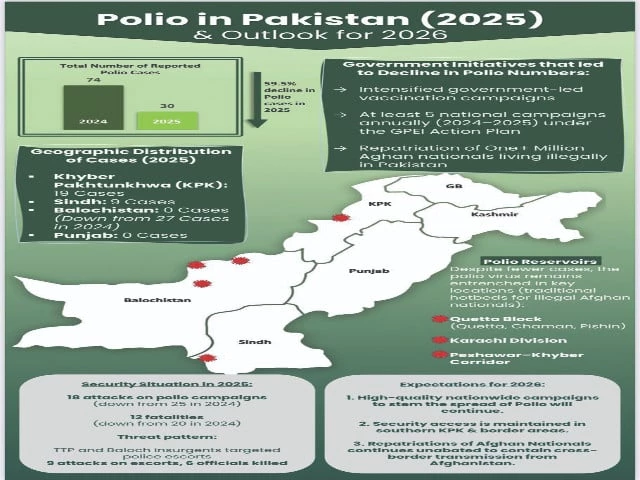
Another polio case was confirmed in Khyber-Pakhtunkhwa (KP) district of North Waziristan on Tuesday, bringing the total number of polio cases reported in 2025 to 31.
However, compared to 2024, there was a 59.5% reduction in the incidence of the disease in the outgoing year. This significant reduction is due to Pakistan’s decision to regulate unorganized cross-border movement with Afghanistan, health officials said based on surveillance data.
Officials said stricter controls on the movement of people and goods across the border have strengthened monitoring systems and reduced opportunities for the virus to spread.
Official figures show that polio cases fell by 59.5% in 2025, and transmission is now restricted to fewer geographic areas compared to previous years.
This containment has allowed vaccination teams to focus their efforts on high-risk districts, improving both coverage and monitoring among vulnerable populations.
The Pakistan-Afghanistan border has long posed a challenge to polio eradication due to frequent and largely uncontrolled population movements.
Afghanistan continues to report circulation of wild poliovirus, and repeated trips across the border have historically contributed to the reimportation of the virus into Pakistan.
Children in mobile families often skipped routine vaccination and multiple vaccine doses, increasing the risk of continued transmission.
Health officials said better regulation of cross-border movement and the repatriation of undocumented Afghan migrants have reduced this risk.
With more structured border management, vaccination at transit points has improved and mobile populations are now easier to track. This has helped close long-standing gaps in immunization coverage.
Furthermore, surveillance systems have become more effective as population flows are now better documented. Officials note that environmental sampling and tracking of suspected cases have improved, allowing for faster detection and response.
Meanwhile, the National Institute of Health (NIH) on Tuesday confirmed a case of wild poliovirus type 1 (WPV1) in Khyber-Pakhtunkhwa (KP) district of North Waziristan.
This is the fifth case reported in the district in 2025, bringing the total number of polio cases in Pakistan over the past year to 31.
Poliovirus was detected in a 4-month-old girl from Union Council Spinwam-2. The girl began having symptoms in December and subsequent samples taken from her were positive for WPV1, the NIH’s Regional Polio Eradication Reference Laboratory reported this week.
Last year, Pakistan reported 20 cases in the KP, nine in Sindh, one in Punjab and one in Gilgit-Baltistan. Southern KP accounted for more than half of Pakistan’s WPV1 cases in 2025, with 17 of the country’s 31 cases reported in the region.
Ongoing security challenges have limited ongoing access for polio teams in parts of southern KP, including North Waziristan, leading to persistent gaps in immunity and leaving children vulnerable to this crippling disease.
It is essential to ensure that all children receive the polio vaccine in every house-to-house campaign and have received their full routine immunization doses.
Pakistan’s Polio Eradication Initiative (PEI) is also taking innovative complementary approaches, especially in southern South Korea, such as involving local influencers in campaigns and providing integrated services such as nutrition, routine vaccination and other health services to boost children’s immunity.
Polio is a highly contagious and incurable disease that can cause lifelong paralysis. The only effective protection is through repeated doses of oral polio vaccine (OPV) for each child under five years of age during each vaccination campaign, together with timely completion of routine immunization.


