
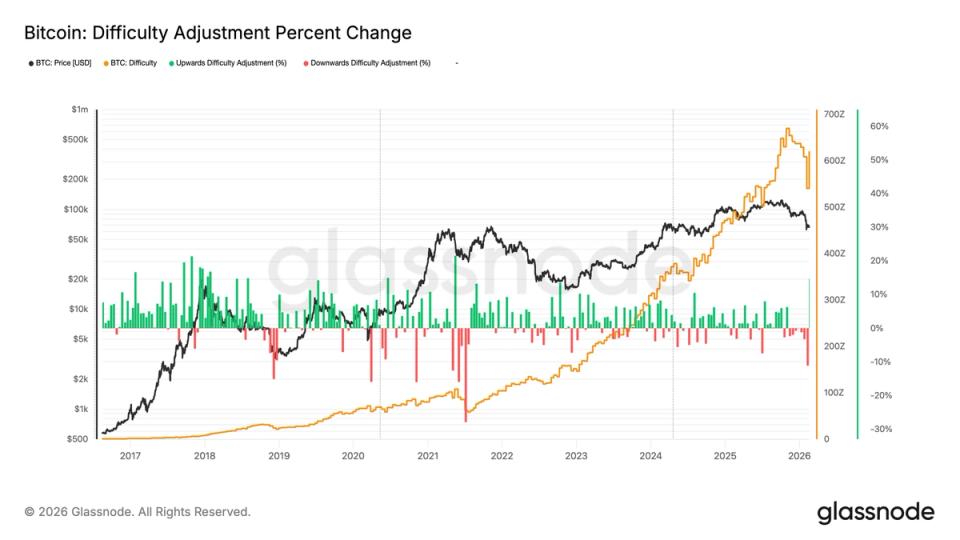
Bitcoin mining difficulty has increased to 144.4 trillion (T), an increase of 15%, the largest percentage increase since 2021, when China’s mining ban caused a major outage, which followed a 22% upward adjustment as the network stabilized.
Difficulty settings measure how difficult it is to mine a new block on the network. It is recalibrated every 2016 blocks, approximately every two weeks, to ensure that blocks continue to be produced approximately every 10 minutes, regardless of hashrate changes.
The adjustment follows a 12% decrease in difficulty after a drop in bitcoin’s hashrate, which is the total computing power protecting the network. Mining activity suffered its biggest setback since late 2021 after a severe winter storm in the United States forced several major operators to scale back operations.
In October, when bitcoin hit an all-time high of around $126,500, the hashrate also hit a high of 1.1 zettahash per second (ZH/s). When prices fell to $60,000 in February, the hashrate fell to 826 exahash per second (EH/s). Since then, the hashrate has recovered to 1 ZH/s, while the price has recovered to around $67,000.
At the same time, the hash price, the estimated daily revenue miners earn per unit of hashrate, remains at multi-year lows ($23.9 PH/s), reducing profitability.
Despite this pressure on profitability, large-scale operators with access to low-cost energy continue to exploit aggressively. The United Arab Emirates, for example, has approximately $344 million in unrealized profits from its mining operations.
Well-capitalized entities that can mine efficiently are helping to keep the hashrate high and resilient, even amid subdued bitcoin prices.


