
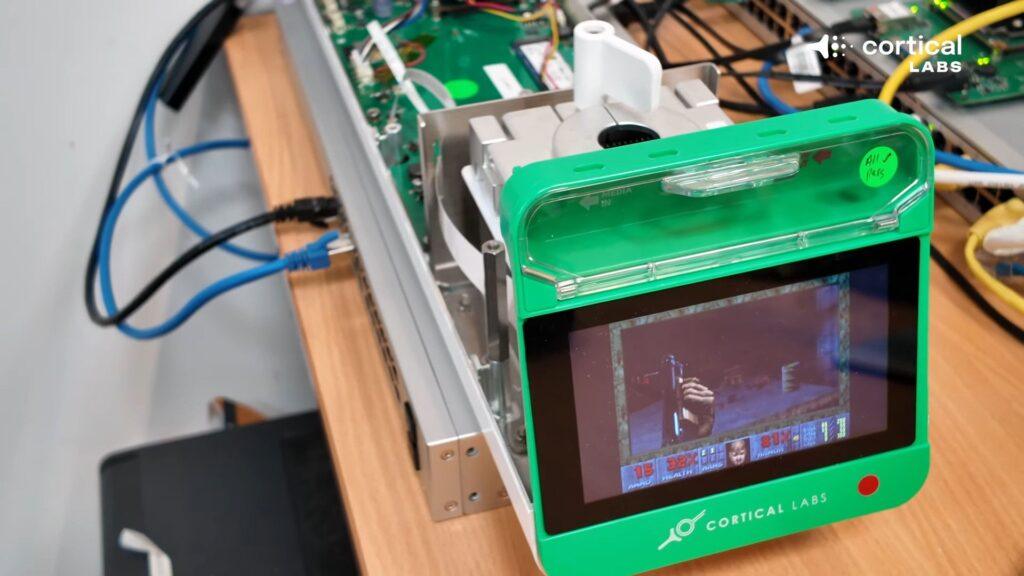
- CL1 ‘biological computer’ has been shown playing Doom
- It is essentially 200,000 human neurons placed on a microchip.
- This brain soup has apparently learned how to find and shoot enemies in the game, although skeptics argue over the definition of “play” here.
Living human brain cells are capable of playing Doom, and by this I mean a group of cells that are not inside a brain (of course, that wouldn’t be a big reveal), but in a laboratory, although there is still some debate about what the definition of actually “playing” a game is here.
As posted on Reddit, this is the work of Cortical Labs, a company that used a “multi-electrode array” to achieve this feat, essentially consisting of 200,000 human neurons placed on a microchip.
This is also known as the CL1 ‘biological computer’, which is a “high-performance closed-loop system where real neurons interact with software in real time.” In this case, Cortical Labs worked with an independent researcher named Sean Cole to get the CL1 running Doom, or rather, playing Doom. Well, sort of, and therein lies part of the controversy.
Article continues below.
These brain cells don’t play through some kind of controller, but rather participate very directly in navigating Doom’s maps and dealing with its grumpy demonic inhabitants.
What happens is that the game’s video stream is mapped directly to neurons using electrical stimulation patterns. As Cortical Labs explains in the YouTube video below demonstrating this, when a monster appears on the left side of the screen, certain electrodes stimulate the left side of the neuron soup sensory area in CL1. The neurons then react to the stimulation, and that cellular activity is interpreted as motor commands, i.e. controlling the Doom guy (moving and firing).
Four years ago, Cortical Labs conducted a similar experiment with Pong, although Doom is obviously much more complicated.
Look
Analysis: learning skills
While this is fascinating, it’s also a very abstract way to play Doom. In theory, brain cells are learning to play, albeit using a very direct interface, as noted.
As Cortical Labs explains in the video, the CL1 is capable of finding enemies and shooting them in Doom, or spinning around if hit from behind, but it plays poorly. If you look at the footage, there’s quite a bit of clumsiness and shooting at walls. As Cortical Labs puts it: “Cells act like a beginner who has never seen a computer,” adding, “and, to be fair, they haven’t.”
That makes it all seem pretty random, which is why some of the detractors on Reddit aren’t all that impressed with the demo, basically saying that we have no proof that Neural Soup is actually honing its skills or gaining any kind of “understanding” about the game. Sure, it’s reacting, they argue, but is it really reacting or learning in any meaningful way? Or is it just waving a gun around, shooting here and there and getting lucky sometimes?
Still, whatever arguments there are about the intent here, or what’s really going on beneath the surface of the neural soup, Cortical Labs admits that, when it comes to Doom, the learning abilities of brain cells need to be improved, but it’s confident that this can be done.
For now, this is an eye-opening demo (though not the only one of its kind), certainly more so than Pong’s effort, and we’ll see where Cortical Labs takes it from here.
As we saw last year, the company’s big vision is to enable cloud access to its CL1 biological computers. You can rent a CL1 for $300 per week through Cortical Labs’ wet software-as-a-service offering, or buy one for $35,000.

The best laptops for all budgets
Follow TechRadar on Google News and add us as a preferred source to receive news, reviews and opinions from our experts in your feeds. Be sure to click the Follow button!
And of course, you can also follow TechRadar on YouTube and tiktok for news, reviews, unboxings in video form and receive regular updates from us on WhatsApp also.


