
Cargo vehicles will receive support of Rs 100 per liter, in addition to a fixed monthly assistance.
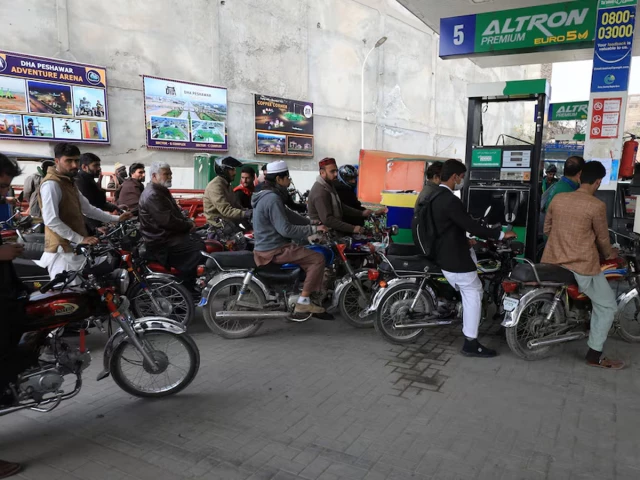
People wait their turn to fill up with fuel at a gas station in Peshawar. Photo: Reuters/ Archive
ISLAMABAD/LAHORE/KARACHI:
In a rare display of coordinated fiscal fightback, the Center and provinces have moved in unison to implement a broad targeted subsidy regime, moving from blanket relief to targeted support, as the country grapples with a major fuel price shock driven by global unrest.
With petrol rising to Rs 458.40 per liter and high-speed diesel at Rs 520.35, the federal government, after consulting with provincial leaders, has handed over the implementation of the relief to the provinces, which will administer subsidized fuel quotas to motorcyclists, farmers and transporters at an estimated monthly cost of Rs 65,000-70,000 crore.
Finance Minister Senator Muhammad Aurangzeb, flanked by Oil Minister Ali Pervaiz Malik, said the leaders have decided “that we are announcing a targeted subsidy program so that the aid is not generalized but reaches those who really deserve it.”
Relief architecture: who gets what
Under the federal framework, a subsidy of Rs 100 per liter will be extended to two-wheeled motorcycles, with a limit of 20 liters per month for three months. Small farmers will receive Rs 1,500 per acre as one-time assistance during the harvest season when diesel consumption peaks.
Freight vehicles will receive support of Rs 100 per litre, along with a fixed monthly assistance of Rs 70,000 for trucks, Rs 80,000 for large transport vehicles and Rs 100,000 for public service buses, initially for one month, subject to review.
Pakistan Railways will also be supported to keep fares affordable for low-income passengers.
Aurangzeb said the evolving global energy landscape required “careful management of resources”, adding that the government would review measures on a monthly basis while ensuring stability in essential sectors.
The provinces intervene
Meanwhile, provinces have raised close to Rs 200 billion in three months under their NFC shares, with Punjab contributing around Rs 100 billion, Sindh Rs 51-52 billion, Khyber Pakhtunkhwa Rs 15 billion and Balochistan Rs 8-9 billion.
Punjab alone is expected to spend Rs 35,000 crore a month, which will cover 22 million cyclists, over 765,000 transport vehicles and over a million farmers.
Sindh will extend support to 6-7 million cyclists through digital transfers of Rs 2,000 per month, along with assistance to farmers through Hari cards.
Khyber-Pakhtunkhwa has already entered the implementation phase, offering Rs 2,000 monthly to over 1.6 million cyclists, while Balochistan faces data constraints, with limited vehicle registration coverage and dependence on BISP data for outreach.
Both Punjab and Sindh had pushed for international fuel prices to be passed on to consumers, arguing that targeted subsidies would allow for more efficient support to vulnerable segments rather than blanket relief.
‘Difficult decision’
In Karachi, Sindh Chief Minister Murad Ali Shah defended the difficult decisions, saying the government had to make “difficult decisions” and noting that blanket subsidies had benefited “rich and poor alike.”
He said a “one-month regimen, consisting of four components”, had been jointly developed with the Centre.
Under this plan, motorcyclists will be “protected from the increase”, with monthly transfers of Rs 2,000 starting between April 15 and 20.
Farmers with holdings of less than 25 acres will receive Rs 1,500 per acre, and the prime minister expressed confidence that the subsidy would “offset the cost of diesel”.
On the other hand, Punjab unveiled a parallel but broader aid initiative. Chief Minister Maryam Nawaz announced free public transport on intra-city routes, covering metro, bus and train services, while implementing fuel subsidies for cyclists and farmers.
“Citizens will not have to buy tickets while traveling on public transport – Orange Line, Metro Bus, Speedo Bus and Green Electric Bus,” he said, calling it a major relief measure under Prime Minister Shehbaz Sharif’s austerity programme.
“By providing aid worth billions of rupees in a month, Prime Minister Shehbaz Sharif has made a sincere and strong effort to protect the public from hardship,” he added. “We will not leave the public alone in difficult times.”
islamabad
In the federal capital, public transportation has also been made free for 30 days. Home Minister Mohsin Naqvi said the government would bear the cost of Rs 350 million.
Meanwhile, a mobile app, expected to go live next week, will manage fuel dues through CNIC-linked records and digital vouchers.
The IT Ministry has already ordered 24,000 mobile devices for distribution at 12,000 petrol stations, with oil marketing companies footing the bill.
Each station will be equipped with two dedicated nozzles for subsidized fuel, while real-time monitoring by OGRA will ensure compliance. The plan will be limited to two-wheeled vehicles, excluding small cars and three-wheeled cars.


