
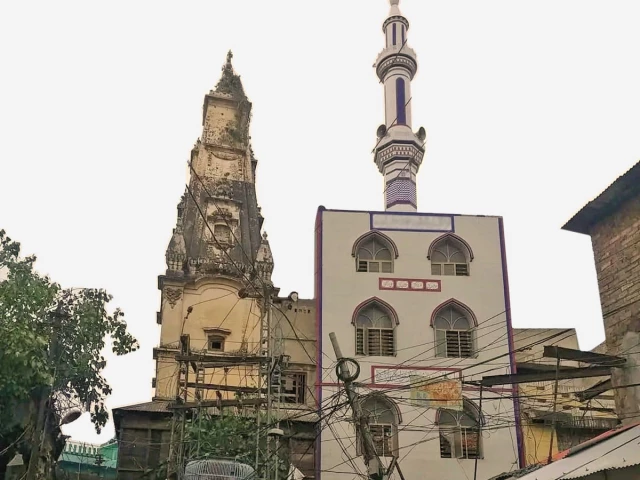
Despite the passage of time, the area retains its architectural charm and cultural importance.
RAWALPINDI:
The historic neighborhood of Mohalla Qutabuddin, popularly known as “Chittian Hattian”, embodies more than 150 years of history, distinguished by the remarkable coexistence of a temple, a mosque and a gurdwara that once stood side by side.
The area’s centuries-old structures, noted for their robust and elegant architecture, remain strong and retain their original grandeur and presence. Before the partition of India, the locality was a vibrant center of Hindus, Muslims and Sikhs, who lived together in harmony, sharing each other’s joys and sorrows.
This spirit of coexistence was exemplified by the adjacent presence of the Madni Mosque, a temple and a gurdwara.
While the gurdwara collapsed some four decades ago and now survives only in vestiges, the mosque and temple remain intact and serve as enduring symbols of the area’s interfaith past.
In fact, Chittian Hattian derives its name from Mohalla Qutabuddin, named after Mian Qutabuddin, a prominent and wealthy Muslim figure known for his integrity. After the birth of his long-awaited son, he distributed sweets throughout the town and, to celebrate, had the small market, which comprises five to six dilapidated shops, painted white.
The word “hatti” in Punjabi and Hindi means “shop”, and the newly whitewashed market became known as “Chittian Hattian” (the white shops), a name that gradually spread to the entire neighborhood.
The area is also home to a historic “Landa Bazaar” that dates back to the Hindu era and continues to operate to this day. Chittian Hattian comprises six narrow streets and is home to several notable monuments, including an imambargah and the centuries-old “Kelay Wali” mosque.
The locality, once known as Kocha Nihal Singh, was a place where members of all three religions worshiped side by side and collectively participated in festivals and community events. Haider Jafri, whose grandfather emigrated from Delhi and settled in the area, said that after the creation of Pakistan, the Sikh family that owned the gurdwara returned briefly to recover valuable fixtures, such as windows and locks, with the consent of local residents who knew them well. The structure subsequently fell into disrepair and eventually collapsed.
The neighborhood was also home to a Brahmin family known as the Bakhshis. One of his elders, Wahid Bakhshi, served as jail superintendent in Rawalpindi during the British era. His son, Mohan Wahid Bakhshi, had a son in 1930 named Anand Bakshi.
Educated up to grade 9 at the Cambridge School in Rawalpindi, Anand later joined the navy. After partition, the family migrated to Delhi. Possessing a deep passion for poetry and music, Anand Bakshi achieved great recognition in the Indian film industry as a celebrated lyricist.
Today, Chittian Hattian remains largely intact, although many of its oldest residents have passed away. Its buildings, which reflect classical Mughal architectural influences, are considered notable heritage assets. Despite being a residential locality, it is now considered one of the most expensive and safest commercial areas in Rawalpindi, preserving both its historical identity and contemporary importance.


